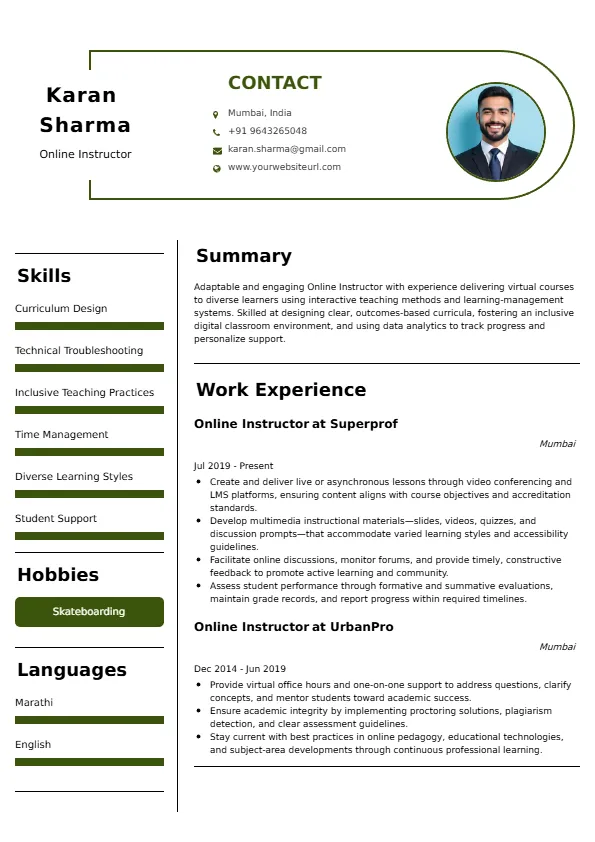
Online Instructor
Welcome to our Online Instructor resume sample page! This expertly crafted resume template is designed to showcase your expertise in designing, developing, and facilitating engaging, effective learning experiences in asynchronous and synchronous virtual environments. Whether you teach for a university, corporate L&D, or an EdTech platform, this sample highlights key skills like Learning Management System (LMS) Mastery, Instructional Design (ID), Virtual Facilitation, Curriculum Customization, and Student/Learner Engagement Strategies tailored to meet top digital learning demands. Use this guide to create a compelling resume that stands out and secures your next career opportunity.
Superbresume.com empowers Online Instructors to craft resumes that highlight their digital pedagogy and measurable learning outcome expertise. Our platform offers customizable templates tailored for virtual education roles, emphasizing skills like advanced LMS features (Gradebook, Analytics), asynchronous discussion moderation, multimedia content integration, and rapid feedback delivery. With ATS-optimized formats, expert-written content suggestions, and real-time resume analysis, we ensure your resume aligns with job descriptions. Showcase your experience in consistently achieving high student completion rates, improving learner performance on online assessments, or developing highly interactive and accessible digital course content with confidence. Superbresume.com helps you create a polished, results-driven resume that grabs hiring managers’ attention and lands interviews.
How to Write a Resume for an Online Instructor
Craft a Targeted Summary: Write a 2-3 sentence summary highlighting your expertise in virtual instruction and course management, proficiency in LMS platforms and digital pedagogy, and success in achieving high learner engagement, retention, and measurable mastery of course objectives.
Use Reverse-Chronological Format: List recent online teaching, instructional design, or training facilitation roles first, focusing on measurable student success and digital content delivery achievements.
Highlight Certifications/Training: Include credentials like Quality Matters (QM) Certification, CPLP/APTD, specialized LMS training (Canvas/Blackboard), or relevant academic degrees (M.A./M.S. in Education/ID) to boost credibility.
Quantify Achievements: Use metrics, e.g., “Maintained a course completion rate of 95% in 8 online modules, 10 points above the department average,” or “Redesigned the digital course materials, resulting in a 15% increase in average student final exam scores,” to show impact.
Incorporate Keywords: Use terms like “Learning Management System (LMS) Mastery (Canvas/Blackboard),” “Virtual/Asynchronous Instruction,” “Digital Pedagogy,” “Online Content Delivery,” “Learner Engagement Strategies,” “Curriculum Customization,” or “Assessment & Grading (Online)” from job descriptions for ATS.
Detail Technical/Teaching Skills: List proficiency with specific LMS platforms, virtual meeting tools (Zoom, WebEx), e-learning content (SCORM/xAPI), discussion forum moderation, and advanced online grading/feedback techniques in a dedicated skills section.
Showcase Course Success: Highlight 3-4 key courses or training programs delivered, detailing the subject, the platform used, the instructional design methodology, and the quantified learner outcome (retention, score improvement).
Emphasize Soft Skills: Include adaptability, strong written/verbal communication, technical proficiency, patience (with learners), organization, and commitment to creating an inclusive digital learning environment.
Keep It Concise: Limit your resume to 1-2 pages, focusing on relevant online teaching, content design, and LMS administration experience.
Proofread Thoroughly: Eliminate typos or jargon for a professional document.
Advanced LMS Feature Utilization: Focus on expertise utilizing sophisticated LMS tools, such as adaptive release, advanced quiz settings, peer review tools, and gradebook integration to enhance instruction and track data.
Digital Content Curation and Creation: Highlight proficiency in selecting, evaluating, and integrating diverse digital media (videos, simulations, interactive labs) and third-party tools (H5P, Nearpod) into the course shell.
Asynchronous Engagement Strategies: Showcase successful techniques for fostering meaningful discussion, collaboration, and social presence among learners in asynchronous forums and group projects.
Accessibility and Inclusive Design: Detail experience ensuring all course materials, digital documents, and videos meet WCAG/Section 508 accessibility standards for diverse learners.
Learning Analytics and Intervention: Emphasize using LMS data and analytics dashboards to monitor student activity, identify "at-risk" learners early, and implement targeted interventions (e.g., personalized outreach, supplemental resources).
Metrics-Driven Achievements: Use results like “Implemented a digital feedback system that increased student revision submission quality by 20%” or “Achieved a 4.6/5.0 student rating on instructional clarity and engagement.”
Virtual Live Session Facilitation: Include expertise leading synchronous sessions (VILT), managing classroom technology (breakouts, polls), and maintaining high engagement levels in a live virtual setting.
Competency-Based Education (CBE) Models: Highlight experience designing or delivering courses within flexible, competency-based learning structures.
Choose Superbresume.com to craft an Online Instructor resume that stands out in the competitive digital education sector. Our platform offers tailored templates optimized for ATS, ensuring your skills in LMS mastery, digital pedagogy, and learner engagement shine. With expert guidance, pre-written content, and real-time feedback, we help you highlight achievements like improving student completion rates or designing engaging virtual content. Whether you teach academic courses or corporate training, our tools make it easy to create a polished, results-driven resume. Trust Superbresume.com to showcase your expertise in reliable, effective, and high-quality virtual instruction. Start building your career today!
20 Key Skills for an Online Instructor Resume
| Learning Management System (LMS) Mastery (Canvas/Blackboard) | Virtual/Asynchronous Instruction & Facilitation |
| Digital Pedagogy & Learning Technologies | Curriculum Customization & Content Curation |
| Learner Engagement Strategies (Online/Blended) | Assessment & Grading (Online Rubrics) |
| Learning Analytics & At-Risk Intervention | Quality Matters (QM) or OSCQR Standards |
| Strong Written Communication (Feedback/Discussions) | Instructional Design (ID) Principles (Basic) |
| Multimedia Content Integration | Accessibility (WCAG) Compliance |
10 Do’s for an Online Instructor Resume
Tailor Your Resume: Customize for the specific platform (e.g., emphasize Canvas features, emphasize corporate training technology) and the subject matter.
Highlight Certifications/Training: List QM Certification, LMS vendor training, and relevant teaching/ID degrees prominently.
Quantify Achievements: Include metrics on course completion rates, student retention, average test/grade improvement, or student satisfaction scores.
Use Action Verbs: Start bullet points with verbs like “facilitated,” “designed,” “managed,” “customized,” or “achieved.”
Showcase Course Success: Detail the platform and the strategic, quantified learner outcome of 3-4 key courses or programs delivered.
Include Soft Skills: Highlight strong communication, adaptability (to technology), organization, and commitment to the online learning experience.
Optimize for ATS: Use standard education/L&D section titles and incorporate key LMS, technology, and pedagogical terms.
Keep It Professional: Use a clean, consistent font and academic/professional layout.
Emphasize LMS and Engagement: Clearly articulate expertise in using the LMS effectively and creating engaging digital learning activities.
Proofread Thoroughly: Eliminate typos or jargon for a professional document.
10 Don’ts for an Online Instructor Resume
Don’t Overload with Jargon: Avoid confusing, internal institutional or platform acronyms; use standardized pedagogical and LMS terminology.
Don’t Exceed Two Pages: Keep your resume concise, focusing on high-impact online instruction and content delivery achievements.
Don’t Omit Dates: Include employment dates for career context.
Don’t Use Generic Templates: Tailor your resume specifically to the specialized digital and facilitation duties of an Online Instructor.
Don’t List Irrelevant Skills: Focus on LMS, digital pedagogy, curriculum, assessment, and communication.
Don’t Skip Metrics: Quantify results wherever possible; link achievements to completion rates, retention, or learning gains.
Don’t Use Complex Formats: Avoid highly stylized elements or confusing graphics.
Don’t Ignore Accessibility: Include explicit experience ensuring digital content meets WCAG/508 standards.
Don’t Include Outdated Experience: Omit non-teaching or non-digital jobs over 15 years old.
Don’t Forget to Update: Refresh for new LMS version mastery, successful course evaluations, or advanced learning analytics skills.
5 FAQ's for an Online Instructor Resume
Prioritize LMS platforms (Canvas, Blackboard, Moodle) and synchronous tools (Zoom, MS Teams, BigBlueButton).
"Increased student completion rates by 20% through the use of gamified content and interactive discussion forums."
Yes. Mention experience with Instructional Design (Quality Matters standards) and ADA Accessibility (WCAG).
"Utilized digital proctoring tools and plagiarism detection (Turnitin) to ensure 100% academic integrity."
No, but mention your "responsiveness metrics," such as "maintaining a <24-hour response time for all student inquiries."
Get 5x more interviews with our crafted Resumes. We make resumes that land jobs.

Get a Free Customized Cover Letter with Resume Expert Advice
with every resume order placed, you will get a free Customized Cover letter.