Kindergarten Teacher
Welcome to our Kindergarten Teacher resume sample page! This expertly crafted resume template is designed to showcase your expertise in early childhood education, foundational literacy/numeracy instruction, positive classroom management, and fostering social-emotional learning (SEL) in young students. Whether you're a recent graduate or a seasoned educator, this sample highlights key skills like play-based learning, differentiated instruction, assessment (DIBELS/running records), parent engagement, and creating an inclusive, nurturing environment tailored to meet top school districts’ demands. Use this guide to create a compelling resume that stands out and secures your next career opportunity.
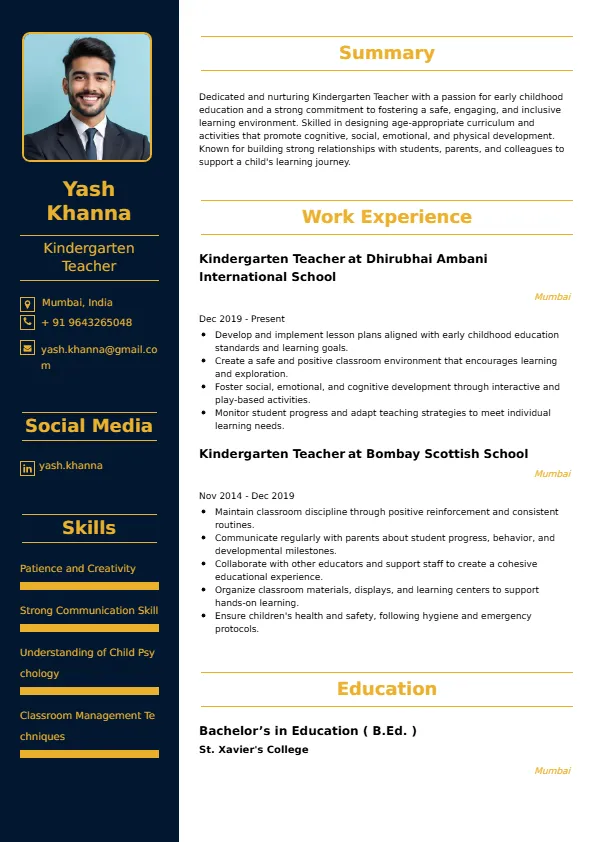
Superbresume.com empowers Kindergarten Teachers to craft resumes that highlight their early childhood expertise and measurable foundational skill development. Our platform offers customizable templates tailored for early education roles, emphasizing skills like developmentally appropriate practice (DAP), positive behavior support, literacy center management, and data-driven reading intervention. With ATS-optimized formats, expert-written content suggestions, and real-time resume analysis, we ensure your resume aligns with job descriptions. Showcase your experience in significantly advancing student literacy rates, implementing successful SEL strategies, or integrating thematic, play-based units with confidence. Superbresume.com helps you create a polished, results-driven resume that grabs hiring managers’ attention and lands interviews.
How to Write a Resume for a Kindergarten Teacher
Craft a Targeted Summary: Write a 2-3 sentence summary highlighting your active teaching certification, expertise in early childhood development and foundational instruction (literacy/numeracy), and success in managing a positive classroom and accelerating measurable student growth.
Use Reverse-Chronological Format: List recent teaching roles, student teaching, or early childhood education experience first, focusing on instructional impact and classroom management.
Highlight Certifications/Licensure: Include credentials like State Teaching Certification (Early Childhood/Elementary), specialized endorsements (e.g., Reading Specialist), CDA (Child Development Associate), or relevant Master’s Degree to boost credibility.
Quantify Achievements: Use metrics, e.g., “Achieved 90% student mastery on end-of-year phonics and early literacy benchmarks (DIBELS),” or “Successfully transitioned 25 first-time students into a structured classroom environment with zero critical behavioral incidents,” to show impact.
Incorporate Keywords: Use terms like “Early Childhood Education (ECE),” “Foundational Literacy & Numeracy,” “Play-Based Learning,” “Social-Emotional Learning (SEL),” “Positive Classroom Management,” “Differentiated Instruction,” or “Developmentally Appropriate Practice (DAP)” from job descriptions for ATS.
Detail Instructional Skills: List proficiency with specific curricula (e.g., Fundations, Everyday Math), assessment tools (running records, DIBELS), parent communication platforms, and EdTech integration in a dedicated skills section.
Showcase Instructional Success: Highlight 3-4 key pedagogical achievements, detailing the challenge, the strategy used (e.g., reading intervention group, behavior system), and the measured student outcome (assessment scores, behavioral metrics).
Emphasize Soft Skills: Include patience, enthusiasm, adaptability, strong parent communication, creative lesson planning, and effective collaboration (with support staff).
Keep It Concise: Limit your resume to 1-2 pages, focusing on relevant teaching, curriculum, and student performance experience.
Proofread Thoroughly: Eliminate typos or jargon for a professional document.
Science of Reading and Phonics Instruction: Focus on deep knowledge and implementation of explicit, systematic phonics and phonological awareness instruction, aligned with the latest literacy research.
Social-Emotional Learning (SEL) Frameworks: Highlight integrating formal SEL frameworks (e.g., Second Step, CASEL) into daily routines and curriculum to build foundational self-regulation and peer interaction skills.
Data-Driven Small Group Instruction: Showcase expertise utilizing diagnostic data (running records, DIBELS) to create fluid, targeted small groups for literacy and numeracy intervention and enrichment.
Play-Based and Thematic Curriculum Design: Emphasize designing centers and thematic units that utilize developmentally appropriate, hands-on, and inquiry-based play to introduce complex academic concepts.
Parent Engagement and Home-School Connection: Detail successful strategies for fostering consistent, positive communication with parents regarding student progress, behavior, and classroom activities (e.g., using Remind/Seesaw).
Metrics-Driven Achievements: Use results like “Achieved 85% of students meeting grade-level standards in number recognition by the end of the first semester” or “Successfully led 10 hours of weekly small group reading intervention.”
Inclusion and Differentiation: Include experience adapting lessons and environment for students with diverse needs, including those with IEPs (Individualized Education Programs) or ELL status.
Technology for Learning Centers: Highlight proficiency integrating simple EdTech tools (e.g., tablets, interactive whiteboards) into learning centers to support individualized instruction and skill practice.
20 Key Skills for a Kindergarten Teacher Resume
| Early Childhood Education (ECE) Pedagogy | Foundational Literacy (Phonics, Phonological Awareness) |
| Positive Classroom Management (Responsive Classroom) | Social-Emotional Learning (SEL) Integration |
| Play-Based & Inquiry-Based Learning | Differentiated Instruction (Small Group) |
| Early Numeracy Instruction (Number Sense) | DIBELS/Running Records Assessment & Data Analysis |
| Developmentally Appropriate Practice (DAP) | Parent/Guardian Communication & Engagement |
| Curriculum Planning & Thematic Unit Design | EdTech Integration (Interactive Whiteboard/Tablets) |
| IEP/504 Plan Familiarity | Collaboration with Support Staff |
| Patience & Enthusiasm | Creating a Nurturing Learning Environment |
10 Do’s for a Kindergarten Teacher Resume
Tailor Your Resume: Customize for the specific grade level (e.g., Pre-K, K, or 1st Grade) and the curriculum model (e.g., play-based, Montessori-aligned).
Highlight Certifications/Licensure: List active teaching license, ECE endorsements, and relevant Master’s degrees prominently.
Quantify Achievements: Include metrics on student reading level growth, assessment benchmark mastery (DIBELS), or successful behavioral management outcomes.
Use Action Verbs: Start bullet points with verbs like “instructed,” “fostered,” “managed,” “differentiated,” or “achieved.”
Showcase Foundational Skills: Detail specific, evidence-based strategies used to teach early literacy and numeracy (e.g., explicit phonics).
Include Soft Skills: Highlight patience, creativity, strong parent communication, and positive classroom management techniques.
Optimize for ATS: Use standard education section titles and incorporate key ECE and curriculum terms.
Keep It Professional: Use a clean, consistent font and academic layout.
Emphasize Data and SEL: Clearly articulate experience using early childhood data (DIBELS) and implementing social-emotional learning strategies.
Proofread Thoroughly: Ensure no typos or errors in curriculum details or assessment names.
10 Don’ts for a Kindergarten Teacher Resume
Don’t Overload with Jargon: Avoid confusing, internal school/district acronyms; use standardized early education terminology (DAP, SEL).
Don’t Exceed Two Pages: Keep your resume concise, focusing on high-impact instruction and student development.
Don’t Omit Dates: Include full dates for education, licensure, and employment for context.
Don’t Use Generic Templates: Tailor your resume specifically to the specialized developmental needs of Kindergarten students.
Don’t List Irrelevant Skills: Focus on ECE, foundational instruction, classroom management, and student assessment.
Don’t Skip Metrics: Quantify results wherever possible; student proficiency gains are the key metrics.
Don’t Use Complex Formats: Avoid highly stylized elements or confusing graphics.
Don’t Ignore Parent Engagement: Include examples of successful strategies for communicating and collaborating with parents.
Don’t Include Outdated Experience: Omit non-teaching or irrelevant jobs over 15 years old.
Don’t Forget to Update: Refresh for new curriculum adoption, successful intervention program results, or recent professional development/certifications.
5 FAQ's for a Kindergarten Teacher Resume
Mention "Utilized Phonics-based instruction to bring 90% of students to grade-level reading benchmarks."
Yes. Mention "Integrated SEL frameworks (e.g., Second Step) to reduce classroom behavioral incidents by 20%."
"Developed individualized learning plans for students with diverse needs, including IEP and ELL learners."
Yes. "Maintained a 95% parent participation rate in digital portfolios (e.g., Seesaw)."
Yes. "Designed 10+ hands-on, play-based learning centers aligned with state standards."
Get 5x more interviews with our crafted Resumes. We make resumes that land jobs.

Get a Free Customized Cover Letter with Resume Expert Advice
with every resume order placed, you will get a free Customized Cover letter.