Instructional Designer
Welcome to our Instructional Designer (ID) resume sample page! This expertly crafted resume template is designed to showcase your expertise in applying learning theory to design, develop, and evaluate engaging and effective learning experiences, training programs, and educational content. Whether you're an entry-level candidate or a seasoned professional, this sample highlights key skills like Instructional Design Models (ADDIE/SAM), E-learning Authoring (Articulate Suite), Adult Learning Theory, needs assessment, and LMS integration tailored to meet top EdTech, corporate L&D, and academic demands. Use this guide to create a compelling resume that stands out and secures your next career opportunity.
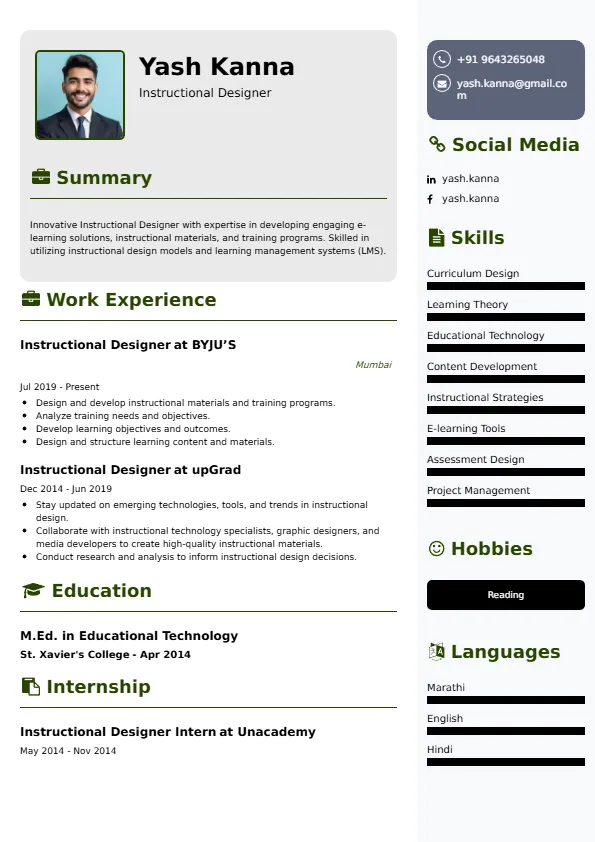
Superbresume.com empowers Instructional Designers to craft resumes that highlight their strategic learning design and measurable performance expertise. Our platform offers customizable templates tailored for L&D roles, emphasizing skills like SME collaboration, rapid prototyping, SCORM/xAPI packaging, and assessment design (Kirkpatrick Levels). With ATS-optimized formats, expert-written content suggestions, and real-time resume analysis, we ensure your resume aligns with job descriptions. Showcase your experience in converting complex content into engaging e-learning, improving course completion rates, or designing training that resulted in measurable job performance improvement with confidence. Superbresume.com helps you create a polished, results-driven resume that grabs hiring managers’ attention and lands interviews.
How to Write a Resume for an Instructional Designer
Craft a Targeted Summary: Write a 2-3 sentence summary highlighting your expertise in full lifecycle instructional design, proficiency in applying learning models (ADDIE/SAM) and authoring tools, and success in designing and evaluating training that achieves measurable performance goals.
Use Reverse-Chronological Format: List recent instructional design, e-learning development, or training management roles first, focusing on measurable design and content efficacy.
Highlight Certifications/Portfolio: Include credentials like ATD Certified Professional in Learning and Performance (CPLP), specialized authoring tool certifications, Master’s Degree in ID/Educational Technology, and feature a digital portfolio link to boost credibility.
Quantify Achievements: Use metrics, e.g., “Designed a mandatory compliance course that increased knowledge retention scores by 25%,” or “Reduced external training costs by $100K annually by converting 5 legacy instructor-led courses to e-learning,” to show impact.
Incorporate Keywords: Use terms like “Instructional Design (ID),” “ADDIE/SAM Model,” “E-learning Authoring (Articulate Storyline/Rise),” “Learning Management System (LMS),” “Needs Assessment,” “SCORM/xAPI,” “Adult Learning Theory,” or “Performance Consulting” from job descriptions for ATS.
Detail Design/Technical Skills: List proficiency with specific ID models, authoring tools, graphic design/video editing software (basic), LMS platforms (Cornerstone, Moodle), assessment design (Kirkpatrick levels), and SME collaboration in a comprehensive skills section.
Showcase Design Projects: Highlight 3-4 key courses or training assets designed, detailing the audience, the instructional model used, the delivery method (e.g., blended, e-learning), and the measured learning/performance result.
Emphasize Soft Skills: Include analytical problem-solving, strategic thinking, strong communication (with SMEs/stakeholders), creativity, and attention to detail (content accuracy/flow).
Keep It Concise: Limit your resume to 1-2 pages, focusing on relevant instructional design, development, and evaluation experience.
Proofread Thoroughly: Eliminate typos or jargon for a professional document.
Learning Measurement and Evaluation (Kirkpatrick Levels): Focus on expertise designing evaluation strategies (Level 3/4) that move beyond satisfaction to measure the impact of training on job performance and business ROI.
Microlearning and Just-in-Time Content: Highlight experience designing short, focused modules (microlearning) and performance support tools delivered via mobile or knowledge bases for immediate skill application.
Gamification and Immersive Scenario Design: Showcase experience designing scenario-based branching, decision-making simulations, and gamified elements to increase engagement and skill transfer.
Rapid Prototyping and Agile ID (SAM): Emphasize utilizing rapid development cycles and the Successive Approximation Model (SAM) to quickly iterate and deploy minimum viable products (MVPs) in agile environments.
SCORM/xAPI and Learning Analytics: Detail technical proficiency packaging courses using SCORM and, increasingly, xAPI (Tin Can API) for advanced data collection on learner behavior and performance.
Metrics-Driven Achievements: Use results like “Increased content consumption for mandatory training by 30% through gamified design” or “Reduced errors in a core operational process by 15% following the deployment of a new training curriculum.”
Cross-Functional Performance Consulting: Include experience moving beyond training requests to conduct root cause analysis (RCA) on performance gaps and recommending non-training solutions when appropriate.
Design for Accessibility (A11y): Highlight commitment to ensuring all e-learning, documents, and videos meet WCAG/Section 508 accessibility standards.
Choose Superbresume.com to craft an Instructional Designer resume that stands out in the competitive L&D and EdTech sectors. Our platform offers tailored templates optimized for ATS, ensuring your skills in ID models, authoring tools, and performance measurement shine. With expert guidance, pre-written content, and real-time feedback, we help you highlight achievements like increasing knowledge retention or reducing training costs. Whether you design corporate compliance courses or academic programs, our tools make it easy to create a polished, results-driven resume. Trust Superbresume.com to showcase your expertise in maximizing learning effectiveness and driving business performance. Start building your career today!
20 Key Skills for an Instructional Designer Resume
| Instructional Design Models (ADDIE/SAM) | E-learning Authoring (Articulate Storyline/Rise) |
| Needs Assessment & Root Cause Analysis | Learning Management System (LMS) Integration & SCORM/xAPI |
| Adult Learning Theory (Andragogy) | Training Evaluation (Kirkpatrick Levels) & Measurement |
| Curriculum Design & Mapping | SME (Subject Matter Expert) Collaboration |
| Assessment Design & Test Item Writing | Microlearning & Performance Support Design |
| Gamification & Interactive Scenario Design | Project Management (ID Timeline) |
| Video/Audio Scripting & Production (Basic) | Design for Accessibility (WCAG/508) |
10 Do’s for an Instructional Designer Resume
Tailor Your Resume: Customize for the industry (e.g., corporate compliance, EdTech product design, university course development) and the primary authoring tools used.
Highlight Certifications/Portfolio: List CPLP, specialized tool certifications, and include a link to a digital portfolio/samples prominently.
Quantify Achievements: Include metrics on knowledge retention, performance improvement (Level 3/4), cost savings, completion rates, or the volume/complexity of content developed.
Use Action Verbs: Start bullet points with verbs like “designed,” “developed,” “evaluated,” “applied,” or “consulted.”
Showcase Design Process: Detail the specific ID model (ADDIE/SAM) and the methodology used to move content from needs analysis to final, measurable delivery.
Include Soft Skills: Highlight analytical problem-solving, strategic thinking, strong communication (with SMEs), and creativity.
Optimize for ATS: Use standard ID/L&D section titles and incorporate key models, software, and measurement terms.
Keep It Professional: Use a clean, consistent font and professional layout.
Emphasize ID and Performance: Clearly articulate expertise in applying learning science to solve measurable performance problems.
Proofread Thoroughly: Eliminate typos or jargon for a professional document.
10 Don’ts for an Instructional Designer Resume
Don’t Overload with Jargon: Avoid confusing, internal company acronyms; use standardized instructional design and learning theory terminology.
Don’t Exceed Two Pages: Keep your resume concise, focusing on high-impact instructional design and development achievements.
Don’t Omit Dates: Include employment dates for career context.
Don’t Use Generic Templates: Tailor your resume specifically to the design, strategic, and evaluation duties of an ID.
Don’t List Irrelevant Skills: Focus on ID models, authoring tools, learning theory, needs assessment, and evaluation.
Don’t Skip Metrics: Quantify results wherever possible; link training to learning outcomes or job performance improvement.
Don’t Use Complex Formats: Avoid highly stylized elements or confusing graphics.
Don’t Ignore Needs Assessment: Include explicit experience conducting root cause analysis before recommending training solutions.
Don’t Include Outdated Experience: Omit non-ID or low-level training support jobs over 15 years old.
Don’t Forget to Update: Refresh for new CPLP status, successful program evaluations, or advanced authoring tool mastery.
Get 5x more interviews with our crafted Resumes. We make resumes that land jobs.

Get a Free Customized Cover Letter with Resume Expert Advice
with every resume order placed, you will get a free Customized Cover letter.