Instructional Coach
Welcome to our Instructional Coach resume sample page! This expertly crafted resume template is designed to showcase your expertise in mentoring teachers, improving instructional practice, facilitating professional development (PD), and leading data-driven school improvement initiatives within an educational setting. Whether you're a former master teacher or a seasoned specialist, this sample highlights key skills like Cognitive Coaching, curriculum fidelity, data analysis (student achievement), adult learning theory, and strong communication/feedback delivery tailored to meet top school district demands. Use this guide to create a compelling resume that stands out and secures your next career opportunity.
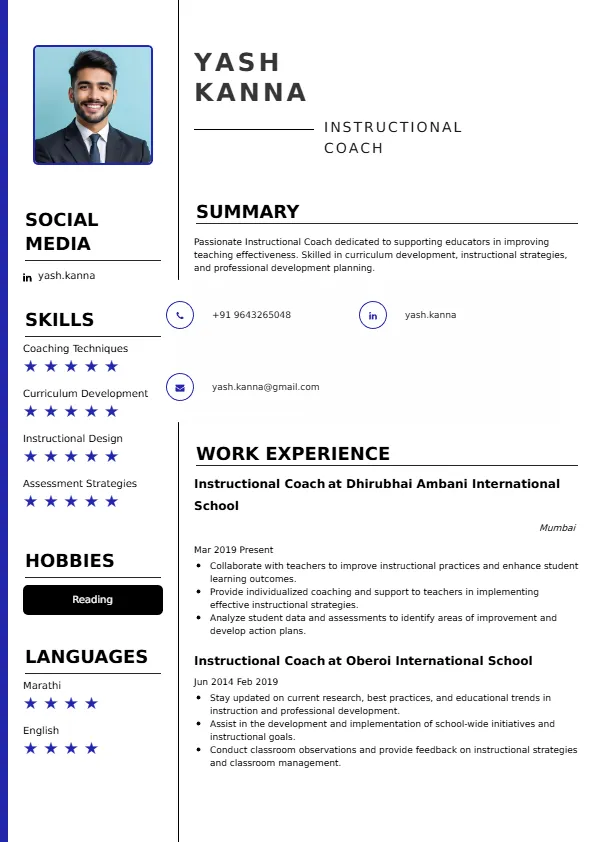
Superbresume.com empowers Instructional Coaches to craft resumes that highlight their teacher development and student achievement expertise. Our platform offers customizable templates tailored for educational leadership roles, emphasizing skills like coaching cycles (planning, observation, reflection), content-specific pedagogy (e.g., literacy/numeracy), professional learning community (PLC) facilitation, and leadership team collaboration. With ATS-optimized formats, expert-written content suggestions, and real-time resume analysis, we ensure your resume aligns with job descriptions. Showcase your experience in significantly improving teacher instructional fidelity, boosting student performance metrics, or leading the successful rollout of a new curriculum model with confidence. Superbresume.com helps you create a polished, results-driven resume that grabs hiring managers’ attention and lands interviews.
How to Write a Resume for an Instructional Coach
Craft a Targeted Summary: Write a 2-3 sentence summary highlighting your extensive experience in instructional leadership and teacher development, proficiency in coaching cycles and data analysis, and success in driving measurable improvements in teaching practice and student achievement.
Use Reverse-Chronological Format: List recent coaching, master teacher, or curriculum specialist roles first, focusing on measurable impact on teacher and student performance.
Highlight Certifications/Training: Include credentials like Teaching Certification (Master’s Level), Instructional Coaching Certification, Cognitive Coaching Training, or relevant content specialization (e.g., Reading Specialist) to boost credibility.
Quantify Achievements: Use metrics, e.g., “Coached 25 teachers annually, resulting in a 10-point average increase in teacher observation scores for instructional rigor,” or “Led a literacy initiative that increased student reading proficiency (F&P) by 15% across coached classrooms,” to show impact.
Incorporate Keywords: Use terms like “Instructional Coaching Cycles,” “Teacher Professional Development (PD),” “Curriculum Fidelity,” “Data-Driven Instruction,” “Adult Learning Theory,” “PLC Facilitation,” “Student Achievement Analysis,” or “Content-Specific Pedagogy” from job descriptions for ATS.
Detail Coaching/Data Skills: List expertise in observation tools (e.g., Danielson Framework), coaching models (Cognitive/GROW), data analysis platforms (e.g., Illuminate, FastBridge), feedback delivery, and PD design in a dedicated skills section.
Showcase Coaching Success: Highlight 3-4 key initiatives or coaching success stories (e.g., new curriculum rollout, specific instructional strategy adoption), detailing the challenge, the coaching strategy, and the measured student/teacher outcome.
Emphasize Soft Skills: Include strong communication, diplomacy, active listening, content expertise, non-evaluative feedback delivery, and leadership without direct authority.
Keep It Concise: Limit your resume to 1-2 pages, focusing on relevant instructional leadership, teacher development, and data analysis experience.
Proofread Thoroughly: Eliminate typos or jargon for a professional document.
Evidence-Based Coaching Cycles: Focus on expertise implementing structured coaching cycles (e.g., planning, observation, modeling, joint analysis) using specific protocols (e.g., Cognitive Coaching, GROWTH Model) to ensure consistency and measurable teacher growth.
Data-Driven Practice Refinement: Highlight proficiency using student achievement data (test scores, proficiency data) to collaboratively analyze instructional gaps with teachers and drive personalized practice changes.
Curriculum and Instructional Fidelity: Showcase experience ensuring teachers accurately implement the adopted core curriculum, providing necessary scaffolding, and monitoring fidelity of high-leverage instructional strategies.
Adult Learning Theory and PD Design: Emphasize expertise designing and facilitating differentiated professional development sessions that adhere to adult learning principles, resulting in high teacher engagement and skill transfer.
Equity-Focused Coaching: Detail experience coaching teachers on implementing culturally responsive pedagogy, mitigating bias in the classroom, and ensuring equitable access to rigorous curriculum for all students.
Metrics-Driven Achievements: Use results like “Successfully led 90% of my caseload to adopt a new collaborative learning strategy within one coaching cycle” or “Increased the department’s average value-added score by X points.”
Technology for Observation and Feedback: Include experience utilizing video analysis tools (e.g., Sibme) and digital platforms for efficient observation, data capture, and asynchronous feedback delivery.
PLC Facilitation and Protocol Development: Highlight experience establishing and running effective Professional Learning Communities (PLCs), ensuring they adhere to protocols focused on data analysis and instructional improvement.
Choose Superbresume.com to craft an Instructional Coach resume that stands out in the competitive educational leadership sector. Our platform offers tailored templates optimized for ATS, ensuring your skills in coaching cycles, data analysis, and teacher development shine. With expert guidance, pre-written content, and real-time feedback, we help you highlight achievements like boosting teacher observation scores or improving student achievement data. Whether you coach literacy or math, our tools make it easy to create a polished, results-driven resume. Trust Superbresume.com to showcase your expertise in maximizing teacher capacity and driving measurable student success. Start building your career today!
20 Key Skills for an Instructional Coach Resume
| Instructional Coaching Cycles (Planning-Observation-Reflection) | Data-Driven Instruction & Student Achievement Analysis |
| Teacher Professional Development (PD) Facilitation | Adult Learning Theory (Andragogy) |
| Curriculum Fidelity & Standards Alignment | Professional Learning Community (PLC) Facilitation |
| Cognitive Coaching/GROW Model | Non-Evaluative Feedback Delivery |
| Content-Specific Pedagogy (e.g., Reading/Math) | Classroom Observation Tools (Danielson/Marzano) |
| Data Analysis Platforms (e.g., Illuminate) | Change Management (Instructional Adoption) |
| Mentoring & Teacher Leadership Development | Cross-Functional Collaboration (Admin/Curriculum) |
| Communication (Active Listening/Diplomacy) | Equity-Focused Coaching |
10 Do’s for an Instructional Coach Resume
Tailor Your Resume: Customize for the specific subject or content area focus (e.g., secondary math, elementary literacy) and the district's preferred coaching model.
Highlight Certifications/Training: List Coaching Certification, advanced content specialization, and formal PD facilitation training prominently.
Quantify Achievements: Include metrics on teacher growth (observation scores, instructional fidelity), student achievement improvement (test scores, proficiency), or size of the team coached.
Use Action Verbs: Start bullet points with verbs like “coached,” “led,” “facilitated,” “analyzed,” or “improved.”
Showcase Coaching Success: Detail the methodology and the strategic, quantified student/teacher outcome of 3-4 key coaching initiatives.
Include Soft Skills: Highlight strong communication, diplomacy, data analysis rigor, and non-evaluative leadership.
Optimize for ATS: Use standard education/leadership section titles and incorporate key coaching, data, and methodology terms.
Keep It Professional: Use a clean, consistent font and professional layout.
Emphasize Data and Growth: Clearly articulate experience using student achievement data to drive teacher growth and improve practice.
Proofread Thoroughly: Eliminate typos or jargon for a professional document.
10 Don’ts for an Instructional Coach Resume
Don’t Overload with Jargon: Avoid confusing, internal school/district acronyms; use standardized coaching and educational terminology (e.g., PLC, VAM).
Don’t Exceed Two Pages: Keep your resume concise, focusing on high-impact instructional leadership and teacher development achievements.
Don’t Omit Dates: Include employment dates for career context.
Don’t Use Generic Templates: Tailor your resume specifically to the specialized teacher development duties of an Instructional Coach.
Don’t List Irrelevant Skills: Focus on coaching models, adult learning, data analysis, curriculum, and leadership.
Don’t Skip Metrics: Quantify results wherever possible; link achievements to measurable teacher growth and student achievement gains.
Don’t Use Complex Formats: Avoid highly stylized elements or confusing graphics.
Don’t Ignore Adult Learning: Include explicit experience designing PD based on adult learning principles.
Don’t Include Outdated Experience: Omit non-teaching or irrelevant jobs over 15 years old.
Don’t Forget to Update: Refresh for new successful coaching cycles, advanced data analysis skills, or new curriculum fidelity initiatives.
Get 5x more interviews with our crafted Resumes. We make resumes that land jobs.

Get a Free Customized Cover Letter with Resume Expert Advice
with every resume order placed, you will get a free Customized Cover letter.