Education Researcher
Welcome to our Education Researcher resume sample page! This expertly crafted resume template is designed to showcase your expertise in designing, executing, and analyzing research studies on educational practices, policy, and learning outcomes. Whether you're a doctoral candidate or a seasoned professional, this sample highlights key skills like quantitative/qualitative methodology, statistical software (SPSS, R), grant writing, and academic publishing tailored to meet top university, think tank, or government demands. Use this guide to create a compelling resume that stands out and secures your next career opportunity.
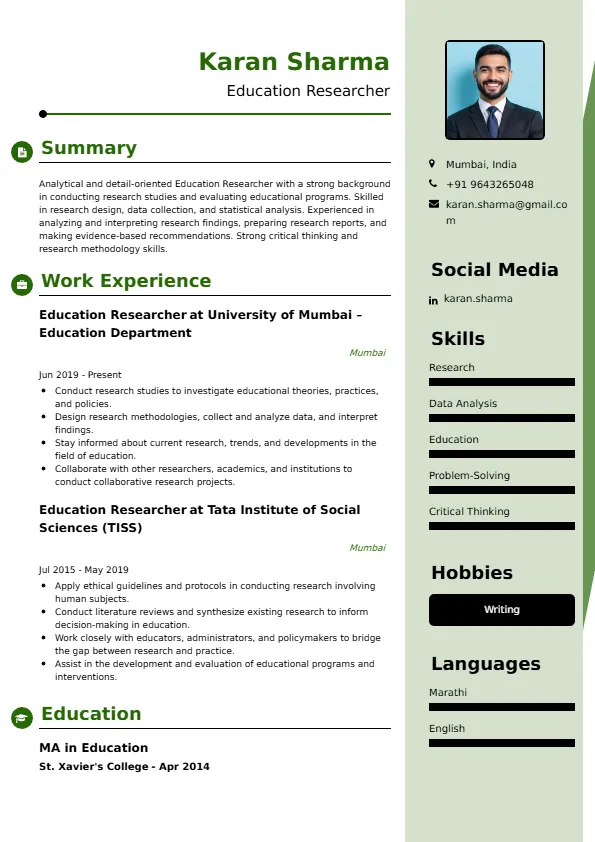
Superbresume.com empowers Education Researchers to craft resumes that highlight their rigorous methodology and impact on policy/practice. Our platform offers customizable templates tailored for research roles, emphasizing skills like experimental design, psychometrics, mixed methods analysis, and large-scale data management. With ATS-optimized formats, expert-written content suggestions, and real-time resume analysis, we ensure your resume aligns with job descriptions. Showcase your experience in securing competitive grants, leading multi-year studies, or publishing influential findings in peer-reviewed journals with confidence. Superbresume.com helps you create a polished, results-driven resume that grabs hiring managers’ attention and lands interviews in academia and policy.
How to Write a Resume for an Education Researcher
Use Reverse-Chronological Format: List recent research fellowships, faculty positions, or senior research roles first, focusing on methodological complexity and research output.
Highlight Certifications/Degrees: Include Ph.D./Ed.D. in Education/Psychology, Post-Doctoral Fellowships, or specialized methodological certifications (e.g., advanced statistics training) to boost credibility.
Quantify Achievements: Use metrics, e.g., “Secured $1.5 million in grant funding from the NSF for a 3-year longitudinal study,” or “Published 10 peer-reviewed articles in Tier 1 educational journals,” to show impact.
Incorporate Keywords: Use terms like “Quantitative/Qualitative Methodology,” “Mixed Methods,” “Statistical Software (R/Stata/SPSS),” “Experimental Design,” “Psychometrics,” “Grant Writing,” or “Policy Analysis” from job descriptions for ATS.
Detail Technical Skills: List proficiency with specific software (R, Python, SPSS, NVivo), research design techniques (RCTs, Causal Inference), and database management in a dedicated skills section.
Showcase Publications/Grants: Dedicate a section to list your most important peer-reviewed publications (full citation preferred) and funded research grants, detailing your role (PI, Co-PI).
Emphasize Soft Skills: Include analytical rigor, critical thinking, written communication (for reports/papers), and ethical research conduct.
Keep It Concise: Limit your resume to 2 pages (3 pages maximum for senior academia), focusing on research output, methodology, and academic impact.
Proofread Thoroughly: Eliminate typos or jargon for a professional document.
Big Data and Learning Analytics: Highlight experience analyzing large-scale educational datasets (e.g., student longitudinal data, LMS data) using computational methods.
Qualitative Rigor and Software: Showcase mastery of advanced qualitative methods (e.g., grounded theory) and software proficiency (NVivo, ATLAS.ti) for textual and interview analysis.
Implementation Science: Detail research focused not just on what works, but how interventions are implemented effectively in practice.
DEI and Equity Research: Emphasize studies specifically investigating equity gaps, culturally responsive practices, and policy impact on diverse learner populations.
Metrics-Driven Achievements: Use results like “Developed a valid and reliable assessment tool now used by 50+ school districts” or “Presentations delivered at 10+ international conferences.”
Data Visualization: Include proficiency in visualizing complex statistical results and research findings for both academic and public audiences (e.g., using ggplot2, Tableau).
Open Science Practices: Highlight experience with pre-registration of studies, sharing data/code, and publishing in open-access journals.
Choose Superbresume.com to craft an Education Researcher resume that stands out in the competitive academic and policy sectors. Our platform offers tailored templates optimized for ATS, ensuring your skills in advanced methodology, statistical analysis, and grant success shine. With expert guidance, pre-written content, and real-time resume analysis, we help you highlight achievements like securing major grants or publishing influential research. Whether you specialize in quantitative policy or qualitative learning theory, our tools make it easy to create a polished, results-driven resume. Trust Superbresume.com to showcase your expertise in rigorous research design and measurable educational impact. Start building your career today!
20 Key Skills for an Education Researcher Resume
| Quantitative Methodology (RCTs, Causal Inference) | Qualitative Methodology (Grounded Theory, Ethnography) |
| Statistical Software (R, Stata, SPSS) | Grant Writing & Administration |
| Academic Publishing (Peer-Reviewed) | Survey Design & Psychometrics (IRT, CFA) |
| Large-Scale Data Management | Policy Analysis & Evaluation |
| Mixed Methods Research | NVivo/ATLAS.ti (Qualitative Software) |
| Data Visualization (ggplot2, Tableau) | Experimental Design |
| Program Evaluation (Logic Models) | Literature Review & Synthesis |
| Ethical Research (IRB/REC Compliance) | Causal Modeling (SEM, HLM) |
| Critical Thinking & Theory Application | Research Team Leadership |
| Written Communication (Reports, Papers) | Public Presentation (Conferences) |
10 Do’s for an Education Researcher Resume
Tailor Your Resume: Customize it for the specific hiring institution—emphasize teaching for faculty roles and emphasize policy or analysis for think tank or research roles.
Highlight Certifications/Degrees: List your Ph.D./Ed.D. and any relevant methodological or research training prominently.
Quantify Achievements: Include metrics such as grant funding secured, publication count, citation numbers, or study participant volume.
Use Action Verbs: Begin statements with verbs like designed, analyzed, published, secured, or led.
Showcase Publications/Grants: Create dedicated sections for your research output and grant portfolio, highlighting impact or significance.
Include Soft Skills: Emphasize analytical rigor, ethical research practice, and the ability to translate complex findings clearly.
Optimize for ATS: Use standard academic and research-based section titles such as “Research Experience,” “Publications,” and “Grants.”
Keep It Professional: Use a clean, consistent font and an academic-friendly layout.
Emphasize Methodology: Clearly specify the research designs, advanced statistical methods, and analytical tools you have mastered.
Proofread Carefully: Ensure accuracy in citations, datasets, terminology, and all technical details.
10 Don’ts for an Education Researcher Resume
Don’t Overload with Jargon: Avoid confusing university or departmental acronyms; use standardized methodological terminology.
Don’t Exceed Two Pages (for non-senior roles): Keep your resume focused on high-level research output, methodology, and relevance to the role.
Don’t Omit Dates: Include complete dates for education, fellowships, and employment to provide necessary academic context.
Don’t Use Generic Templates: Tailor your resume to reflect the rigorous, data-driven expectations of education research roles.
Don’t List Irrelevant Skills: Prioritize research design, statistics, content analysis, academic writing, and other research-focused competencies.
Don’t Skip Metrics: Quantify results whenever possible—research success is measured through publications, funding, and measurable impact.
Don’t Use Complex Formats: Avoid decorative designs or graphics that distract from your academic accomplishments.
Don’t Ignore Ethics: Highlight IRB/REC compliance, ethical data management, and adherence to research standards.
Don’t Include Outdated Experience: Remove non-academic or unrelated roles more than 15 years old.
Don’t Forget to Update: Continuously refresh your resume with new publications, grant submissions, conference presentations, or research milestones.
5 FAQs for an Education Researcher Resume
Prioritize quantitative and qualitative methodology mastery, statistical software proficiency (such as R or Stata), grant writing success, and a strong publication record.
Use standard academic section titles, avoid graphics, and include keywords like “Causal Inference,” “Psychometrics,” and “Mixed Methods.”
For a resume, include only the top 5–10 most relevant publications. Add a link to your full CV or Google Scholar profile for the complete list.
Detail the funding source (for example, IES or NSF), the amount secured, your role (PI or Co-PI), and the title and duration of the funded project.
Use a reverse-chronological format, emphasizing your most recent, methodologically complex research roles and academic output.
Get 5x more interviews with our crafted Resumes. We make resumes that land jobs.

Get a Free Customized Cover Letter with Resume Expert Advice
with every resume order placed, you will get a free Customized Cover letter.