School Social Worker
Welcome to our School Social Worker resume sample page! This expertly crafted resume template is designed to showcase your expertise in providing mental health support, crisis intervention, family liaison services, and addressing barriers to student achievement through a systemic approach. Whether you work in a single school or a district, this sample highlights key skills like Clinical Assessment, Crisis Intervention, Family Engagement, IEP/504 Support, and Resource Coordination tailored to meet top school district demands. Use this guide to create a polished, results-driven resume that stands out and secures your next career opportunity.
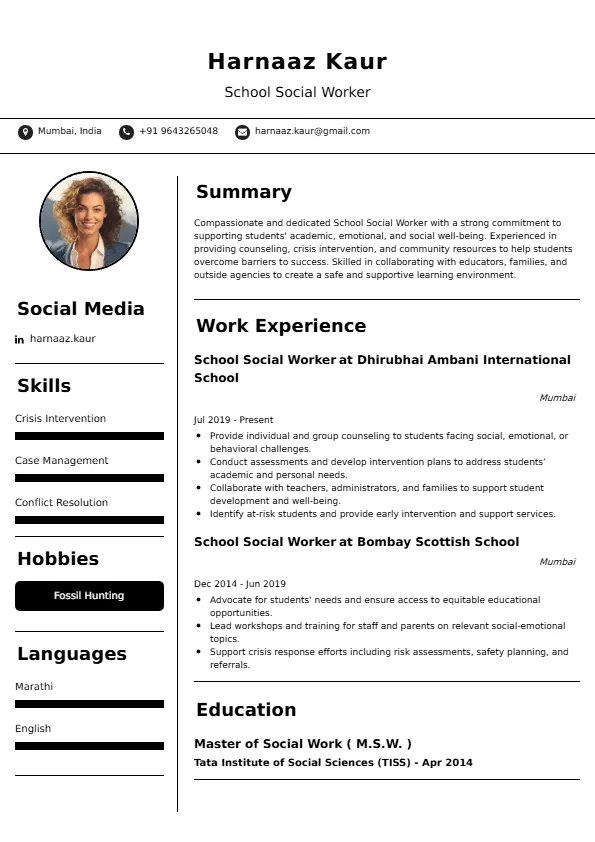
Superbresume.com empowers School Social Workers to craft resumes that highlight their clinical competence and systemic intervention expertise. Our platform offers customizable templates tailored for specialized education roles, emphasizing skills like risk assessment (suicide/self-harm), trauma-informed care, home visitation, and adherence to regulatory compliance (HIPAA/FERPA). With ATS-optimized formats, expert-written content suggestions, and real-time resume analysis, we ensure your resume aligns with job descriptions. Showcase your experience in successfully managing a high-risk student caseload, significantly increasing family engagement rates, or leading successful prevention programs that reduced disciplinary incidents with confidence. Superbresume.com helps you create a polished, results-driven resume that grabs hiring managers’ attention and lands interviews.
How to Write a Resume for a School Social Worker
Craft a Targeted Summary: Write a 2-3 sentence summary highlighting your active clinical licensure (LCSW/LSW), expertise in mental health/crisis intervention and systemic problem-solving, and success in reducing barriers to student learning and improving family-school communication.
Use Reverse-Chronological Format: List recent School Social Worker, clinical counseling, or therapeutic support roles first, focusing on measurable student outcome and case management achievements.
Highlight Certifications/Licensure: Include credentials like Active State Clinical Licensure (LCSW, LSW, LMSW), specialized training (e.g., Trauma-Informed Care, CBT/DBT), BLS/CPR, or relevant Master’s Degree (MSW) to boost credibility.
Quantify Achievements: Use metrics, e.g., “Managed a high-risk caseload of 40+ students, successfully reducing chronic absenteeism by 15% through targeted home visits and resource coordination,” or “Provided 100+ crisis interventions annually, ensuring 100% adherence to safety protocols and successful external referrals,” to show impact.
Incorporate Keywords: Use terms like “Crisis Intervention & Risk Assessment,” “Family Engagement & Liaison,” “Individual/Group Counseling (Psychotherapy),” “IEP/504 Plan Support,” “Trauma-Informed Care (TIC),” “Resource Coordination (External Agencies),” or “HIPAA/FERPA Compliance” from job descriptions for ATS.
Detail Clinical/Intervention Skills: List proficiency with specific therapeutic modalities (CBT, brief solution-focused), diagnostic criteria (DSM-5 awareness), mandated reporting protocols, EMR/record systems, and strong documentation standards in a dedicated skills section.
Showcase Intervention Projects: Highlight 3-4 key programs or initiatives (e.g., developing a substance abuse prevention workshop, managing a district-wide mental health resource guide, leading a truancy reduction program), detailing the scope and the measured student/program outcome.
Emphasize Soft Skills: Include empathy, strong therapeutic communication, crisis management, confidentiality, collaboration (administrators/parents), and advocacy.
Keep It Concise: Limit your resume to 1-2 pages, focusing on relevant clinical, systemic, and educational support experience.
Proofread Thoroughly: Eliminate typos or jargon for a professional document.
Trauma-Informed Care (TIC) and SEL Integration: Focus on expertise applying TIC principles across the school environment and implementing Social-Emotional Learning (SEL) strategies through individual and group counseling.
Crisis and Risk Assessment Leadership: Highlight advanced skills in conducting suicide/self-harm risk assessments, managing crisis response teams, and coordinating seamless transitions to external mental health resources.
Systemic Intervention and Advocacy: Showcase experience identifying systemic barriers to student success (e.g., housing instability, poverty) and advocating for school or district-level policy changes and community resource allocation.
Family Engagement and Home-School Liaison: Detail successful strategies for building trust with difficult-to-reach families, conducting home visits, and serving as the primary liaison between the family and school staff.
IEP/504 Consultation and Support: Emphasize expertise participating in IEP/504 meetings, conducting social/emotional assessments, and consulting with teachers/administrators on appropriate behavioral and mental health accommodations.
Metrics-Driven Achievements: Use results like “Successfully integrated 90% of referred students back into the classroom after a mental health crisis event” or “Increased parental attendance at problem-solving meetings by 25% through improved outreach.”
Resource and Referral Network Management: Include detailed knowledge of and experience connecting students and families with external community resources (e.g., food banks, housing assistance, long-term therapy).
Compliance and Ethical Practice: Highlight meticulous adherence to mandated reporting laws, professional ethical codes, and student confidentiality protocols (HIPAA, FERPA).
Choose Superbresume.com to craft a School Social Worker resume that stands out in the essential educational support and clinical sector. Our platform offers tailored templates optimized for ATS, ensuring your skills in clinical licensure, crisis intervention, and family engagement shine. With expert guidance, pre-written content, and real-time feedback, we help you highlight achievements like reducing absenteeism or successfully managing high-risk student cases. Whether you support elementary or secondary students, our tools make it easy to create a polished, results-driven resume. Trust Superbresume.com to showcase your expertise in reliable, compassionate, and systemic support for student success. Start building your career today!
20 Key Skills for a School Social Worker Resume
| Clinical Licensure (LCSW/LSW) & Ethical Practice | Crisis Intervention & Risk Assessment (Suicide/Self-Harm) |
| Family Engagement & Home-School Liaison | Trauma-Informed Care (TIC) & SEL Integration |
| IEP/504 Plan Consultation & Support | Resource Coordination & External Referral Management |
10 Do’s for a School Social Worker Resume
Tailor Your Resume: Customize for the specific school level (Elementary, Middle, High School) and the primary intervention focus (e.g., trauma, poverty, mental health).
Highlight Certifications/Licensure: List Active Clinical Licensure (LCSW, LSW), MSW degree, and specialized TIC training prominently.
Quantify Achievements: Include metrics on caseload size managed, chronic absenteeism reduction, successful crisis interventions, or family engagement rates.
Use Action Verbs: Start bullet points with verbs like “intervened,” “counseled,” “managed,” “assessed,” or “advocated.”
Showcase Clinical and Systemic Impact: Detail the methodology and the strategic, quantified student/systemic result of 3-4 key intervention projects.
Include Soft Skills: Highlight empathy, crisis management, strong communication, and advocacy.
Optimize for ATS: Use standard counseling/social work section titles and incorporate key clinical and regulatory terms.
Keep It Professional: Use a clean, consistent font and professional layout.
Emphasize Crisis and Family Work: Clearly articulate expertise in high-risk intervention and connecting school resources to family needs.
Proofread Thoroughly: Eliminate typos or jargon for a professional document.
10 Don’ts for a School Social Worker Resume
Don’t Overload with Jargon: Avoid confusing, internal school/district acronyms; use standardized social work and clinical terminology.
Don’t Exceed Two Pages: Keep your resume concise, focusing on high-impact clinical and systemic intervention achievements.
Don’t Omit Dates: Include full dates for education, licensure, and employment for context.
Don’t Use Generic Templates: Tailor your resume specifically to the specialized clinical and community duties of a School Social Worker.
Don’t List Irrelevant Skills: Focus on clinical assessment, crisis intervention, family engagement, resource coordination, and compliance.
Don’t Skip Metrics: Quantify results wherever possible; link clinical work to absenteeism, crisis management, or family engagement rates.
Don’t Use Complex Formats: Avoid highly stylized elements or confusing graphics.
Don’t Ignore Regulatory Compliance: Include explicit experience adhering to HIPAA/FERPA confidentiality and mandated reporting.
Don’t Include Outdated Experience: Omit non-clinical or non-social work jobs over 15 years old.
Don’t Forget to Update: Refresh for new licensure renewals, successful intervention program results, or advanced clinical training.
5 FAQ's for a School Social Worker Resume
"Secured community resources (housing, food, medical) for 100+ families, reducing barriers to student learning."
CBT (Cognitive Behavioral Therapy), trauma-informed care, and de-escalation.
Vital. "Authored 200+ Social-Developmental Studies for IEP evaluations and sat on the Special Education eligibility team."
"Conducted 50+ home visits annually to strengthen the partnership between families and the school district."
"Implemented a Peer Mediation program that reduced student-on-student conflicts by 30%."
Get 5x more interviews with our crafted Resumes. We make resumes that land jobs.

Get a Free Customized Cover Letter with Resume Expert Advice
with every resume order placed, you will get a free Customized Cover letter.