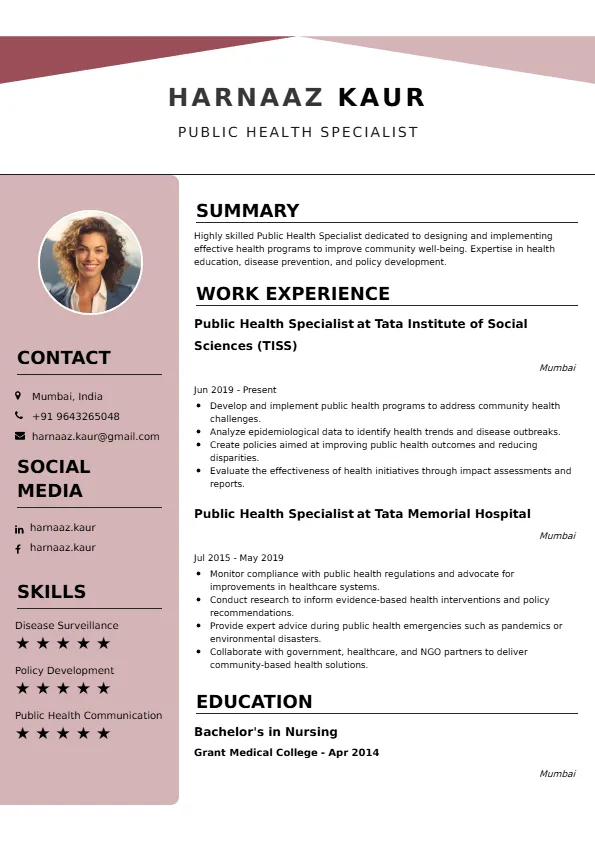
Public Health Specialist
Welcome to our Public Health Specialist resume sample page! This expertly crafted resume template is designed to showcase your expertise in designing, implementing, and evaluating programs and policies to prevent disease, promote health, and ensure the well-being of populations. Whether you focus on health education, policy analysis, or program administration, this sample highlights key skills like Program Evaluation, Policy Analysis, Health Communication, Data Analysis (Survey/Statistical), and Community Engagement tailored to meet top government (CDC, NIH), non-profit, and academic demands. Use this guide to create a polished, results-driven resume that stands out and secures your next career opportunity.
Superbresume.com empowers Public Health Specialists to craft resumes that highlight their program effectiveness and policy impact expertise. Our platform offers customizable templates tailored for health roles, emphasizing skills like needs assessment, grant writing/management, epidemiological surveillance (basic), and social marketing campaigns. With ATS-optimized formats, expert-written content suggestions, and real-time resume analysis, we ensure your resume aligns with job descriptions. Showcase your experience in successfully leading community health interventions, achieving measurable improvements in health behavior (e.g., vaccination rates, screening compliance), or securing funding for key public health programs with confidence. Superbresume.com helps you create a polished, results-driven resume that grabs hiring managers’ attention and lands interviews.
How to Write a Resume for a Public Health Specialist
Craft a Targeted Summary: Write a 2-3 sentence summary highlighting your expertise in public health program management and evaluation, proficiency in data analysis and policy, and success in designing effective interventions that resulted in measurable population health improvements.
Use Reverse-Chronological Format: List recent public health, health education, program coordinator, or policy analyst roles first, focusing on measurable program outcomes and analytical achievements.
Highlight Certifications/Training: Include credentials like Certified in Public Health (CPH), Master’s Degree (MPH/MPA), Certified Health Education Specialist (CHES), or specialized training in epidemiology/biostatistics to boost credibility.
Quantify Achievements: Use metrics, e.g., “Designed and implemented a vaccination awareness campaign that increased compliance rates by 15% in the target population (N=10,000),” or “Secured $250K in grant funding for a community health program, achieving 95% of stated health outcome goals (Logic Model),” to show impact.
Incorporate Keywords: Use terms like “Program Evaluation,” “Health Communication & Social Marketing,” “Policy Analysis,” “Community Needs Assessment,” “Data Analysis (Survey/Statistical),” “Grant Writing & Management,” or “Epidemiological Surveillance” from job descriptions for ATS.
Detail Technical/Program Skills: List proficiency with specific software (SPSS/R/Stata, GIS, survey tools), program planning models (Logic Model), data visualization (Tableau), and regulatory frameworks (HIPAA, HEDIS) in a dedicated skills section.
Showcase Program Success: Highlight 3-4 key interventions or projects (e.g., launching a diabetes prevention program, conducting a community needs assessment, developing a new health policy brief), detailing the methodology, the target population, and the quantified health/policy result.
Emphasize Soft Skills: Include analytical rigor, strong communication (to diverse audiences), cultural competence, strategic thinking, and collaboration (community partners, government agencies).
Keep It Concise: Limit your resume to 1-2 pages, focusing on relevant program management, policy, and data analysis experience.
Proofread Thoroughly: Eliminate typos or jargon for a professional document.
Health Equity and Social Determinants of Health (SDOH): Focus on designing and evaluating programs that explicitly address SDOH (e.g., housing, food security) and demonstrate measurable progress in reducing health disparities among specific populations.
Data Visualization and GIS: Highlight expertise utilizing BI tools (Tableau) and Geographic Information Systems (GIS) to map health disparities, track outbreak spread, and communicate complex health data effectively to policymakers and the public.
Grant Writing and Program Sustainability: Showcase success in writing competitive grant proposals (federal, foundation) and developing sustainable funding plans for long-term program continuation.
Social Marketing and Health Communication: Detail experience utilizing social media, digital campaigns, and community events to influence health behavior change based on established health behavior models (e.g., Transtheoretical Model).
Program Evaluation (Logic Model/Outcomes): Emphasize expertise in designing evaluation plans using Logic Models to track inputs, outputs, and, most importantly, measurable population-level health outcomes.
Metrics-Driven Achievements: Use results like “Successfully transitioned an intervention program to a new health department, ensuring 100% fidelity and 95% program retention” or “Contributed analysis to a policy report that resulted in $X funding for a health initiative.”
Telehealth and Digital Health Integration: Include experience supporting the implementation and evaluation of digital health interventions or remote patient monitoring programs within the community setting.
Interdisciplinary Collaboration: Highlight experience working closely with clinical providers, policymakers, community leaders, and non-profit organizations to execute comprehensive health strategies.
Choose Superbresume.com to craft a Public Health Specialist resume that stands out in the competitive health and policy sector. Our platform offers tailored templates optimized for ATS, ensuring your skills in program evaluation, health communication, and CPH certification shine. With expert guidance, pre-written content, and real-time feedback, we help you highlight achievements like boosting vaccination rates or securing grant funding. Whether you focus on community intervention or policy analysis, our tools make it easy to create a polished, results-driven resume. Trust Superbresume.com to showcase your expertise in driving measurable population health improvements. Start building your career today!
20 Key Skills for a Public Health Specialist Resume
| Program Evaluation & Outcomes Measurement (Logic Model) | Health Communication & Social Marketing |
| Data Analysis (Survey/Statistical) & Reporting | Policy Analysis & Advocacy Support |
| Community Needs Assessment & Engagement | Grant Writing & Management (Funding Proposals) |
| Epidemiological Surveillance (Basic) | Cultural Competence & Health Equity |
10 Do’s for a Public Health Specialist Resume
Tailor Your Resume: Customize for the specific public health domain (e.g., chronic disease, maternal health, environmental health) and the employer (government, non-profit, academic).
Highlight Certifications/Training: List CPH, MPH/MPA, and CHES certifications prominently.
Quantify Achievements: Include metrics on population reached, funding secured, health behavior change rates (percentage), or program outcome improvement.
Use Action Verbs: Start bullet points with verbs like “designed,” “evaluated,” “implemented,” “analyzed,” or “secured.”
Showcase Program Success: Detail the methodology and the strategic, quantified health/policy result of 3-4 key interventions.
Include Soft Skills: Highlight analytical rigor, strategic thinking, strong communication, and cross-cultural competence.
Optimize for ATS: Use standard public health section titles and incorporate key evaluation, policy, and data terms.
Keep It Professional: Use a clean, consistent font and professional layout.
Emphasize Outcomes and Policy: Clearly articulate expertise in using data to prove program impact and inform policy development.
Proofread Thoroughly: Eliminate typos or jargon for a professional document.
10 Don’ts for a Public Health Specialist Resume
Don’t Overload with Jargon: Avoid confusing, internal agency or organizational acronyms; use standardized public health and evaluation terminology.
Don’t Exceed Two Pages: Keep your resume concise, focusing on high-impact program management, evaluation, and policy achievements.
Don’t Omit Dates: Include employment dates for career context.
Don’t Use Generic Templates: Tailor your resume specifically to the strategic, evidence-based duties of a Public Health Specialist.
Don’t List Irrelevant Skills: Focus on public health programs, policy, data analysis, communication, and community engagement.
Don’t Skip Metrics: Quantify results wherever possible; health outcomes, funding secured, and behavior change rates are key metrics.
Don’t Use Complex Formats: Avoid highly stylized elements or confusing graphics.
Don’t Ignore Data Analysis: Include explicit experience analyzing health data and reporting findings (SQL/SPSS proficiency, if applicable).
Don’t Include Outdated Experience: Omit non-public health or non-administrative jobs over 15 years old.
Don’t Forget to Update: Refresh for new CPH certification, successful grant acquisitions, or advanced program evaluation completions.
5 FAQ's Public Health Specialist Resume
"Conducted surveillance on infectious disease trends, identifying a local cluster and coordinating a response that reduced transmission by 30%."
Mention SPSS, SAS, R, or ArcGIS.
"Designed an outreach program for underserved populations that increased screening rates for chronic diseases by 25%."
Yes. "Managed a $1M federal health grant, ensuring 100% compliance with CDC reporting standards."
"Drafted a policy brief that informed local legislation regarding indoor air quality and public health standards."
Get 5x more interviews with our crafted Resumes. We make resumes that land jobs.

Get a Free Customized Cover Letter with Resume Expert Advice
with every resume order placed, you will get a free Customized Cover letter.