Oceanographer
Welcome to our Oceanographer resume sample page! This expertly crafted resume template is designed to showcase your expertise in conducting research on the physical, chemical, geological, or biological aspects of the ocean, utilizing advanced instrumentation, analyzing complex oceanographic data, and communicating scientific findings. Whether you specialize in physical oceanography, marine biology, or chemical oceanography, this sample highlights key skills like Research Methodology, Data Analysis (Python/R), Numerical Modeling, Fieldwork/Cruises, and Scientific Publication tailored to meet top academic, government (NOAA, USGS), and environmental demands. Use this guide to create a compelling resume that stands out and secures your next career opportunity.
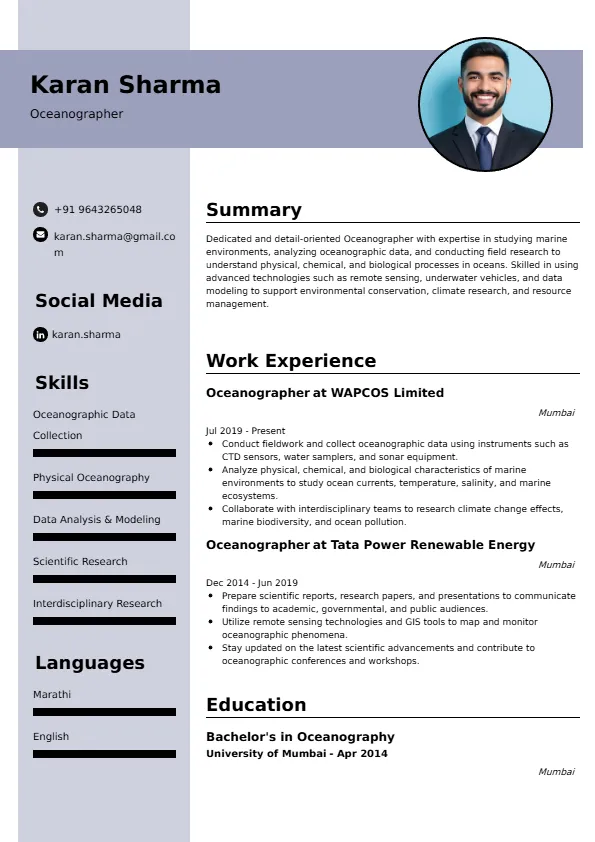
Superbresume.com empowers Oceanographers to craft resumes that highlight their scientific rigor and specialized data expertise. Our platform offers customizable templates tailored for research roles, emphasizing skills like advanced statistical modeling, instrument deployment and calibration, GIS/geospatial analysis, and successful grant proposal writing. With ATS-optimized formats, expert-written content suggestions, and real-time resume analysis, we ensure your resume aligns with job descriptions. Showcase your experience in leading successful research cruises, publishing high-impact peer-reviewed articles, or developing advanced numerical models of ocean currents and climate with confidence. Superbresume.com helps you create a polished, results-driven resume that grabs hiring managers’ attention and lands interviews.
How to Write a Resume for an Oceanographer
Craft a Targeted Summary: Write a 2-3 sentence summary highlighting your expertise in oceanographic research (specify sub-discipline: Physical, Chemical, Biological), proficiency in advanced data modeling and analysis, and success in securing funding or publishing impactful scientific findings.
Use Reverse-Chronological Format: List recent research scientist, post-doctoral, or academic roles first, focusing on measurable research output and fieldwork experience.
Highlight Certifications/Degrees: Include Ph.D./M.S. in Oceanography/Marine Science, relevant specialized certifications (e.g., dive certification, boat handling), or specialized data analysis training to boost credibility.
Quantify Achievements: Use metrics, e.g., “Secured $500K in grant funding from NSF/ONR for a 3-year climate modeling project,” or “Authored 10 peer-reviewed publications in high-impact journals (e.g., Nature Geoscience),” to show impact.
Incorporate Keywords: Use terms like “Numerical Modeling (e.g., ROMS),” “Data Analysis (Python/R/MATLAB),” “Research Cruises/Fieldwork,” “Acoustic/Remote Sensing (ADCP, Satellite),” “Geographic Information Systems (GIS),” “Climate Variability,” or “Scientific Publication” from job descriptions for ATS.
Detail Technical Skills: List proficiency with specific software (MATLAB, Python, R, ArcGIS, WRF), specialized instruments (CTD, ADCP, hydrophones), modeling tools, and advanced statistical methods in a comprehensive skills section.
Showcase Research Projects: Highlight 3-4 key studies or field campaigns, detailing the research question, the methodology (modeling, observation, lab work), and the final published or presented result.
Emphasize Soft Skills: Include analytical rigor, intellectual curiosity, attention to detail (data accuracy), systematic problem-solving, and strong written/verbal communication (reports, presentations).
Keep It Concise: Limit your resume to 1-2 pages, focusing on relevant scientific research, data analysis, and fieldwork experience.
Proofread Thoroughly: Eliminate typos or jargon for a professional document.
Computational Modeling and Climate: Focus on expertise developing, running, and validating high-resolution Numerical Weather Prediction (NWP) and Ocean General Circulation Models (OGCMs) to forecast ocean variability and climate change impacts.
Big Data and AI in Oceanography: Highlight experience analyzing massive, heterogeneous datasets (satellite imagery, sensor networks, genomics) using Python/ML/AI techniques for pattern recognition and forecasting.
Remote Sensing and Autonomous Systems: Showcase proficiency utilizing and processing data from satellite altimetry, sea surface temperature (SST) measurements, and Autonomous Underwater Vehicles (AUVs)/gliders.
GIS and Geospatial Analysis: Detail expertise using Geographic Information Systems (GIS) software (ArcGIS/QGIS) for spatial visualization, mapping, and analysis of oceanographic data layers.
Successful Grant Writing and Funding: Emphasize a track record of securing funding (grants, contracts) from major agencies (NSF, NOAA, ONR, EU) to support research and technology development.
Metrics-Driven Achievements: Use results like “Successfully led a 3-week expedition, collecting 2TB of high-resolution ADCP data with 99% data recovery” or “Published findings that led to a significant revision of regional fisheries management policy.”
Interdisciplinary Collaboration: Include experience working with diverse teams (chemists, biologists, physicists, engineers) to address complex problems like ocean acidification or harmful algal blooms.
Scientific Communication and Outreach: Highlight proficiency presenting complex scientific results to academic peers, government agencies, and the public clearly and persuasively.
Choose Superbresume.com to craft an Oceanographer resume that stands out in the competitive scientific research sector. Our platform offers tailored templates optimized for ATS, ensuring your skills in numerical modeling, data analysis (Python/R), and fieldwork expertise shine. With expert guidance, pre-written content, and real-time feedback, we help you highlight achievements like securing major grants or publishing high-impact research. Whether you specialize in deep-sea ecology or coastal circulation, our tools make it easy to create a polished, results-driven resume. Trust Superbresume.com to showcase your expertise in rigorous atmospheric and marine science. Start building your career today!
20 Key Skills for an Oceanographer Resume
| Numerical Weather/Ocean Modeling (ROMS/WRF) | Data Analysis (Python/R/MATLAB) & Statistics |
| Research Cruises & Fieldwork (CTD/ADCP Deployment) | Geographic Information Systems (GIS/ArcGIS) |
| Scientific Publication (Peer-Reviewed) | Remote Sensing (Satellite Altimetry/SST) |
| Grant Writing & Funding Acquisition | Physical Oceanography (Currents/Tides/Waves) |
| Chemical/Biological Oceanography (Sampling/Assays) | Instrument Calibration & Maintenance |
10 Do’s for an Oceanographer Resume
Tailor Your Resume: Customize for the specific scientific focus (e.g., emphasize modeling for a climate role, emphasize taxonomy/sampling for a biological role).
Highlight Certifications/Degrees: List Ph.D./M.S. and relevant field certifications (e.g., advanced diving, marine equipment) prominently.
Quantify Achievements: Include metrics on grant dollars secured, number of publications, citation counts, or data volume analyzed.
Use Action Verbs: Start bullet points with verbs like “analyzed,” “modeled,” “conducted,” “published,” or “secured.”
Showcase Research Projects: Detail the methodology and the strategic, quantified result of 3-4 key studies or campaigns.
Include Soft Skills: Highlight analytical rigor, strong communication (reports/presentations), and systematic problem-solving.
Optimize for ATS: Use standard scientific section titles and incorporate key modeling, data analysis, and regulatory terms.
Keep It Professional: Use a clean, consistent font and scientific layout.
Emphasize Data and Fieldwork: Clearly articulate expertise in both collecting raw data and performing complex computational analysis.
Proofread Thoroughly: Eliminate typos or jargon for a professional document.
10 Don’ts for an Oceanographer Resume
Don’t Overload with Jargon: Avoid confusing, internal lab or agency acronyms; use standardized oceanographic terminology.
Don’t Exceed Two Pages: Keep your resume concise, focusing on high-impact research, analysis, and fieldwork achievements.
Don’t Omit Dates: Include employment dates for career context.
Don’t Use Generic Templates: Tailor your resume specifically to the scientific rigor and specialized duties of an Oceanographer.
Don’t List Irrelevant Skills: Focus on oceanography, physics, biology, chemistry, data modeling, and research.
Don’t Skip Metrics: Quantify results wherever possible; funding, publications, and data volume are key metrics.
Don’t Use Complex Formats: Avoid highly stylized elements or confusing graphics.
Don’t Ignore Computational Skills: Include explicit experience with programming languages (Python/R/MATLAB) and numerical modeling software.
Don’t Include Outdated Experience: Omit non-scientific or irrelevant jobs over 15 years old.
Don’t Forget to Update: Refresh for new grant awards, successful expedition completions, or advanced modeling skills.
5 FAQ's for an Oceanographer Resume
Yes. Mention specific cruises, durations, and your role (e.g., Chief Scientist, Lead Hydrologist).
Mention Python, R, and specialized modeling software like ROMS or WRF.
List experience deploying and retrieving CTDs, ADCPs, gliders, and mooring arrays.
Yes. Mention experience processing satellite altimetry or sea surface temperature (SST) data.
Yes. List your peer-reviewed work and the impact factor of the journals (e.g., Nature, JPO).
Get 5x more interviews with our crafted Resumes. We make resumes that land jobs.

Get a Free Customized Cover Letter with Resume Expert Advice
with every resume order placed, you will get a free Customized Cover letter.