Meteorologist
Welcome to our Meteorologist resume sample page! This expertly crafted resume template is designed to showcase your expertise in forecasting weather, analyzing complex atmospheric data, utilizing specialized modeling software, and communicating scientific information (e.g., to the public, aviation, energy sector). Whether you work in broadcasting, consulting, or government, this sample highlights key skills like Numerical Weather Prediction (NWP), Data Analysis (GIS/Python), Climatology, Forecasting Accuracy, and Communication (Verbal/Written) tailored to meet top scientific demands. Use this guide to create a compelling resume that stands out and secures your next career opportunity.
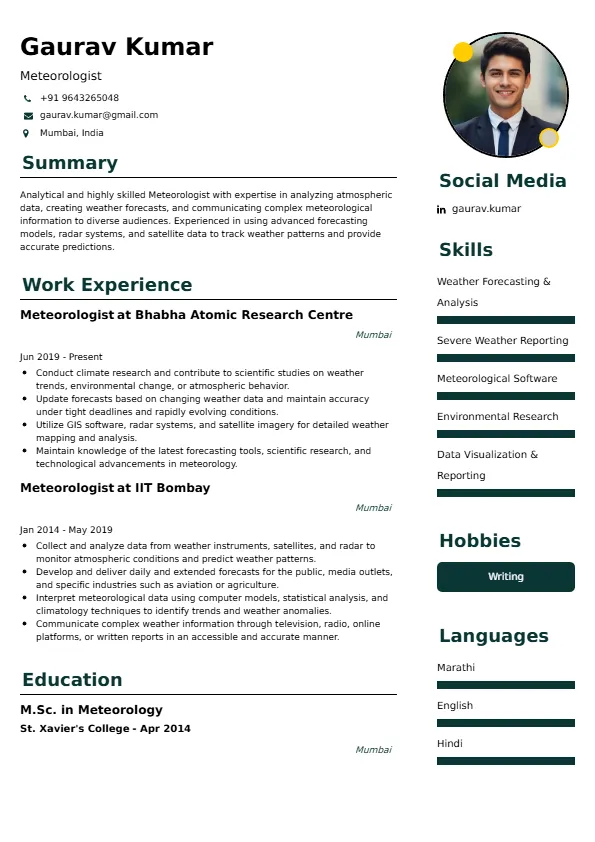
Superbresume.com empowers Meteorologists to craft resumes that highlight their scientific analysis and communication expertise. Our platform offers customizable templates tailored for scientific roles, emphasizing skills like remote sensing (Radar/Satellite), specialized forecasting models (GFS/ECMWF), crisis warning systems, and data visualization (GIS). With ATS-optimized formats, expert-written content suggestions, and real-time resume analysis, we ensure your resume aligns with job descriptions. Showcase your experience in consistently achieving high forecast accuracy, issuing critical weather warnings, or providing specialized weather consulting that mitigated client operational risk with confidence. Superbresume.com helps you create a polished, results-driven resume that grabs hiring managers’ attention and lands interviews.
How to Write a Resume for a Meteorologist
Craft a Targeted Summary: Write a 2-3 sentence summary highlighting your expertise in weather forecasting and atmospheric science, proficiency in NWP modeling and data analysis (Python/GIS), and success in delivering accurate forecasts and clear, impactful communication to stakeholders.
Use Reverse-Chronological Format: List recent meteorology, atmospheric science, or research roles first, focusing on measurable forecasting accuracy and project impact.
Highlight Certifications/Training: Include credentials like AMS Certified Broadcast Meteorologist (CBM), relevant Master’s/Ph.D. in Meteorology, specialized modeling software training, or FAA weather certification to boost credibility.
Quantify Achievements: Use metrics, e.g., “Consistently achieved a 90% accuracy rate for 24-hour severe weather forecasts in a 5-state region,” or “Provided specialized weather consulting to an energy client that mitigated $2M in potential storm-related operational losses,” to show impact.
Incorporate Keywords: Use terms like “Numerical Weather Prediction (NWP),” “Forecasting Accuracy,” “Atmospheric Data Analysis (Python/R),” “Remote Sensing (Radar/Satellite),” “Climatology,” “Severe Weather Warning,” or “GIS (Geographic Information Systems)” from job descriptions for ATS.
Detail Technical Skills: List proficiency with specific modeling software (WRF, GFS), programming languages (Python, R, MATLAB), data visualization/GIS tools (ArcGIS), and specialized communication equipment in a dedicated skills section.
Showcase Forecasting/Research Projects: Highlight 3-4 key projects or responsibilities (e.g., leading a seasonal outlook, developing a custom forecast model, contributing to climate research), detailing the methodology, the challenge, and the quantified result (accuracy, mitigation, publication).
Emphasize Soft Skills: Include analytical rigor, critical thinking, rapid decision-making (weather events), strong verbal/written communication, and the ability to simplify complex science for public understanding.
Keep It Concise: Limit your resume to 1-2 pages, focusing on relevant forecasting, research, and communication experience.
Proofread Thoroughly: Eliminate typos or jargon for a professional document.
Data Science and Machine Learning: Focus on expertise utilizing Python/R and ML techniques to enhance traditional NWP models, improve probabilistic forecasting, and analyze vast quantities of observational data.
Specialized Industry Consulting: Highlight experience providing tailored weather services to niche markets, such as the energy sector (wind/solar forecasting), insurance (catastrophe modeling), or transportation (aviation/marine routing).
Remote Sensing and Big Data: Showcase proficiency utilizing and processing high-resolution data from Doppler radar, satellite imagery (GOES), and automated weather stations for localized forecasting.
GIS and Geospatial Visualization: Detail expertise using Geographic Information Systems (GIS) to overlay weather data with spatial risk information (e.g., flood zones, power lines) for impactful visualization and analysis.
Crisis and Risk Communication: Emphasize advanced skills in communicating complex severe weather threats (hurricanes, tornados) clearly and calmly to the public or operational teams for effective risk mitigation.
Metrics-Driven Achievements: Use results like “Successfully reduced false alarm rates for winter storm warnings by 10% through refined model calibration” or “Developed a proprietary localized microclimate forecast model.”
Cloud Computing for Modeling: Include experience running high-resolution NWP models and managing large datasets within public cloud environments (AWS, Azure, GCP).
Climatology and Climate Change Impacts: Highlight expertise analyzing long-term climate trends and modeling the localized impacts of climate change for government or corporate planning.
Choose Superbresume.com to craft a Meteorologist resume that stands out in the competitive scientific forecasting sector. Our platform offers tailored templates optimized for ATS, ensuring your skills in NWP modeling, forecasting accuracy, and data analysis shine. With expert guidance, pre-written content, and real-time feedback, we help you highlight achievements like achieving high prediction accuracy or mitigating client operational risks. Whether you work in broadcasting, research, or consulting, our tools make it easy to create a polished, results-driven resume. Trust Superbresume.com to showcase your expertise in reliable and strategic atmospheric science. Start building your career today!
20 Key Skills for a Meteorologist Resume
| Numerical Weather Prediction (NWP) Modeling | Forecasting Accuracy & Verification |
| Atmospheric Data Analysis (Python/R/MATLAB) | Remote Sensing (Radar/Satellite Interpretation) |
| Severe Weather Warning & Crisis Communication | Climatology & Climate Change Analysis |
| Geographic Information Systems (GIS) (ArcGIS) | Synoptic & Mesoscale Meteorology |
| Presentation & Public Speaking (Broadcasting) | Custom Model Development (WRF/GFS) |
10 Do’s for a Meteorologist Resume
Tailor Your Resume: Customize for the specific career path (e.g., emphasize CBM/public speaking for broadcasting, emphasize Python/NWP for research/consulting).
Highlight Certifications/Training: List CBM/AMS Certification and relevant advanced degrees prominently.
Quantify Achievements: Include metrics on forecast accuracy (percentage), impact of consulting (dollar savings/mitigation), or data volume analyzed/modeled.
Use Action Verbs: Start bullet points with verbs like “forecasted,” “analyzed,” “modeled,” “communicated,” or “developed.”
Showcase Forecasting/Research: Detail the methodology and the strategic, quantified result of 3-4 key forecasting or modeling projects.
Include Soft Skills: Highlight analytical rigor, strong communication (simplifying science), and rapid decision-making under pressure.
Optimize for ATS: Use standard scientific section titles and incorporate key NWP, data analysis, and regulatory terms.
Keep It Professional: Use a clean, consistent font and scientific layout.
Emphasize Modeling and Data: Clearly articulate expertise in utilizing NWP output and manipulating large atmospheric datasets (Python/GIS).
Proofread Thoroughly: Eliminate typos or jargon for a professional document.
10 Don’ts for a Meteorologist Resume
Don’t Overload with Jargon: Avoid confusing, internal company or research unit acronyms; use standardized meteorological terminology.
Don’t Exceed Two Pages: Keep your resume concise, focusing on high-impact forecasting, analysis, and communication achievements.
Don’t Omit Dates: Include employment dates for career context.
Don’t Use Generic Templates: Tailor your resume specifically to the scientific rigor and communication duties of a Meteorologist.
Don’t List Irrelevant Skills: Focus on atmospheric science, forecasting, modeling, data analysis, and communication.
Don’t Skip Metrics: Quantify results wherever possible; accuracy and mitigation are critical metrics.
Don’t Use Complex Formats: Avoid highly stylized elements or confusing graphics.
Don’t Ignore Communication: Include explicit experience translating complex science into actionable public or client advice.
Don’t Include Outdated Experience: Omit non-scientific or non-meteorology jobs over 15 years old.
Don’t Forget to Update: Refresh for new CBM certification, successful model development projects, or advanced data science skills.
5 FAQ's for a Meteorologist Resume
For broadcast roles, yes. For research roles, link to published papers or forecast reports.
Mention WRF, GFS, or ECMWF modeling experience.
"Issued early weather warnings during a major storm event, cited by local authorities for mitigating property damage risk."
Yes. "Expertly utilized Doppler radar, satellite imagery, and surface observation networks to refine short-term forecasts."
Yes. "Integrated meteorological data into GIS platforms for advanced spatial climate analysis."
Get 5x more interviews with our crafted Resumes. We make resumes that land jobs.

Get a Free Customized Cover Letter with Resume Expert Advice
with every resume order placed, you will get a free Customized Cover letter.