Mental Health Counselor
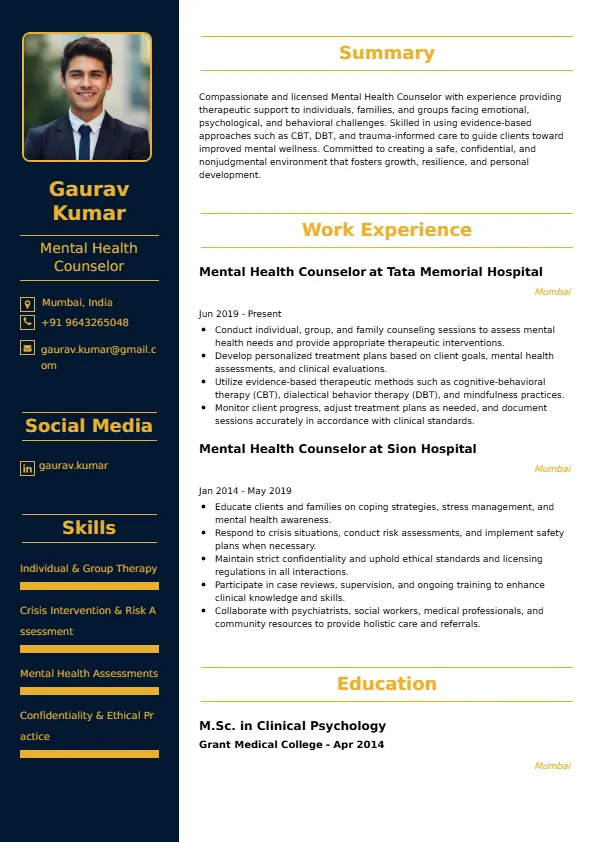
Welcome to our Mental Health Counselor resume sample page! This expertly crafted resume template is designed to showcase your expertise in providing psychotherapy, diagnostic assessment (DSM-5), treatment planning, crisis intervention, and case management for individuals, families, or groups with various mental health disorders. Whether you work in a clinic, private practice, or community center, this sample highlights key skills like Therapeutic Modalities (CBT/DBT), Licensure (LPC/LMHC), Ethical Practice (HIPAA), Crisis Management, and Electronic Health Records (EHR) Proficiency tailored to meet top behavioral health demands. Use this guide to create a compelling resume that stands out and secures your next career opportunity.
Superbresume.com empowers Mental Health Counselors to craft resumes that highlight their clinical expertise and measurable client outcomes. Our platform offers customizable templates tailored for behavioral health roles, emphasizing skills like advanced diagnostic assessment, treatment planning (SMART goals), multidisciplinary collaboration, and ethical/legal compliance. With ATS-optimized formats, expert-written content suggestions, and real-time resume analysis, we ensure your resume aligns with job descriptions. Showcase your experience in consistently managing a large client caseload, achieving high client retention/progress rates, or leading specialized therapeutic groups with confidence. Superbresume.com helps you create a polished, results-driven resume that grabs hiring managers’ attention and lands interviews.
How to Write a Resume for a Mental Health Counselor
Craft a Targeted Summary: Write a 2-3 sentence summary highlighting your active state licensure (LPC/LMHC), expertise in providing evidence-based psychotherapy (CBT/DBT), and success in diagnostic assessment, treatment planning, and managing complex client needs.
Use Reverse-Chronological Format: List recent counseling, clinical, or behavioral health roles first, focusing on measurable client progress and clinical responsibilities.
Highlight Certifications/Licensure: Include credentials like State Licensure (LPC, LMHC, etc.), specialized certifications (e.g., CBT, EMDR, addiction), Board Certified Counselor (NCC), or relevant Master’s Degree (Counseling/Psychology) to boost credibility.
Quantify Achievements: Use metrics, e.g., “Managed a weekly caseload of 25 individual clients, achieving a 20% average reduction in symptom severity (PHQ-9/GAD-7 scores),” or “Facilitated 5 therapeutic groups monthly, maintaining a 90% attendance and retention rate,” to show impact.
Incorporate Keywords: Use terms like “Psychotherapy (Individual/Group),” “Diagnostic Assessment (DSM-5),” “Treatment Planning (Evidence-Based),” “Therapeutic Modalities (CBT/DBT/ACT),” “Crisis Intervention,” “EHR Proficiency (TherapyNotes/SimplePractice),” or “Ethical/HIPAA Compliance” from job descriptions for ATS.
Detail Clinical/Technical Skills: List proficiency with specific therapeutic approaches, diagnostic coding, EHR/billing systems, safety planning protocols, and strong case management in a dedicated skills section.
Showcase Clinical Success: Highlight 3-4 key responsibilities or projects (e.g., leading a specialized group, developing a new assessment protocol, assisting with program accreditation), detailing the scope, the challenge, and the quantified client outcome/compliance result.
Emphasize Soft Skills: Include empathy, active listening, strong communication (therapeutic alliance), professional boundary setting, emotional resilience, and adherence to ethical/legal standards.
Keep It Concise: Limit your resume to 1-2 pages, focusing on relevant clinical practice, supervision, and program experience.
Proofread Thoroughly: Eliminate typos or jargon for a professional document.
Telehealth and Virtual Counseling: Focus on expertise delivering effective psychotherapy sessions and maintaining HIPAA compliance via secure telehealth platforms.
Evidence-Based Practice (EBP) Mastery: Highlight advanced proficiency applying evidence-based modalities like CBT, DBT, or ACT to specific disorders (e.g., anxiety, depression, trauma).
EHR and Billing Integration: Showcase expertise utilizing Electronic Health Records (EHR) for clinical documentation (progress notes, intake forms) and coordinating with billing for accurate claim submission.
Crisis and Risk Assessment: Detail expertise conducting rapid risk assessments (suicide, homicide) and implementing appropriate safety planning and crisis intervention protocols (e.g., mobile crisis referral).
Metrics-Driven Treatment Planning: Emphasize utilizing standardized assessment tools (PHQ-9, GAD-7, PCL-5) to establish measurable treatment goals (SMART goals) and track client progress objectively.
Metrics-Driven Achievements: Use results like “Maintained client session attendance at 90% through effective engagement strategies” or “Successfully managed 5 high-risk clients through crisis and stabilization in one year.”
Specialized Population/Disorder Focus: Include advanced training or high-volume experience with a specific population (e.g., adolescents, veterans) or disorder (e.g., substance use, eating disorders).
Multidisciplinary Collaboration: Highlight experience working closely with psychiatrists (medication management), social workers, and primary care physicians to ensure integrated patient care.
Choose Superbresume.com to craft a Mental Health Counselor resume that stands out in the competitive behavioral health sector. Our platform offers tailored templates optimized for ATS, ensuring your skills in licensure, therapeutic modalities, and ethical practice shine. With expert guidance, pre-written content, and real-time feedback, we help you highlight achievements like improving client outcomes or leading specialized groups. Whether you work with individuals or families, our tools make it easy to create a polished, results-driven resume. Trust Superbresume.com to showcase your expertise in providing safe, ethical, and effective clinical intervention. Start building your career today!
20 Key Skills for a Mental Health Counselor Resume
| State Licensure (LPC/LMHC/LCSW) | Diagnostic Assessment (DSM-5/ICD-10) |
| Evidence-Based Psychotherapy (CBT, DBT, ACT) | Treatment Planning (SMART Goals) & Case Management |
| Crisis Intervention & Safety Planning | EHR Documentation (Clinical Notes) & Billing Support |
| Ethical & Legal Compliance (HIPAA) | Group & Family Therapy Facilitation |
| Standardized Assessment Tools (PHQ-9/GAD-7) | Multidisciplinary Collaboration (Psychiatry/PCP) |
| Empathy & Therapeutic Alliance Building | Telehealth Counseling Delivery |
10 Do’s for a Mental Health Counselor Resume
Tailor Your Resume: Customize for the specific clinical setting (e.g., community mental health, private group practice, substance abuse) and the population served.
Highlight Certifications/Licensure: List Active State Licensure (LPC/LMHC/LCSW) and key specialty certifications (e.g., CBT, EMDR) prominently.
Quantify Achievements: Include metrics on caseload size, client retention rate, measurable symptom reduction (PHQ-9 scores), or volume of group sessions led.
Use Action Verbs: Start bullet points with verbs like “counseled,” “assessed,” “implemented,” “facilitated,” or “managed.”
Showcase Clinical Expertise: Detail the therapeutic modality used and the resulting quantified clinical outcome for clients.
Include Soft Skills: Highlight empathy, strong communication, ethical conduct, crisis management, and emotional resilience.
Optimize for ATS: Use standard clinical/counseling section titles and incorporate key licensure, modality, and assessment terms.
Keep It Professional: Use a clean, consistent font and medical/clinical layout.
Emphasize EBP and Ethics: Clearly articulate expertise in evidence-based practice and strict adherence to professional ethics/HIPAA.
Proofread Thoroughly: Eliminate typos or jargon for a professional document.
10 Don’ts for a Mental Health Counselor Resume
Don’t Overload with Jargon: Avoid confusing, internal facility or agency acronyms; use standardized clinical and diagnostic terminology (DSM-5, ICD-10).
Don’t Exceed Two Pages: Keep your resume concise, focusing on high-impact clinical practice, procedural, and ethical achievements.
Don’t Omit Dates: Include full dates for education, licensure, and employment for credentialing purposes.
Don’t Use Generic Templates: Tailor your resume specifically to the clinical and specialized duties of a Mental Health Counselor.
Don’t List Irrelevant Skills: Focus on therapeutic modalities, assessment, treatment planning, crisis intervention, and case management.
Don’t Skip Metrics: Quantify results wherever possible; link clinical work to client progress, caseload size, or group success.
Don’t Use Complex Formats: Avoid highly stylized elements or confusing graphics.
Don’t Ignore Technology: Include mastery of secure EHR systems for clinical documentation.
Don’t Include Outdated Experience: Omit non-counseling or non-clinical jobs over 15 years old.
Don’t Forget to Update: Refresh for new certification renewals, successful treatment outcome data, or advanced modality training.
5 FAQs for a Mental Health Counselor Resume
Prioritize active state licensure (LPC/LMHC), evidence-based modalities (CBT/DBT), DSM-5 diagnostic assessment, crisis intervention, and EHR documentation.
Use standard clinical/counseling section titles, avoid graphics, and include keywords like “DSM-5,” “CBT,” and “Treatment Planning.”
Yes, quantifying the average weekly caseload or the number of group sessions led demonstrates capacity.
Detail a specific modality used and the resulting quantified improvement in client-reported symptomology (e.g., 20% reduction in PHQ-9 score).
Use a reverse-chronological format to emphasize your most recent, high-impact clinical practice and specialized training achievements.
Get 5x more interviews with our crafted Resumes. We make resumes that land jobs.

Get a Free Customized Cover Letter with Resume Expert Advice
with every resume order placed, you will get a free Customized Cover letter.