Sound Designer
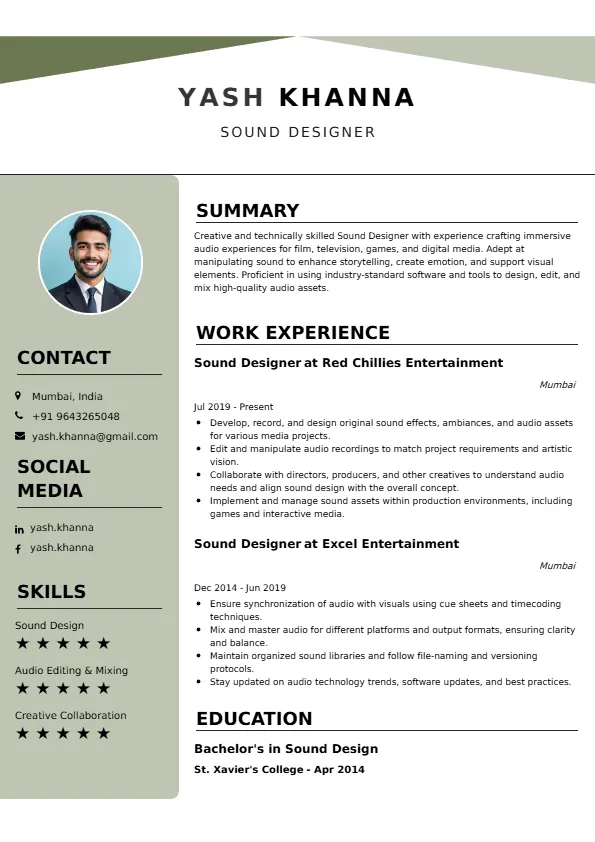
Welcome to our Sound Designer resume sample page! This expertly crafted resume template is designed to showcase your expertise in creating, manipulating, and implementing the complete sonic experience (SFX, ambience, UI sounds) for games, film, television, or digital media, utilizing digital audio workstations (DAW) and middleware. Whether you focus on cinematic soundscapes or interactive game audio, this sample highlights key skills like Digital Audio Workstation (DAW) Mastery, Audio Post-Production, Sound Implementation (Middleware), Audio Editing, and Foley/SFX Creation tailored to meet top studio and media production demands. Use this guide to create a polished, results-driven resume that stands out and secures your next career opportunity.
Superbresume.com empowers Sound Designers to craft resumes that highlight their creative auditory vision and technical implementation expertise. Our platform offers customizable templates tailored for media roles, emphasizing skills like game audio integration (Wwise/FMOD), field recording/foley creation, mixing/mastering (immersive audio), and collaborative work with directors/developers. With ATS-optimized formats, expert-written content suggestions, and real-time resume analysis, we ensure your resume aligns with job descriptions. Showcase your experience in successfully creating the audio for commercially released games/films, significantly optimizing audio memory/performance, or leading the complete sound post-production pipeline for a major project with confidence. Superbresume.com helps you create a polished, results-driven resume that grabs hiring managers’ attention and lands interviews.
How to Write a Resume for a Sound Designer
Craft a Targeted Summary: Write a 2-3 sentence summary highlighting your expertise in full-cycle sound design and post-production, proficiency in DAW/middleware, and success in creating immersive, high-quality audio experiences that enhance narrative and user engagement.
Use Reverse-Chronological Format: List recent Sound Designer, Audio Post-Production, or Game Audio roles first, focusing on measurable creative and technical achievements.
Highlight Certifications/Portfolio: Include credentials like Pro Tools Certified Operator, Game Audio (Wwise/FMOD) Certification, specialized Foley/Mixing training, or feature a link to your sound design demo reel/portfolio to boost credibility.
Quantify Achievements: Use metrics, e.g., “Designed and implemented the audio for a AAA game title, achieving 99% accurate localization across 5 languages and optimizing audio memory to <1GB,” or “Led the sound post-production for a feature film, reducing the final audio mix time by 20% through streamlined file organization,” to show impact.
Incorporate Keywords: Use terms like “Digital Audio Workstation (DAW) (Pro Tools/Reaper),” “Sound Implementation (Wwise/FMOD),” “Audio Post-Production,” “SFX/Foley Creation,” “Mixing & Mastering,” “Audio Editing & Manipulation,” or “Game Audio Design” from job roles for ATS.
Detail Technical Skills: List proficiency with specific DAWs, middleware, audio plugins, field recording equipment, scripting (Python/Lua for tools), and industry standards (Dolby Atmos, ITU) in a comprehensive skills section.
Showcase Sound Projects: Highlight 3-4 key projects (e.g., game sound system, film final mix, interactive installation), detailing the media type, the creative challenge (e.g., fantasy creature sounds, atmospheric realism), the tools used, and the quantified technical/creative result.
Emphasize Soft Skills: Include creative vision, acute hearing/listening, technical precision, strong communication (director/audio team), and attention to detail (syncing, timing).
Keep It Concise: Limit your resume to 1-2 pages, focusing on relevant sound design, technical production, and creative implementation experience.
Proofread Thoroughly: Eliminate typos or jargon for a professional document.
Interactive Audio and Middleware (Wwise/FMOD): Focus on advanced expertise designing and implementing dynamic, interactive sound systems for video games, utilizing middleware tools to manage audio logic, states, and performance.
Immersive Audio Mixing (Dolby Atmos, Spatial Audio): Highlight experience mixing and mastering audio content for modern immersive formats (Dolby Atmos, virtual reality), demonstrating advanced knowledge of spatialization techniques.
Audio Optimization and Performance: Showcase technical skills in optimizing audio assets (compression, sample rate), managing memory budgets, and profiling in-game/real-time audio performance to prevent CPU/memory spikes.
Field Recording and Sound Library Creation: Detail expertise in conducting professional field recording sessions, utilizing specialized equipment (e.g., shotgun mics, recorders), and managing/tagging a large personal or commercial sound library.
Procedural Audio and Synthesis: Emphasize utilizing tools and techniques (e.g., procedural generation, physical modeling) to create unique, complex sound effects that are difficult to record in the real world.
Metrics-Driven Achievements: Use results like “Optimized the audio engine integration, reducing the game’s peak audio thread usage by 15%” or “Led the post-production for a project that achieved 99% sync accuracy and zero technical compliance failures.”
Cross-Functional Collaboration (Dev/Art): Include experience working closely with Game Developers/Engineers (for audio code/integration) and Directors/Writers (for creative sound concepts).
Source Control and Asset Management: Highlight proficiency utilizing version control (Perforce, Git) and Digital Asset Management (DAM) systems for large volumes of audio files and project backups.
Choose Superbresume.com to craft a Sound Designer resume that stands out in the competitive media production and game industry. Our platform offers tailored templates optimized for ATS, ensuring your skills in DAW mastery, game audio middleware, and creative sound execution shine. With expert guidance, pre-written content, and real-time feedback, we help you highlight achievements like optimizing audio performance or leading a successful final mix. Whether you specialize in film post-production or interactive sound, our tools make it easy to create a polished, results-driven resume. Trust Superbresume.com to showcase your expertise in engineering captivating and functional auditory experiences. Start building your career today!
20 Key Skills for a Sound Designer Resume
| Digital Audio Workstation (DAW) Mastery (Pro Tools/Reaper) | Audio Post-Production & Mixing (5.1/Dolby Atmos) |
| Sound Implementation Middleware (Wwise/FMOD) | SFX/Foley Creation & Recording (Field/Studio) |
| Audio Editing, Restoration, & Synthesis | Acoustic & Psychoacoustic Principles |
10 Do’s for a Sound Designer Resume
Tailor Your Resume: Customize for the primary medium (e.g., emphasize Wwise/FMOD for games, emphasize Pro Tools/Mix for film/TV).
Highlight Certifications/Portfolio: List Wwise/FMOD/Pro Tools certifications and include a link to your sound design demo reel prominently.
Quantify Achievements: Include metrics on audio memory reduction, peak thread usage optimization, number of assets created, or sync accuracy rates.
Use Action Verbs: Start bullet points with verbs like “designed,” “implemented,” “mixed,” “optimized,” or “recorded.”
Showcase Creative/Technical Projects: Detail the methodology and the strategic, quantified performance/creative result of 3-4 key sound design projects.
Include Soft Skills: Highlight creative vision, technical precision, strong communication, and attention to detail (sync/mixing).
Optimize for ATS: Use standard creative/production section titles and incorporate key DAW, middleware, and format terms.
Keep It Professional: Use a clean, consistent font and professional layout.
Emphasize Implementation and Mixing: Clearly articulate expertise in both creating the sound and getting it correctly into the final product (mix/engine).
Proofread Thoroughly: Eliminate typos or jargon for a professional document.
10 Don’ts for a Sound Designer Resume
Don’t Overload with Jargon: Avoid confusing, internal studio or project acronyms; use standardized audio post-production terminology.
Don’t Exceed Two Pages: Keep your resume concise; the demo reel is the most critical element.
Don’t Omit Dates: Include employment dates for career context.
Don’t Use Generic Templates: Tailor your resume specifically to the specialized creative and technical duties of a Sound Designer.
Don’t List Irrelevant Skills: Focus on sound, editing, mixing, middleware, and creative production.
Don’t Skip Metrics: Quantify results wherever possible; memory usage, latency, and mix quality are key metrics.
Don’t Use Complex Formats: Avoid highly stylized elements or confusing graphics.
Don’t Ignore Middleware: Include explicit experience integrating audio into game engines using Wwise/FMOD.
Don’t Include Outdated Experience: Omit non-audio or irrelevant jobs over 15 years old.
Don’t Forget to Update: Refresh for new software mastery, successful project completions, or advanced immersive audio training.
5 FAQ's for a Sound Designer Resume
Yes. A link to a high-quality portfolio site (like ArtStation or a personal domain) is non-negotiable for creative sound roles.
Mention proficiency in DAWs like Pro Tools, Ableton Live, or Reaper, and game audio middleware like Wwise or FMOD.
Mention your ability to implement sound via scripting (C#, C++) or visual scripting (Blueprints) within Unity or Unreal Engine.
Briefly list your field recording equipment (e.g., Zoom/Sound Devices recorders) to show you can capture original assets.
Describe working with directors or game designers to "establish the sonic identity of a project from pre-production to final mix."
Get 5x more interviews with our crafted Resumes. We make resumes that land jobs.

Get a Free Customized Cover Letter with Resume Expert Advice
with every resume order placed, you will get a free Customized Cover letter.