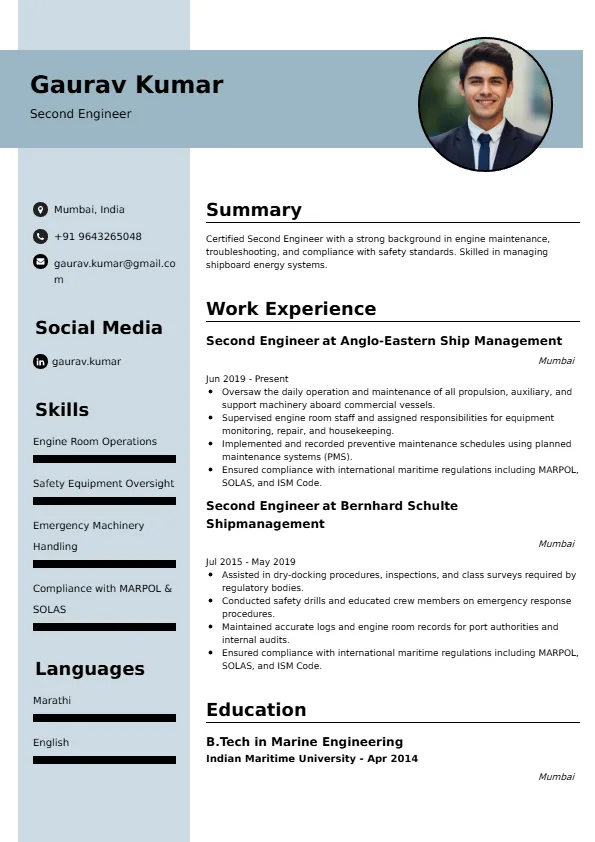
Second Engineer
Welcome to our Second Engineer resume sample page! This expertly crafted resume template is designed to showcase your expertise in managing the engine room watch, overseeing the planned maintenance system (PMS), supervising engineering staff, and ensuring the efficient and compliant operation of main propulsion and auxiliary machinery. As the Chief Engineer's second-in-command, this sample highlights key skills like STCW CoC, Engine Room Management, PMS Strategy, Staff Supervision, and Regulatory Compliance (MARPOL/SOLAS) tailored to meet top shipping and marine demands. Use this guide to create a polished, results-driven resume that stands out and secures your next career opportunity.
Superbresume.com empowers Second Engineers to craft resumes that highlight their operational leadership and machinery management expertise. Our platform offers customizable templates tailored for senior officer roles, emphasizing skills like advanced technical troubleshooting, maintenance budget control, drydock/refit planning support, and adherence to classification society rules. With ATS-optimized formats, expert-written content suggestions, and real-time resume analysis, we ensure your resume aligns with job descriptions. Showcase your experience in successfully leading complex machinery overhauls, significantly improving engine performance metrics, or maintaining a flawless compliance record during PSC/ISM audits with confidence. Superbresume.com helps you create a polished, results-driven resume that grabs hiring managers’ attention and lands interviews.
How to Write a Resume for a Second Engineer
Craft a Targeted Summary: Write a 2-3 sentence summary highlighting your active STCW Second Engineer Certificate of Competency (CoC), expertise in managing engine room watch and maintenance, and success in leading engineering staff, controlling budgets, and ensuring regulatory and operational efficiency.
Use Reverse-Chronological Format: List recent Second Engineer, Senior Third Engineer, or shore-based technical superintendent roles first, focusing on measurable operational, financial, and team achievements.
Highlight Certifications/CoC: Include essential credentials like STCW Second Engineer CoC, High Voltage (HV) Certification, Engine Resource Management (ERM), and specialized vessel training (e.g., Dual Fuel, Diesel-Electric) to boost credibility.
Quantify Achievements: Use metrics, e.g., “Oversaw the Planned Maintenance System (PMS) for a fleet of 3 vessels (average 30,000 GT), achieving 100% compliance with maintenance schedules and surveys,” or “Reduced vessel fuel consumption by 5% through optimizing engine tuning and monitoring procedures, saving $X annually,” to show impact.
Incorporate Keywords: Use terms like “Engine Room Management,” “Planned Maintenance System (PMS) Oversight,” “STCW/MARPOL Compliance,” “Auxiliary & Main Engine Overhaul,” “Staff Supervision & Development,” “Maintenance Budget Control,” or “Engine Resource Management (ERM)” from job descriptions for ATS.
Detail Leadership/Technical Skills: List expertise in staff scheduling/performance review, budget tracking (OpEx/MRO), advanced troubleshooting (Diesel/Electrical), maintenance software (AMOS/MAXIMO), and regulatory adherence (MARPOL/SOLAS) in a dedicated skills section.
Showcase Maintenance/Compliance Projects: Highlight 3-4 key projects or sea contracts (e.g., leading a major drydock preparation, managing a main engine component renewal, implementing a new PMS module), detailing the scope, the challenge, and the quantified operational/financial result.
Emphasize Soft Skills: Include decisive leadership, strong technical troubleshooting, financial acumen, attention to regulatory detail, and effective teamwork/communication.
Keep It Concise: Limit your resume to 1-2 pages, focusing on relevant senior marine engineering, leadership, and operational experience.
Proofread Thoroughly: Eliminate typos or jargon for a professional document.
Digital PMS and Data Analytics: Focus on advanced expertise utilizing computerized maintenance systems (CMMS/PMS) for predictive maintenance (PdM), analyzing machinery condition data, and optimizing spare parts inventory.
Emissions Compliance and Alternative Fuels: Highlight experience managing systems related to MARPOL Annex VI (e.g., scrubbers, SCR) and handling systems for alternative fuels (e.g., LNG, methanol) on modern vessels.
Drydock and Refit Management Support: Showcase expertise assisting the Chief Engineer with the technical planning, vendor coordination, and execution of major machinery overhauls and vessel refits.
High Voltage (HV) Systems Management: Detail experience overseeing maintenance and safety protocols for high-voltage power generation and distribution systems (if applicable to vessel type).
Engine Performance Optimization: Emphasize utilizing engine diagnostic tools and performance analysis to optimize fuel efficiency, monitor component wear, and reduce emissions.
Metrics-Driven Achievements: Use results like “Achieved 99.9% engine room availability during all critical voyages under my supervision” or “Reduced annual MRO (Maintenance, Repair, Overhaul) expenditure by 10% through strategic internal repair and inventory control.”
Staff Mentoring and Development: Include experience training and mentoring junior engineers (3rd/4th Engineer, Cadets) on watchkeeping duties, maintenance tasks, and safety protocols.
Regulatory Audit Readiness: Highlight experience preparing the engine room department for seamless Port State Control (PSC), Flag State, and Classification Society inspections.
Choose Superbresume.com to craft a Second Engineer resume that stands out in the essential maritime leadership sector. Our platform offers tailored templates optimized for ATS, ensuring your skills in STCW CoC, PMS oversight, and operational reliability shine. With expert guidance, pre-written content, and real-time feedback, we help you highlight achievements like reducing fuel consumption or leading successful maintenance periods. Whether you manage conventional or diesel-electric propulsion, our tools make it easy to create a polished, results-driven resume. Trust Superbresume.com to showcase your expertise in commanding safe, efficient, and compliant marine technical operations. Start building your career today!
20 Key Skills for a Second Engineer Resume
| STCW Second Engineer CoC | Planned Maintenance System (PMS) Oversight (AMOS/MAXIMO) |
| Engine Room Watchkeeping & Management | Staff Supervision & Technical Mentoring |
| Diesel Engine Overhaul & Component Maintenance | Regulatory Compliance (MARPOL, SOLAS, PSC Readiness) |
| Maintenance Budget & MRO Cost Control | High Voltage (HV) Systems & Power Management (if applicable) |
10 Do’s for a Second Engineer Resume
Tailor Your Resume: Customize for the specific vessel type and propulsion system (e.g., focus on LNG Carrier, focus on low-speed 2-stroke engines).
Highlight Certifications/CoC: List active STCW Second Engineer CoC, HV Certification, and ERM training prominently.
Quantify Achievements: Include metrics on fuel consumption reduction (percentage), MRO cost savings, system availability rate, or team size supervised.
Use Action Verbs: Start bullet points with verbs like “managed,” “oversaw,” “led,” “optimized,” or “maintained.”
Showcase Leadership and Maintenance: Detail the methodology and the strategic, quantified financial/operational result of 3-4 key maintenance or compliance projects.
Include Soft Skills: Highlight decisive leadership, technical problem-solving, financial acumen, and strong regulatory adherence.
Optimize for ATS: Use standard maritime section titles and incorporate key STCW, PMS, and system terms.
Keep It Professional: Use a clean, consistent font and professional layout.
Emphasize Leadership and Cost Control: Clearly articulate experience managing people, systems, and budgets for optimal engine performance.
Proofread Thoroughly: Eliminate typos or jargon for a professional document.
10 Don’ts for a Second Engineer Resume
Don’t Overload with Jargon: Avoid confusing, internal ship or company acronyms; use standardized maritime engineering and regulatory terminology.
Don’t Exceed Two Pages: Keep your resume concise, focusing on high-level operational, maintenance, and compliance leadership.
Don’t Omit Dates: Include full dates for sea service and CoC renewals.
Don’t Use Generic Templates: Tailor your resume specifically to the demanding, supervisory duties of a Second Engineer.
Don’t List Irrelevant Skills: Focus on maintenance management, watchkeeping, compliance, technical leadership, and propulsion systems.
Don’t Skip Metrics: Quantify results wherever possible; fuel efficiency, MRO costs, and availability are key metrics.
Don’t Use Complex Formats: Avoid highly stylized elements or confusing graphics.
Don’t Ignore Regulatory Compliance: Include explicit experience ensuring MARPOL/SOLAS/ISM compliance and audit readiness.
Don’t Include Outdated Experience: Omit non-maritime or non-engineering jobs over 15 years old.
Don’t Forget to Update: Refresh for new CoC upgrades, successful drydock planning, or advanced performance optimization techniques.
5 FAQ's for a Second Engineer Resume
Clearly state your experience as the Engineer Officer of the Watch (EOOW) and your ability to stand a lone watch in a UMS (Unattended Machinery Space) environment.
List specific main engines (e.g., MAN B&W, Wärtsilä) and auxiliary systems like purifiers, boilers, and fresh water generators.
"Managed 50+ repair specifications during a 30-day scheduled drydocking, ensuring 100% on-time vessel departure."
Yes. "Acted as the primary fire-fighting and damage control lead, conducting weekly safety drills for a crew of 25."
Absolutely. Use a table to list Vessel Type, Rank, Engine Power (kW), and Duration in months.
Get 5x more interviews with our crafted Resumes. We make resumes that land jobs.

Get a Free Customized Cover Letter with Resume Expert Advice
with every resume order placed, you will get a free Customized Cover letter.