Quality Control Inspector
Welcome to our Quality Control (QC) Inspector resume sample page! This expertly crafted resume template is designed to showcase your expertise in performing physical inspections, conducting precise measurements, documenting defects, and ensuring products/materials adhere to strict quality standards and engineering specifications. Whether you work in manufacturing, construction, or a lab, this sample highlights key skills like Metrology (Calipers, Micrometers), Blueprints/Specifications Reading, Inspection Procedures (First-Article/In-Process), Documentation (Non-Conformance Reports - NCRs), and Calibration tailored to meet top industrial demands. Use this guide to create a polished, results-driven resume that stands out and secures your next career opportunity.
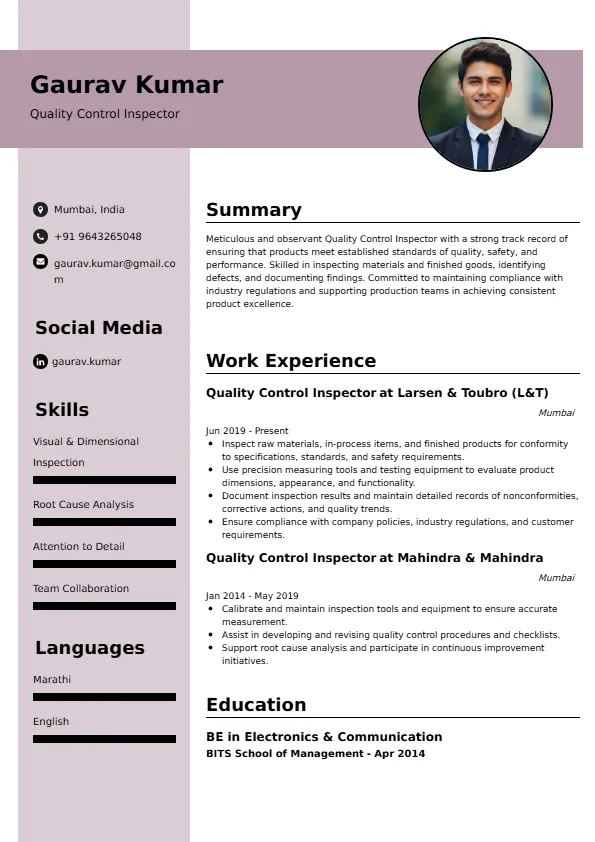
Superbresume.com empowers Quality Control Inspectors to craft resumes that highlight their precision measurement and specification adherence expertise. Our platform offers customizable templates tailored for industrial roles, emphasizing skills like CMM (Coordinate Measuring Machine) operation, statistical sampling, gauge calibration, and non-conformance reporting. With ATS-optimized formats, expert-written content suggestions, and real-time resume analysis, we ensure your resume aligns with job descriptions. Showcase your experience in consistently achieving zero critical defects on inspected parts, significantly reducing scrap rates, or maintaining a flawless audit record for equipment calibration with confidence. Superbresume.com helps you create a polished, results-driven resume that grabs hiring managers’ attention and lands interviews.
How to Write a Resume for a Quality Control Inspector
Craft a Targeted Summary: Write a 2-3 sentence summary highlighting your expertise in physical quality inspection and control, proficiency in metrology and blueprint reading, and success in ensuring product adherence to specifications and minimizing defects/scrap rates.
Use Reverse-Chronological Format: List recent QC inspector, technician, or manufacturing quality roles first, focusing on measurable accuracy and compliance achievements.
Highlight Certifications/Training: Include credentials like ASQ Certified Quality Inspector (CQI), specialized metrology training, Geometric Dimensioning and Tolerancing (GD&T) certification, or relevant trade school/technical degrees to boost credibility.
Quantify Achievements: Use metrics, e.g., “Performed 100% final inspection on 5,000+ critical components annually, maintaining a defect escape rate of <5 PPM,” or “Led a root cause analysis (RCA) effort that reduced internal scrap rate by 15%, saving $X in material costs annually,” to show impact.
Incorporate Keywords: Use terms like “Metrology & Precision Measurement,” “Blueprint/Specification Reading (GD&T),” “Inspection Procedures (FAIR/In-Process),” “Non-Conformance Report (NCR) Documentation,” “Equipment Calibration & Maintenance,” “Statistical Sampling,” or “Quality Management System (QMS)” from job roles for ATS.
Detail Technical Skills: List proficiency with specific tools (CMM, optical comparators, gauges), statistical software (Minitab), inspection methods, documentation systems, and strong knowledge of material specifications in a comprehensive skills section.
Showcase Inspection Projects: Highlight 3-4 key responsibilities or projects (e.g., conducting a First Article Inspection (FAI) on a new product, managing the calibration schedule for all metrology tools, reducing a specific defect type), detailing the challenge, the method used, and the quantified quality/cost result.
Emphasize Soft Skills: Include meticulous attention to detail, precision, adherence to standards, strong communication (reporting defects), and analytical problem-solving (defect identification).
Keep It Concise: Limit your resume to 1 page, focusing on relevant inspection, measurement, and quality control experience.
Proofread Thoroughly: Eliminate typos or jargon for a professional document.
Advanced Metrology (CMM/Vision Systems): Focus on expertise operating and programming Coordinate Measuring Machines (CMM) and/or advanced non-contact vision inspection systems for automated, high-precision measurement.
GD&T Blueprint Interpretation: Highlight deep proficiency interpreting complex engineering drawings utilizing Geometric Dimensioning and Tolerancing (GD&T) standards for accurate measurement and feature inspection.
Digital Non-Conformance Reporting (NCR): Showcase experience utilizing quality management software (QMS) or ERP systems to digitally document, track, and manage Non-Conformance Reports (NCRs) and corresponding Corrective and Preventive Actions (CAPA).
Gauge Calibration and Audit Readiness: Detail expertise managing the periodic calibration schedule for all measuring equipment (gauges, blocks, micrometers) and maintaining records required for ISO/regulatory audits.
Statistical Sampling and SPC: Emphasize knowledge of applying statistical sampling methods (e.g., AQL tables) and utilizing Statistical Process Control (SPC) data to monitor quality trends proactively.
Metrics-Driven Achievements: Use results like “Successfully migrated 100% of inspection records from paper to digital QMS, improving data retrieval time by 70%” or “Reduced external customer complaints related to fit/finish by 20%.”
First Article and In-Process Inspection: Include explicit experience conducting detailed First Article Inspection (FAI) and managing the necessary in-process and final product quality checks.
Cross-Functional Communication: Highlight experience communicating technical deviations and quality issues clearly to engineers, production staff, and supplier quality teams.Choose Superbresume.com to craft a Quality Control Inspector resume that stands out in the essential industrial and technical sector. Our platform offers tailored templates optimized for ATS, ensuring your skills in precision measurement, GD&T, and compliance documentation shine. With expert guidance, pre-written content, and real-time feedback, we help you highlight achievements like reducing scrap rates or maintaining flawless calibration records. Whether you inspect machined parts or final assembly, our tools make it easy to create a polished, results-driven resume. Trust Superbresume.com to showcase your expertise in reliable, accurate, and safety-compliant quality assurance. Start building your career today!
20 Key Skills for a Quality Control Inspector Resume
| Metrology & Precision Measurement (Calipers, Micrometers, Gauges) | Blueprint Reading & GD&T Interpretation |
| Non-Conformance Report (NCR) Documentation | Inspection Procedures (FAIR, In-Process, Final) |
| Equipment Calibration & Gauge Control | Quality Management System (QMS) Adherence (ISO) |
| Statistical Sampling & SPC (Basic) | CMM/Vision System Operation (if applicable) |
10 Do’s for a Quality Control Inspector Resume
Tailor Your Resume: Customize for the specific materials/products inspected (e.g., emphasize metals/machining, emphasize textiles/apparel).
Highlight Certifications/Training: List ASQ CQI, GD&T certification, and relevant metrology training prominently.
Quantify Achievements: Include metrics on defect escape rate (PPM), scrap rate reduction, accuracy rates in measurement, or volume of inspections performed.
Use Action Verbs: Start bullet points with verbs like “inspected,” “measured,” “documented,” “audited,” or “verified.”
Showcase Precision and Compliance: Detail the methodology and the strategic, quantified quality/cost result of 3-4 key inspection or control projects.
Include Soft Skills: Highlight meticulous detail, precision, adherence to standards, and strong communication.
Optimize for ATS: Use standard quality/technical section titles and incorporate key metrology and compliance terms.
Keep It Professional: Use a clean, consistent font and technical layout.
Emphasize GD&T and Documentation: Clearly articulate expertise in interpreting specifications and documenting non-conformances accurately.
Proofread Thoroughly: Eliminate typos or jargon for a professional document.
10 Don’ts for a Quality Control Inspector Resume
Don’t Overload with Jargon: Avoid confusing, internal company acronyms; use standardized quality and metrology terminology.
Don’t Exceed One Page: Keep your resume sharp and focused on the most relevant, measurable QC duties.
Don’t Omit Dates: Include employment dates for career context.
Don’t Use Generic Templates: Tailor your resume specifically to the detailed, precision duties of a QC Inspector.
Don’t List Irrelevant Skills: Focus on inspection, measurement, documentation, and quality standards.
Don’t Skip Metrics: Quantify results wherever possible; PPM, accuracy, and scrap reduction are key metrics.
Don’t Use Complex Formats: Avoid highly stylized elements or confusing graphics.
Don’t Ignore QMS/Calibration: Include explicit experience working within ISO standards and managing equipment calibration.
Don’t Include Outdated Experience: Omit non-QC or non-technical jobs over 10 years old.
Don’t Forget to Update: Refresh for new certification mastery, successful defect reduction projects, or advanced metrology equipment operation.
5 FAQ's for a Quality Control Inspector Resume
Mention specific tools: "Expert in the use of calipers, micrometers, height gauges, and CMM (Coordinate Measuring Machines)."
Vital. Mention ASME, ASTM, or AWS standards relevant to your field (e.g., aerospace, medical, automotive).
"Authored 50+ Non-Conformance Reports (NCRs) and collaborated with engineering to implement Corrective Actions (CAPA)."
Yes. "Proficient in interpreting complex blueprints and GD&T (Geometric Dimensioning and Tolerancing) symbols."
Yes. If applicable, note your "eye for detail" and "adherence to AQL (Acceptable Quality Level) sampling plans."
Get 5x more interviews with our crafted Resumes. We make resumes that land jobs.

Get a Free Customized Cover Letter with Resume Expert Advice
with every resume order placed, you will get a free Customized Cover letter.