Ordinary Seaman (OS)
Welcome to our Ordinary Seaman (OS) resume sample page! This expertly crafted resume template is designed to showcase your expertise in performing deck duties, assisting with watchkeeping, maintaining the vessel's exterior and equipment, and adhering to strict safety and regulatory procedures under the supervision of the Bosun and Deck Officers. Whether you work on merchant vessels, tugs, or offshore units, this sample highlights key skills like Seamanship (Knots/Splicing), Deck Maintenance (Chipping/Painting), Watchkeeping Assistance, Emergency Response, and STCW Basic Safety tailored to meet top maritime demands. Use this guide to create a polished, results-driven resume that stands out and secures your next career opportunity.
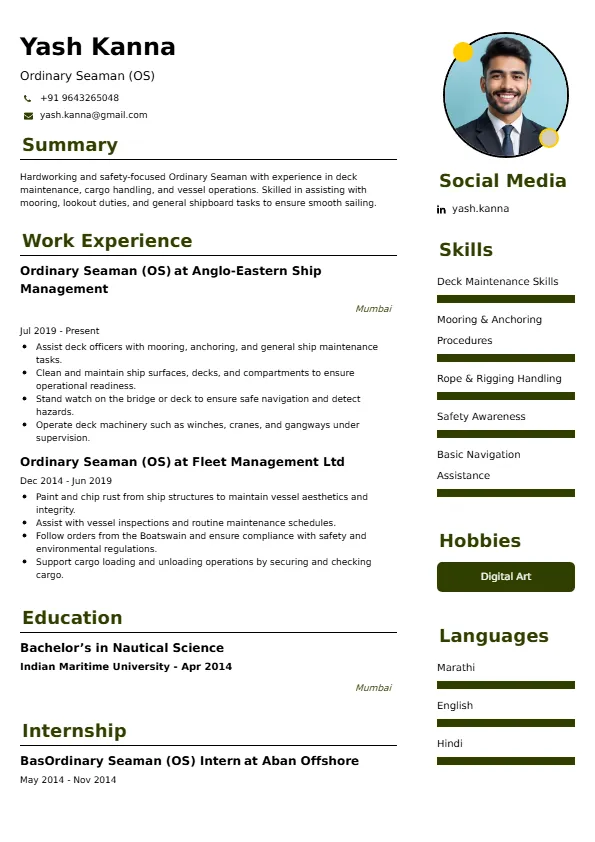
Superbresume.com empowers Ordinary Seamen (OS) to craft resumes that highlight their practical seamanship skills and dedication to deck safety. Our platform offers customizable templates tailored for entry-level deck roles, emphasizing skills like mooring operations, cargo handling (lashing), preventative maintenance (PM), and adherence to safety management systems (SMS). With ATS-optimized formats, expert-written content suggestions, and real-time resume analysis, we ensure your resume aligns with job descriptions. Showcase your experience in successfully performing deck maintenance tasks, assisting safely with high-risk operations (mooring/cargo), or maintaining a clean and secure deck environment with confidence. Superbresume.com helps you create a polished, results-driven resume that grabs hiring managers’ attention and lands interviews.
How to Write a Resume for an Ordinary Seaman (OS)
Craft a Targeted Summary: Write a 2-3 sentence summary highlighting your active STCW Basic Safety Training, experience in deck operations and maintenance, proficiency in basic seamanship and safety protocols, and commitment to supporting the deck crew effectively.
Use Reverse-Chronological Format: List recent sea service, maritime training, or physically demanding labor roles first, focusing on measurable operational and safety achievements.
Highlight Certifications/Licenses: Include essential credentials like STCW Basic Safety Training (BST), Security Awareness Training, Crowd Management (if applicable), and any relevant deck ratings or endorsements (e.g., AB endorsement progress) to boost credibility.
Quantify Achievements: Use metrics, e.g., “Completed 20+ mooring/unmooring operations safely under supervision, ensuring timely vessel turnaround,” or “Executed 100% of assigned preventative maintenance tasks (chipping, painting, cleaning) on time, contributing to vessel integrity,” to show impact.
Incorporate Keywords: Use terms like “Deck Operations,” “Seamanship (Knots/Rope Work),” “Deck Maintenance (Chipping/Painting),” “Mooring/Unmooring Assistance,” “STCW Compliance,” “Cargo Lashing & Securing,” or “Watchkeeping Assistant” from job descriptions for ATS.
Detail Technical Skills: List proficiency with specific deck equipment (winches, capstans), hand tools (chipping hammer, scrapers), safety gear (PPE, firefighting equipment), and basic navigation knowledge in a dedicated skills section.
Showcase Sea Service/Duties: Highlight 3-4 key responsibilities or sea contracts, detailing the vessel type (e.g., Cargo, Tanker, Tug), tonnage (GT), and the complexity of the deck duties performed.
Emphasize Soft Skills: Include physical stamina, reliability, adherence to strict schedules, attention to safety protocols, and strong teamwork/following orders.
Keep It Concise: Limit your resume to 1 page, focusing on relevant sea service, practical skills, and safety training.
Proofread Thoroughly: Eliminate typos or jargon for a professional document.
Advanced Deck Maintenance Techniques: Focus on proficiency utilizing modern tools for surface preparation (e.g., needle guns, hydro-blasting) and applying specialized marine coatings for corrosion control.
Safety Protocol Leadership (Basic): Highlight active involvement in safety drills (fire, abandon ship), conducting basic Job Safety Analysis (JSA), and ensuring compliance with Personal Protective Equipment (PPE) requirements.
Cargo Operations Support: Showcase experience assisting with the lashing, securing, and movement of diverse types of cargo, adhering to stability and weight distribution rules.
Vessel Housekeeping and Hygiene: Emphasize maintaining high standards of cleanliness and organization on the deck, bridge, and accommodation areas to ensure a safe, compliant environment.
Watchkeeping Duties: Detail experience assisting the AB/Officer with routine tasks during the watch, such as hourly rounds, lookout duties, and helm watch (if training permits).
Metrics-Driven Achievements: Use results like “Maintained 100% compliance with all deck safety protocols and zero incidents over X months” or “Successfully assisted with 15+ major cargo evolutions without delay.”
Line Handling and Mooring Proficiency: Include hands-on skills in handling heavy mooring lines, operating winches/capstans, and adhering to safe procedures during berthing/unberthing.
STCW Progression: If working toward the Able Seaman (AB) endorsement, mention the progress (e.g., "Working toward AB rating, currently documenting sea time").
Choose Superbresume.com to craft an Ordinary Seaman (OS) resume that stands out in the entry-level maritime sector. Our platform offers tailored templates optimized for ATS, ensuring your skills in deck maintenance, safety compliance, and seamanship shine. With expert guidance, pre-written content, and real-time feedback, we help you highlight achievements like maintaining vessel integrity or assisting safely with complex cargo operations. Whether you seek work on a commercial freighter or an offshore vessel, our tools make it easy to create a polished, results-driven resume. Trust Superbresume.com to showcase your expertise in reliable, hard-working deck operations. Start building your career today!
20 Key Skills for an Ordinary Seaman (OS) Resume
| Deck Maintenance (Chipping, Painting, Cleaning) | Mooring & Line Handling Assistance |
| STCW Basic Safety Training (BST) | Cargo Lashing & Securing Procedures |
| Watchkeeping Assistance & Lookout Duties | Seamanship (Knots, Splicing, Rope Work) |
| Ship Safety Protocols & PPE Adherence | Firefighting & Lifesaving Appliance (LSA) Familiarity |
| Hatch Cover & Access Way Maintenance | Cargo Gear Maintenance (Basic) |
| Physical Stamina & Heavy Lifting | Inventory Management (Deck Stores/Paint) |
10 Do’s for an Ordinary Seaman (OS) Resume
Tailor Your Resume: Customize for the specific vessel type (e.g., commercial cargo, fishing vessel, tugboat) and its operational environment.
Highlight Certifications/Licenses: List STCW BST and any deck ratings/endorsements prominently.
Quantify Achievements: Include metrics on sea time logged, size of vessel served on (GT), or successful completion of maintenance/cargo tasks.
Use Action Verbs: Start bullet points with verbs like “assisted,” “executed,” “maintained,” “operated,” or “adhered.”
Showcase Seamanship and Safety: Detail specific hands-on skills, emphasizing safety protocol adherence during high-risk operations.
Include Soft Skills: Highlight physical stamina, reliability, discipline, and attention to safety.
Optimize for ATS: Use standard maritime section titles and incorporate key STCW, deck, and equipment terms.
Keep It Concise: Limit your resume to one page, focusing on relevant sea service and training.
Emphasize Practical Skills: Clearly articulate expertise in deck maintenance, knots, and line handling.
Proofread Thoroughly: Eliminate typos or jargon for a professional document.
10 Don’ts for an Ordinary Seaman (OS) Resume
Don’t Overload with Jargon: Avoid confusing, internal ship or company acronyms; use standardized maritime terminology (STCW, SOLAS).
Don’t Exceed One Page: Keep your resume sharp and focused on the most relevant, entry-level duties.
Don’t Omit Dates: Include full dates for sea service and training for regulatory context.
Don’t Use Generic Templates: Tailor your resume specifically to the operational and maintenance duties of an OS.
Don’t List Irrelevant Skills: Focus on deck work, seamanship, maintenance, and safety compliance.
Don’t Skip Metrics: Quantify results wherever possible; sea time and safety records are key metrics.
Don’t Use Complex Formats: Avoid highly stylized elements or confusing graphics.
Don’t Ignore Safety: Include explicit experience in safety drills and protocols.
Don’t Include Outdated Experience: Omit non-maritime or non-labor jobs over 10 years old.
Don’t Forget to Update: Refresh for new training, endorsements, or additional sea time immediately upon completion.
5 FAQs for an Ordinary Seaman (OS) Resume
Prioritize STCW Basic Safety Training, deck maintenance (chipping/painting), mooring/line handling assistance, and adherence to safety protocols.
Use standard maritime section titles, avoid graphics, and include keywords like “STCW,” “Mooring,” and “Cargo Lashing.”
Yes, mentioning physical stamina and ability to lift/handle heavy lines/gear is highly relevant.
State explicit adherence to company Safety Management System (SMS) and participation in all safety drills.
Use a reverse-chronological format to emphasize your most recent, relevant sea service and training.
Get 5x more interviews with our crafted Resumes. We make resumes that land jobs.

Get a Free Customized Cover Letter with Resume Expert Advice
with every resume order placed, you will get a free Customized Cover letter.