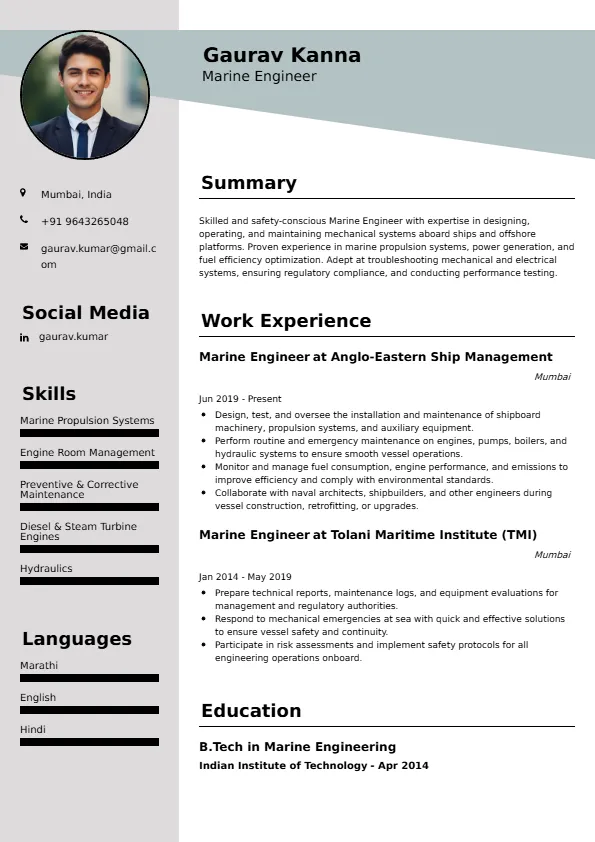
Marine Engineer
Welcome to our Marine Engineer resume sample page! This expertly crafted resume template is designed to showcase your expertise in designing, operating, and maintaining propulsion, electrical, hydraulic, and auxiliary machinery systems onboard commercial or naval vessels. Whether you work in shipbuilding, at sea (as a Chief/2nd Engineer), or in shore-based technical management, this sample highlights key skills like Ship Systems Design, STCW/IMO Compliance, Planned Maintenance System (PMS), Diesel Engine Overhaul, and Shipyard Project Management tailored to meet top maritime and naval demands. Use this guide to create a compelling resume that stands out and secures your next career opportunity.Build a Standout Marine Engineer Resume with Superbresume.com
Superbresume.com empowers Marine Engineers to craft resumes that highlight their system reliability and regulatory compliance expertise. Our platform offers customizable templates tailored for maritime roles, emphasizing skills like thermodynamics/fluid mechanics, high-voltage (HV) systems (if applicable), engine performance optimization, and drydock/refit project management. With ATS-optimized formats, expert-written content suggestions, and real-time resume analysis, we ensure your resume aligns with job descriptions. Showcase your experience in significantly reducing fuel consumption, achieving zero deficiencies during PSC/ISM audits, or leading complex machinery overhauls and maintenance periods with confidence. Superbresume.com helps you create a polished, results-driven resume that grabs hiring managers’ attention and lands interviews.
How to Write a Resume for a Marine Engineer
Craft a Targeted Summary: Write a 2-3 sentence summary highlighting your expertise in marine engineering (specify focus: shipboard operation, design, or technical management), proficiency in complex mechanical and electrical systems, and success in ensuring regulatory compliance and high system availability.
Use Reverse-Chronological Format: List recent Chief/2nd Engineer sea service, naval officer, or shore-based technical management/shipyard roles first, focusing on measurable operational, maintenance, and compliance achievements.
Highlight Certifications/CoC: Include essential credentials like STCW Chief/2nd Engineer Certificate of Competency (CoC), High Voltage (HV) Certification, Professional Engineer (PE) license (if shore-based), or specialized vessel training (e.g., LNG, Diesel-Electric) to boost credibility.
Quantify Achievements: Use metrics, e.g., “Managed the maintenance budget and overhaul schedule for a fleet of 5 vessels (30,000 GT each), achieving a 99.9% engine room availability rate,” or “Reduced vessel fuel consumption by 5% through engine performance tuning and energy efficiency measures,” to show impact.
Incorporate Keywords: Use terms like “STCW/IMO Compliance,” “Planned Maintenance System (PMS) Strategy,” “Diesel Engine Overhaul/Maintenance,” “Propulsion & Auxiliary Systems,” “High Voltage (HV) Systems,” “Engine Resource Management (ERM),” or “Drydock/Refit Project Management” from job roles for ATS.
Detail Technical Skills: List proficiency with specific machinery (e.g., 2-stroke/4-stroke engines, Gas Turbines, Steam Plants), maintenance software (AMOS, MAXIMO), diagnostic tools, power management systems (PMS), and regulatory standards (MARPOL/SOLAS) in a comprehensive skills section.
Showcase Sea Service/Projects: Highlight 3-4 key projects or sea contracts (e.g., major main engine overhaul, successful drydock period, implementation of a new PMS), detailing the vessel type, the challenge, and the quantified operational/financial result.
Emphasize Soft Skills: Include decisive leadership (engine room), systematic troubleshooting, safety commitment, financial accountability (budget/cost control), and strong teamwork/communication.
Keep It Concise: Limit your resume to 1-2 pages, focusing on relevant marine engineering, technical management, and compliance experience.
Proofread Thoroughly: Eliminate typos or jargon for a professional document.
Alternative Fuels and Decarbonization: Focus on experience operating or designing systems utilizing LNG, methanol, or ammonia (if applicable), and managing emissions reduction technology (e.g., scrubbers, selective catalytic reduction - SCR).
Diesel-Electric and Hybrid Propulsion: Highlight expertise managing complex electrical and power management systems (PMS) associated with modern diesel-electric or hybrid propulsion plants.
Digitalization and Smart Ship Systems: Showcase experience implementing and utilizing digital monitoring systems, remote diagnostics, and condition-based maintenance (CBM) strategies for machinery.
Drydock and Refit Project Management: Detail experience leading the planning, budgeting, contractor management, and execution phases of major vessel drydockings or refits.
Cybersecurity for OT (Operational Technology): Include knowledge of and experience managing the cyber risks associated with vessel control and automation systems (e.g., engine control, navigation).
Metrics-Driven Achievements: Use results like “Achieved 100% engine room availability during all critical voyages” or “Reduced maintenance costs by 15% via negotiated MRO contracts and in-house repair.”
Engine Resource Management (ERM) Leadership: Emphasize training and practical leadership in applying ERM principles to ensure efficient communication and decision-making within the engine department.
Regulatory Auditing and Compliance: Highlight experience preparing the vessel for and successfully navigating Port State Control (PSC), Flag State, and Classification Society surveys with minimal deficiencies.
20 Key Skills for a Marine Engineer Resume
| STCW CoC (Chief/2nd Engineer) | Planned Maintenance System (PMS) Strategy |
| Diesel Engine Overhaul & Maintenance (2-Stroke/4-Stroke) | High Voltage (HV) Systems & Power Management |
| Auxiliary Machinery & System Operation | Drydock & Refit Project Management |
| Regulatory Compliance (MARPOL/SOLAS/ISM) | Engine Resource Management (ERM) |
| Fuel Efficiency & Performance Optimization | Budgeting & MRO (Maintenance, Repair, Overhaul) Cost Control |
| Technical Troubleshooting & Diagnostics | Ship Systems Design & Fluid Mechanics |
| Welding/Fabrication & Workshop Skills | Condition Monitoring & Predictive Maintenance (PdM) |
| Supervisory & Team Leadership | Propulsion Systems (Shafting, Bearings, Thrusters) |
10 Do’s for a Marine Engineer Resume
Tailor Your Resume: Customize for the specific career path (e.g., emphasis on shore-based technical management, emphasis on deep-sea sailing).
Highlight Certifications/CoC: List STCW Engineer CoC (Class), HV Certification, and any relevant PE/technical management certifications prominently.
Quantify Achievements: Include metrics on fuel consumption reduction, budget size managed, system availability rate, or success rate in PSC/Flag State audits.
Use Action Verbs: Start bullet points with verbs like “managed,” “oversaw,” “optimized,” “led,” or “maintained.”
Showcase Strategic Projects: Detail the methodology and the strategic, quantified financial/operational result of 3-4 key maintenance or refit projects.
Include Soft Skills: Highlight decisive leadership, financial acumen, systematic troubleshooting, and strong regulatory compliance focus.
Optimize for ATS: Use standard maritime/engineering section titles and incorporate key regulatory and system terms.
Keep It Professional: Use a clean, consistent font and professional engineering layout.
Emphasize Systems and Compliance: Clearly articulate expertise in complex ship systems and adherence to international maritime law.
Proofread Thoroughly: Eliminate typos or jargon for a professional document.
10 Don’ts for a Marine Engineer Resume
Don’t Overload with Jargon: Avoid confusing, internal ship or company acronyms; use standardized maritime engineering and regulatory terminology.
Don’t Exceed Two Pages: Keep your resume concise, focusing on high-level operational, maintenance, and compliance leadership.
Don’t Omit Dates: Include full dates for sea service and CoC renewals.
Don’t Use Generic Templates: Tailor your resume specifically to the specialized technical and leadership duties of a Marine Engineer.
Don’t List Irrelevant Skills: Focus on propulsion, auxiliary systems, maintenance, compliance, and budget/project management.
Don’t Skip Metrics: Quantify results wherever possible; fuel efficiency, availability, and budget control are key metrics.
Don’t Use Complex Formats: Avoid highly stylized elements or confusing graphics.
Don’t Ignore Project Management: Include explicit experience leading drydock, refit, or major repair projects.
Don’t Include Outdated Experience: Omit non-maritime or non-engineering jobs over 15 years old.
Don’t Forget to Update: Refresh for new CoC upgrades, successful drydock completions, or advanced alternative fuel training.
5 FAQ's for a Marine Engineer Resume
List your sea-time categorized by vessel type (e.g., Tanker, Container) and engine size (kW/HP).
Your USCG/STCW Endorsements (e.g., 1st/2nd Assistant Engineer).
"Optimized fuel consumption by 5% through meticulous monitoring of combustion parameters."
Very. "Managed machinery overhauls and technical projects during a 30-day scheduled drydocking."
Yes. "Ensured 100% compliance with MARPOL regulations and Oil Record Book (ORB) accuracy."
Get 5x more interviews with our crafted Resumes. We make resumes that land jobs.

Get a Free Customized Cover Letter with Resume Expert Advice
with every resume order placed, you will get a free Customized Cover letter.