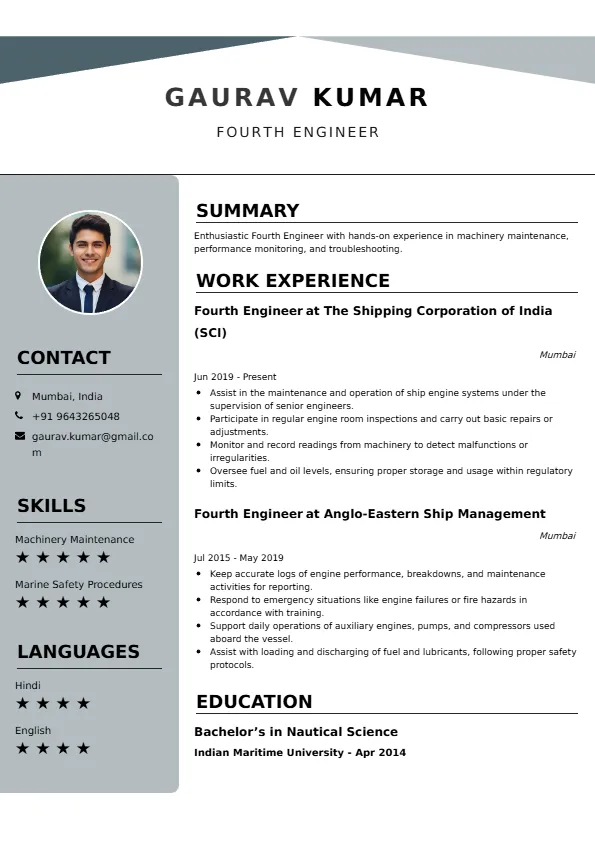
Fourth Engineer
Welcome to our Fourth Engineer resume sample page! This expertly crafted resume template is designed to showcase your expertise in assisting with watchkeeping, performing planned and unplanned maintenance on ship machinery, adhering to safety/environmental regulations, and supporting the Chief Engineer. Whether you're a recent academy graduate or an experienced junior officer, this sample highlights key skills like STCW CoC, diesel engine maintenance, auxiliary machinery operation, planned maintenance systems (PMS), and engine room safety tailored to meet top shipping and marine demands. Use this guide to create a compelling resume that stands out and secures your next career opportunity.
Superbresume.com empowers Fourth Engineers to craft resumes that highlight their practical machinery maintenance and watchkeeping competence. Our platform offers customizable templates tailored for junior officer roles, emphasizing skills like main engine systems knowledge, fuel/lube oil management, auxiliary machinery overhaul, and strict adherence to MARPOL/SOLAS/STCW compliance. With ATS-optimized formats, expert-written content suggestions, and real-time resume analysis, we ensure your resume aligns with job descriptions. Showcase your experience in maintaining assigned machinery with 100% reliability, executing detailed PM schedules, or quickly troubleshooting and repairing auxiliary equipment with confidence. Superbresume.com helps you create a polished, results-driven resume that grabs hiring managers’ attention and lands interviews.
How to Write a Resume for a Fourth Engineer
Craft a Targeted Summary: Write a 2-3 sentence summary highlighting your active STCW Third/Fourth Engineer Certificate of Competency (CoC), expertise in diesel/auxiliary machinery maintenance, proficiency in watchkeeping, and commitment to safety and regulatory compliance in the engine room.
Use Reverse-Chronological Format: List recent sea service periods and ranks held first, focusing on watch duties, hands-on maintenance, and compliance responsibilities.
Highlight Certifications/CoC: Include essential credentials like STCW Third/Fourth Engineer CoC, Engine Resource Management (ERM), High Voltage Awareness (if applicable), and all required safety/survival courses (e.g., BOSIET/HUET) to boost credibility.
Quantify Achievements: Use metrics, e.g., “Successfully stood watch (4-8) on a vessel over 15,000 GT, maintaining all engine room parameters within limits,” or “Executed 100+ preventive maintenance tasks monthly using the AMOS PMS, achieving 100% completion rate,” to show impact.
Incorporate Keywords: Use terms like “Engine Room Watchkeeping,” “Planned Maintenance System (PMS),” “Auxiliary Machinery Maintenance,” “STCW Compliance,” “MARPOL/SOLAS,” “Diesel Engine Operation,” or “Fuel/Lube Oil Management” from job descriptions for ATS.
Detail Technical Skills: List proficiency with specific machinery (e.g., Purifiers, Compressors, Pumps), maintenance software (AMOS, MAXIMO), troubleshooting methods, and basic electrical systems in a dedicated skills section.
Showcase Sea Service: Highlight specific vessel types (e.g., Container Ship, Tanker, Bulk Carrier), tonnage (GT), and the assigned watch and maintenance duties performed during sea time.
Emphasize Soft Skills: Include discipline, technical aptitude, physical stamina, systematic troubleshooting, and effective teamwork/communication within the engine department.
Keep It Concise: Limit your resume to 1-2 pages, focusing on relevant sea service, technical maintenance, and regulatory compliance.
Proofread Thoroughly: Eliminate typos or jargon for a professional document.
Planned Maintenance System (PMS) Mastery: Focus on advanced proficiency in utilizing computerized maintenance systems (AMOS, MAXIMO) for work order execution, defect reporting, and spare parts inventory management.
Environmental Compliance (MARPOL Annex VI/BWTS): Highlight hands-on experience maintaining and operating systems related to emissions reduction (e.g., scrubbers, low-sulfur fuel handling) and Ballast Water Treatment Systems (BWTS).
Condition-Based Monitoring (CBM): Showcase experience utilizing condition monitoring techniques (e.g., vibration analysis, oil sampling) to predict machinery failures and optimize PM intervals.
Troubleshooting and Root Cause Analysis (RCA): Emphasize systematic approach to troubleshooting failures in auxiliary systems and applying RCA techniques to prevent recurrence.
Fuel Efficiency and Performance Monitoring: Detail experience assisting senior engineers with monitoring and optimizing machinery performance for reduced fuel consumption and improved efficiency.
Metrics-Driven Achievements: Use results like “Successfully overhauled a major auxiliary machine (e.g., separator) resulting in 100% operational availability” or “Maintained a zero-defect record on all assigned PMs for the last contract.”
Safety Protocols and LOTO: Include active involvement in safety committees, conducting JSA (Job Safety Analysis), and adhering strictly to Lockout/Tagout (LOTO) procedures.
Electrical/Control Systems Awareness: Highlight basic knowledge of the vessel's electrical distribution, motor controls, and automation systems, complementing the ETO.
Choose Superbresume.com to craft a Fourth Engineer resume that stands out in the competitive maritime engineering field. Our platform offers tailored templates optimized for ATS, ensuring your skills in watchkeeping, PM execution, and STCW compliance shine. With expert guidance, pre-written content, and real-time feedback, we help you highlight achievements like minimizing equipment failures or maintaining perfect maintenance records. Whether you serve on tankers or container ships, our tools make it easy to create a polished, results-driven resume. Trust Superbresume.com to showcase your expertise in reliable, safe, and efficient engine room operations. Start building your career today!
20 Key Skills for a Fourth Engineer Resume
| STCW Fourth Engineer CoC | Engine Room Watchkeeping (4-8) |
| Planned Maintenance System (PMS) Execution | Diesel Engine Operation & Troubleshooting |
| Auxiliary Machinery Maintenance (Pumps/Purifiers) | MARPOL/SOLAS/STCW Compliance |
| Fuel/Lube Oil Transfer & Testing | Boiler & Steam System Operation (Basic) |
| Root Cause Analysis (RCA) of Equipment Failures | Safety Protocols (LOTO, Firefighting) |
| PMS Software (AMOS/MAXIMO) Proficiency | Engine Resource Management (ERM) |
| Mechanical Fitting & Assembly | Logbook & Record Keeping Accuracy |
| Basic Electrical Systems Troubleshooting | Inventory Management (Spares) |
| Physical Stamina & Discipline | Teamwork (Engine Dept. Hierarchy) |
10 Do’s for a Fourth Engineer Resume
Tailor Your Resume: Customize for the specific vessel type (e.g., Bulk Carrier, Chemical Tanker) and the size/type of the engine plant (2-stroke, 4-stroke).
Highlight Certifications/CoC: List active STCW Fourth Engineer CoC and all relevant endorsements prominently.
Quantify Achievements: Include metrics on GT of vessels served on, reliability of assigned machinery, successful PM completion rates, or complexity of overhauls assisted.
Use Action Verbs: Start bullet points with verbs like “maintained,” “executed,” “stood watch,” “oversaw,” or “troubleshooted.”
Showcase Sea Service: Detail the rank, vessel type, and key watchkeeping/maintenance responsibilities for each contract.
Include Soft Skills: Highlight technical aptitude, discipline, attention to detail (for readings/logs), and strong teamwork.
Optimize for ATS: Use standard maritime section titles and incorporate key engineering and regulatory terms.
Keep It Professional: Use a clean, consistent font and professional maritime layout.
Emphasize Maintenance and Watchkeeping: Clearly articulate experience performing hands-on PM and standing watch independently.
Proofread Carefully: Ensure no typos or errors in CoC details, machinery names, or regulatory compliance statements.
10 Don’ts for a Fourth Engineer Resume
Don’t Overload with Jargon: Avoid confusing, internal ship or company acronyms; use standardized marine engineering and regulatory terminology.
Don’t Exceed Two Pages: Keep your resume concise, focusing on high-level engine room competence and compliance.
Don’t Omit Dates: Include full dates for sea service, training, and CoC renewals.
Don’t Use Generic Templates: Tailor your resume specifically to the operational and maintenance duties of a Fourth Engineer.
Don’t List Irrelevant Skills: Focus on marine engineering, watchkeeping, maintenance, and safety compliance.
Don’t Skip Metrics: Quantify results wherever possible; all achievements must link back to system reliability, maintenance adherence, or safe operation.
Don’t Use Complex Formats: Avoid highly stylized elements or confusing graphics.
Don’t Ignore Regulatory Compliance: Include explicit experience with MARPOL, SOLAS, and STCW requirements.
Don’t Include Outdated Experience: Omit non-maritime or non-engineering jobs over 15 years old.
Don’t Forget to Update: Refresh for new sea contracts, successful inspections, or CoC upgrades.
5 FAQs for a Fourth Engineer Resume
Prioritize active STCW CoC, Engine Room Watchkeeping, PMS execution (AMOS/MAXIMO), and hands-on maintenance of auxiliary machinery.
Use standard maritime section titles, avoid graphics, and include keywords like “PMS,” “Auxiliary Machinery,” and “MARPOL Compliance.”
Yes, listing specific machinery types (e.g., Alfa Laval purifiers, electrically driven pumps) demonstrates practical familiarity.
Detail a process change or maintenance technique you implemented that led to a quantified reduction in PM time or improved a machine's Mean Time Between Failures (MTBF).
Use a reverse-chronological format to emphasize your most recent, high-responsibility sea service and CoC status.
Get 5x more interviews with our crafted Resumes. We make resumes that land jobs.

Get a Free Customized Cover Letter with Resume Expert Advice
with every resume order placed, you will get a free Customized Cover letter.