Foley Artist
Welcome to our Foley Artist resume sample page! This expertly crafted resume template is designed to showcase your expertise in creating, performing, and recording realistic sound effects (footsteps, props, cloth movement) synchronized to visual media (film, TV, games) in a specialized studio environment. Whether you're an entry-level technician or a seasoned professional, this sample highlights key skills like sound synchronization (syncing), acoustic manipulation, prop design/manipulation, recording studio technology (DAWs), and creative problem-solving tailored to meet top film and post-production demands. Use this guide to create a compelling resume that stands out and secures your next career opportunity.
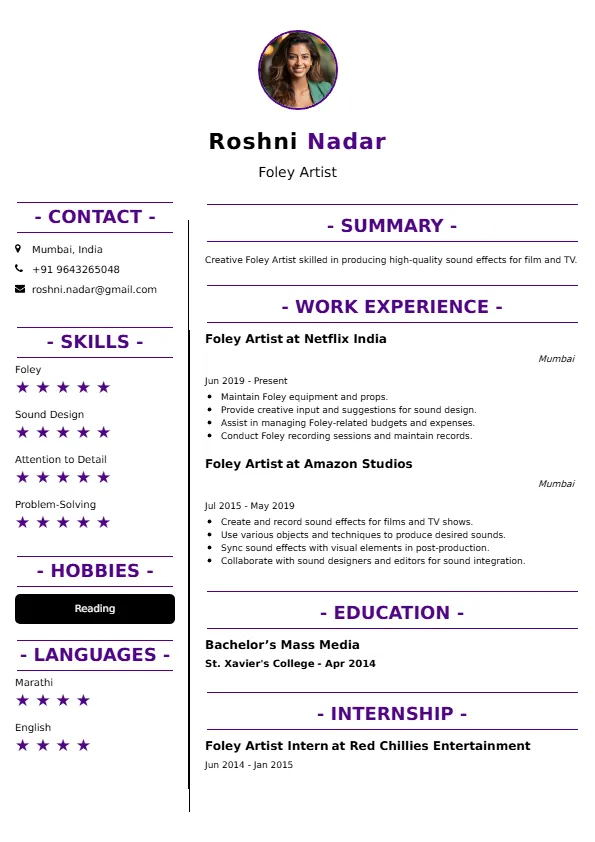
Superbresume.com empowers Foley Artists to craft resumes that highlight their creative acoustic performance and technical synchronization expertise. Our platform offers customizable templates tailored for post-production roles, emphasizing skills like advanced mic placement, digital audio workstation (DAW) proficiency, prop inventory management, and collaborative work with sound editors/mixers. With ATS-optimized formats, expert-written content suggestions, and real-time resume analysis, we ensure your resume aligns with job descriptions. Showcase your experience in successfully synchronizing complex scenes, contributing to award-winning productions, or developing unique sound solutions with confidence. Superbresume.com helps you create a polished, results-driven resume that grabs hiring managers’ attention and lands interviews.
How to Write a Resume for a Foley Artist
Use Reverse-Chronological Format: List recent Foley studio work, post-production roles, or relevant sound design projects first, focusing on measurable production contribution and complexity.
Highlight Certifications/Training: Include credentials like Audio Engineering certifications, specialized DAW training (e.g., Pro Tools Certified), or relevant film/theatre arts degrees to boost credibility.
Quantify Achievements: Use metrics, e.g., “Contributed Foley sound for 5 major feature films and 3 television series over 2 years,” or “Reduced post-production sound costs by 15% through efficient in-studio performance versus library sound use,” to show impact.
Incorporate Keywords: Use terms like “Foley Performance,” “Sound Synchronization (Syncing),” “Acoustic Manipulation,” “Digital Audio Workstation (DAW),” “Prop Design/Manipulation,” “Sound Effects (SFX),” or “Post-Production Audio” from job descriptions for ATS.
Detail Technical Skills: List proficiency with specific DAWs (Pro Tools, Logic), microphone types and placement techniques, sound editing/cleanup, and prop maintenance/inventory in a dedicated skills section.
Showcase Productions/Projects: Highlight 3-4 notable film, TV, or game projects, detailing the complexity of the sound challenge (e.g., period footsteps, fantasy creature sounds), your creative solution, and the final delivery.
Emphasize Soft Skills: Include creativity, precise timing, acute listening, physical performance ability, attention to synchronization detail, and collaborative teamwork.
Keep It Concise: Limit your resume to 1-2 pages, focusing on relevant Foley performance, recording, and post-production experience.
Proofread Thoroughly: Eliminate typos or jargon for a professional document.
Specialized Prop Development: Highlight experience creating or sourcing highly specific, non-traditional props and surfaces to achieve unique acoustic signatures for demanding projects (e.g., sci-fi, fantasy).
Game Audio Integration: Showcase experience creating loopable or interactive Foley sound effects intended for integration into game engines (e.g., Wwise, Unity) where timing is dynamic.
High-Definition and Immersive Audio: Detail experience recording and delivering Foley sounds optimized for modern formats like Dolby Atmos or other immersive audio standards.
Mic Placement and Acoustic Space: Emphasize advanced knowledge of microphone techniques and how to utilize the Foley stage’s acoustic properties to capture optimal sound realism.
Metrics-Driven Achievements: Use results like “Delivered 100% of required Foley tracks on time for a network pilot launch” or “Collaborated with sound mixers to reduce Foley track count by 20% through efficient layering.”
ADR (Automated Dialogue Replacement) Support: Include basic awareness or support experience with ADR recording and synchronization processes, as Foley often coordinates with these efforts.
Clean Recording Techniques: Highlight proficiency ensuring clean recordings free of unwanted noise, enabling seamless integration into the final mix.
Choose Superbresume.com to craft a Foley Artist resume that stands out in the competitive post-production audio industry. Our platform offers tailored templates optimized for ATS, ensuring your skills in sound synchronization, acoustic performance, and DAW proficiency shine. With expert guidance, pre-written content, and real-time feedback, we help you highlight achievements like contributing to major media projects or developing unique sound solutions. Whether you specialize in footsteps or prop manipulation, our tools make it easy to create a polished, results-driven resume. Trust Superbresume.com to showcase your expertise in bringing realism and texture to the auditory experience. Start building your career today!
20 Key Skills for a Foley Artist Resume
| Foley Performance (Live Sound Effects) | Sound Synchronization (Syncing to Picture) |
| Digital Audio Workstation (DAW) Proficiency (Pro Tools) | Prop Design & Inventory Management |
| Acoustic Manipulation & Mic Placement | Footstep Performance (Surface/Shoe Variety) |
| Cloth Movement & Body Mechanics Sound | Recording Techniques (Clean Audio Capture) |
| Sound Editing & Cleanup | Creative Problem-Solving (Sound Sourcing) |
| Audio Equipment Setup & Maintenance | Post-Production Workflow Familiarity |
| Technical Timing & Precision | Collaboration (Sound Editor/Mixer) |
| Film/TV/Game Industry Standards | Advanced Listening Skills |
| ADR (Automated Dialogue Replacement) Awareness | Sound Library Management (Basic) |
10 Do’s for a Foley Artist Resume
Tailor Your Resume: Customize for the type of media (e.g., emphasize game audio integration or feature film experience).
Highlight Certifications/Training: List audio engineering certifications or relevant Pro Tools proficiency prominently.
Quantify Achievements: Include metrics on the number of projects completed, the budget level of productions, or efficiency/cost savings achieved.
Use Action Verbs: Start bullet points with verbs like “performed,” “synchronized,” “recorded,” “created,” or “collaborated.”
Showcase Productions/Projects: Detail specific, notable media projects, emphasizing the complexity of the Foley work involved.
Include Soft Skills: Highlight precise timing, creativity, physical performance ability, and strong teamwork with the audio post team.
Optimize for ATS: Use standard production section titles and incorporate key audio technical and production terms.
Keep It Professional: Use a clean, consistent font and professional layout.
Emphasize Performance and Sync: Clearly articulate hands-on experience performing Foley effects and achieving perfect synchronization with the visual feed.
Proofread Carefully: Ensure no typos or errors in production titles or technical audio terms.
10 Don’ts for a Foley Artist Resume
Don’t Overload with Jargon: Avoid confusing, internal studio or niche audio acronyms; use standardized post-production audio terminology.
Don’t Exceed Two Pages: Keep your resume concise, focusing on relevant Foley performance and production experience.
Don’t Omit Dates: Include employment dates and project completion dates for career context.
Don’t Use Generic Templates: Tailor your resume specifically to the specialized creative and technical duties of a Foley Artist.
Don’t List Irrelevant Skills: Focus on sound, synchronization, performance, prop manipulation, and studio recording technology.
Don’t Skip Metrics: Quantify results wherever possible; link work to production volume, efficiency, or project quality.
Don’t Use Complex Formats: Avoid highly stylized elements or confusing graphics.
Don’t Ignore Technology: Include mastery of the specific DAWs and recording equipment used in Foley studios.
Don’t Include Outdated Experience: Omit non-audio or non-performance jobs over 15 years old.
Don’t Forget to Update: Refresh for new award-winning projects, advanced synchronization techniques, or mastery of new immersive audio formats.
5 FAQs for a Foley Artist Resume
Prioritize live Foley performance, precise sound synchronization, DAW proficiency (Pro Tools), and creative prop manipulation.
Use standard production section titles, avoid graphics, and include keywords like “Synchronization,” “Prop Design,” and “Post-Production Audio.”
Yes, a link to an audio or video demo reel showcasing your Foley work is highly valuable and often required.
Detail the specific challenge of a scene (e.g., complex fight choreography) and your ability to perform and record effects that perfectly sync with the visual timing.
Use a reverse-chronological format to emphasize your most recent, high-impact Foley performance and post-production achievements.
Get 5x more interviews with our crafted Resumes. We make resumes that land jobs.

Get a Free Customized Cover Letter with Resume Expert Advice
with every resume order placed, you will get a free Customized Cover letter.