Trauma Nurse
Welcome to our Trauma Nurse resume sample page! This expertly crafted resume template is designed to showcase your expertise in providing rapid, critical nursing care and stabilization for severely injured patients across the continuum of trauma care (ED, ICU, OR), adhering to strict trauma protocols, and managing complex life support interventions. Whether you work in a Level I or Level II Trauma Center, this sample highlights key skills like TNCC/ATLS Certified, Trauma Assessment (Primary/Secondary Survey), Advanced Life Support, Hemodynamic Monitoring, and Crisis Leadership tailored to meet top hospital demands. Use this guide to create a polished, results-driven resume that stands out and secures your next career opportunity.
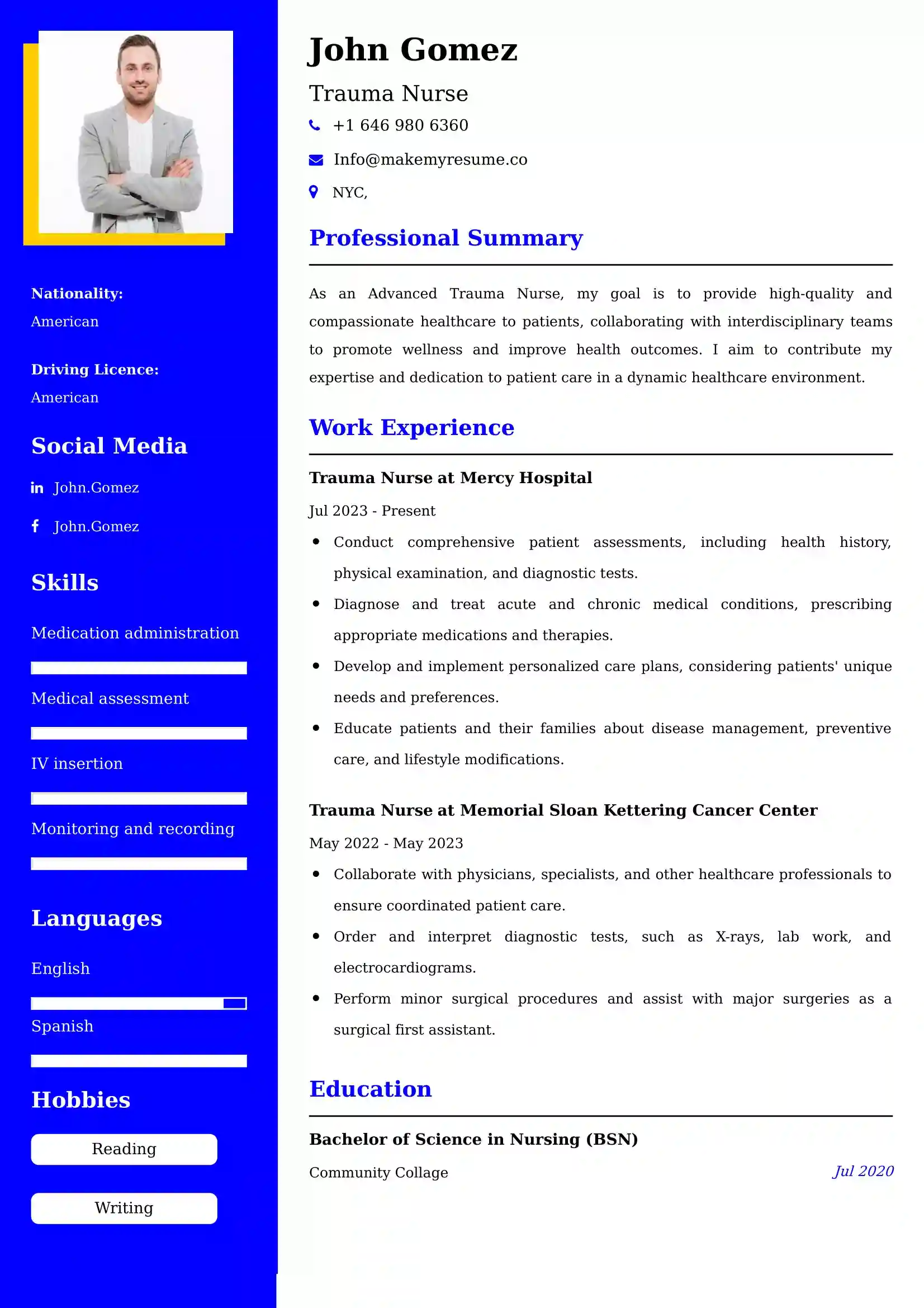
Superbresume.com empowers Trauma Nurses to craft resumes that highlight their high-acuity critical care and rapid intervention expertise. Our platform offers customizable templates tailored for specialized nursing roles, emphasizing skills like advanced hemodynamic monitoring, mechanical ventilation management, specialized trauma procedural assistance, and adherence to strict ATLS/TNCC protocols. With ATS-optimized formats, expert-written content suggestions, and real-time resume analysis, we ensure your resume aligns with job descriptions. Showcase your experience in successfully managing complex polytrauma patients, leading successful trauma team resuscitations, or contributing to quality improvement initiatives that reduced critical care time with confidence. Superbresume.com helps you create a polished, results-driven resume that grabs hiring managers’ attention and lands interviews.
How to Write a Resume for a Trauma Nurse
Craft a Targeted Summary: Write a 2-3 sentence summary highlighting your active RN licensure, extensive experience in high-acuity trauma care, proficiency in advanced life support and rapid assessment (TNCC/ATLS), and commitment to decisive, quality patient stabilization.
Use Reverse-Chronological Format: List recent Trauma Center (ED/ICU), Critical Care, or Emergency Nursing roles first, focusing on measurable patient outcome and procedural achievements.
Highlight Certifications/Licensure: Include essential credentials like Registered Nurse (RN) license, Trauma Nursing Core Course (TNCC) Certified, Advanced Trauma Life Support (ATLS) awareness/support, ACLS/PALS, or specialty certifications (e.g., CCRN, CEN) to boost credibility.
Quantify Achievements: Use metrics, e.g., “Managed care for 4-5 high-acuity trauma patients per shift (Level I Trauma Center), ensuring 100% adherence to Primary/Secondary Survey protocols,” or “Served as the primary nurse for 20+ trauma team activations monthly, reducing time-to-CT-scan by 10 minutes through streamlined triage,” to show impact.
Incorporate Keywords: Use terms like “Trauma Nursing Core Course (TNCC),” “Trauma Assessment (Primary/Secondary Survey),” “Advanced Life Support (ACLS/PALS),” “Surgical/Neuro Critical Care,” “Hemodynamic Monitoring & Titration,” “Level I/II Trauma Center Experience,” or “Rapid Stabilization & Intervention” from job descriptions for ATS.
Detail Clinical/Procedural Skills: List proficiency with specific procedures (e.g., chest tube assistance, advanced IV access, rapid infuser operation, ventilator management), EMR systems, trauma scoring (GCS, ISS), and complex medication administration in a comprehensive skills section.
Showcase Quality/Safety Initiatives: Highlight 3-4 key contributions, such as serving on the Trauma Review Committee, precepting new trauma nurses, or leading a QI project focused on reducing preventable errors or improving protocol adherence.
Emphasize Soft Skills: Include rapid critical thinking, decisive leadership (during code/trauma), emotional resilience, strong teamwork, and meticulous attention to detail (meds/vitals/documentation).
Keep It Concise: Limit your resume to 1-2 pages, focusing on relevant critical care, trauma, and procedural experience.
Proofread Thoroughly: Eliminate typos or jargon for a professional document.
Trauma Protocol Mastery (ATLS/TNCC): Focus on deep expertise executing the rapid, systematic assessment and intervention protocols required during a trauma activation, including managing massive transfusion protocols (MTP).
Advanced Monitoring and Stabilization: Highlight proficiency managing complex monitoring (invasive lines, cardiac monitoring) and titrating high-risk vasoactive medications (e.g., Levophed, Dopamine) for shock stabilization.
Specialized Resuscitation: Showcase experience managing specialized resuscitations, including burn care, neuro-trauma (ICP monitoring), and blunt/penetrating cardiac/pulmonary trauma.
Quality Improvement and Registry Data: Detail experience participating in the hospital's trauma registry data collection, chart review, and serving on QI committees to reduce complication rates (e.g., VAP, CLABSI).
Triage and Patient Flow: Emphasize expertise in rapidly triaging incoming trauma patients (START, ESI) and managing patient flow to ensure swift access to definitive care (OR/CT/Angio).
Metrics-Driven Achievements: Use results like “Successfully led 10+ MTP activations, adhering to protocol guidelines with 100% compliance” or “Reduced the unit's documented fall rate by 50% through targeted safety interventions.”
Surgical and Neuro Critical Care: Include experience managing complex post-operative trauma patients, often requiring ventilator and neuro-monitoring support (e.g., external ventricular drain - EVD).
Team Leadership and Communication: Highlight strong communication skills, ensuring clear, closed-loop communication within the multidisciplinary trauma team (MDs, RTs, OR).
Choose Superbresume.com to craft a Trauma Nurse resume that stands out in the critical care and emergency sector. Our platform offers tailored templates optimized for ATS, ensuring your skills in TNCC certification, trauma assessment, and crisis leadership shine. With expert guidance, pre-written content, and real-time feedback, we help you highlight achievements like reducing time-to-treatment or mastering complex stabilization procedures. Whether you work in the ED or ICU, our tools make it easy to create a polished, results-driven resume. Trust Superbresume.com to showcase your expertise in reliable, decisive, and high-quality trauma patient care. Start building your career today!
20 Key Skills for a Trauma Nurse Resume
| Trauma Nursing Core Course (TNCC) Certified | Trauma Assessment (Primary/Secondary Survey) |
| Advanced Life Support (ACLS/PALS) & MTP Activation | Hemodynamic Monitoring & Vasoactive Titration |
| Surgical/Neuro Critical Care Management | Rapid Triage & Stabilization |
10 Do’s for a Trauma Nurse Resume
Tailor Your Resume: Customize for the specific trauma level (Level I, II, or III) and setting (e.g., ED Trauma Bay, Surgical Trauma ICU).
Highlight Certifications/Licensure: List TNCC, ACLS/PALS, and active RN license prominently.
Quantify Achievements: Include metrics on patient acuity managed, trauma volume, protocol adherence rates, or QI project success (e.g., SSI reduction).
Use Action Verbs: Start bullet points with verbs like “stabilized,” “intervened,” “managed,” “led,” or “assessed.”
Showcase Protocol Mastery: Detail specific advanced skills and protocols utilized in trauma care (MTP, RSI assistance, damage control).
Include Soft Skills: Highlight rapid critical thinking, decisive leadership, emotional resilience, and strong teamwork.
Optimize for ATS: Use standard nursing section titles and incorporate key trauma, procedural, and certification terms.
Keep It Professional: Use a clean, consistent font and medical layout.
Emphasize Assessment and Crisis: Clearly articulate expertise in rapid, systematic assessment and managing life-threatening emergencies.
Proofread Thoroughly: Eliminate typos or jargon for a professional document.
10 Don’ts for a Trauma Nurse Resume
Don’t Overload with Jargon: Avoid confusing, internal hospital or unit acronyms; use standardized trauma and critical care terminology.
Don’t Exceed Two Pages: Keep your resume concise, focusing on high-impact trauma nursing and critical care experience.
Don’t Omit Dates: Include full dates for education, licensure, and employment for credentialing purposes.
Don’t Use Generic Templates: Tailor your resume specifically to the high-acuity, specialized duties of a Trauma Nurse.
Don’t List Irrelevant Skills: Focus on trauma care, critical monitoring, emergency procedures, and life support.
Don’t Skip Metrics: Quantify results wherever possible; link clinical work to protocol adherence, time-to-treatment, or adverse event reduction.
Don’t Use Complex Formats: Avoid highly stylized elements or confusing graphics.
Don’t Ignore Quality Improvement: Include explicit experience serving on trauma committees or leading QI projects.
Don’t Include Outdated Experience: Omit non-critical care or non-nursing jobs over 15 years old.
Don’t Forget to Update: Refresh for new certification renewals, successful QI project results, or advanced trauma training.
5 FAQs for a Trauma Nurse Resume
Prioritize TNCC certification, Trauma Assessment (Primary/Secondary), ACLS/PALS, Hemodynamic Monitoring, and Level I/II Trauma Center experience.
Use standard nursing section titles, avoid graphics, and include keywords like “TNCC,” “MTP Activation,” and “Critical Care.”
Yes, quantifying the acuity level or the volume of trauma activations managed demonstrates capacity under pressure.
Detail your role in a major trauma activation or code (e.g., primary nurse, MTP lead) and the successful, rapid stabilization achieved.
Use a reverse-chronological format to emphasize your most recent, high-acuity trauma and critical care achievements.
Get 5x more interviews with our crafted Resumes. We make resumes that land jobs.

Get a Free Customized Cover Letter with Resume Expert Advice
with every resume order placed, you will get a free Customized Cover letter.