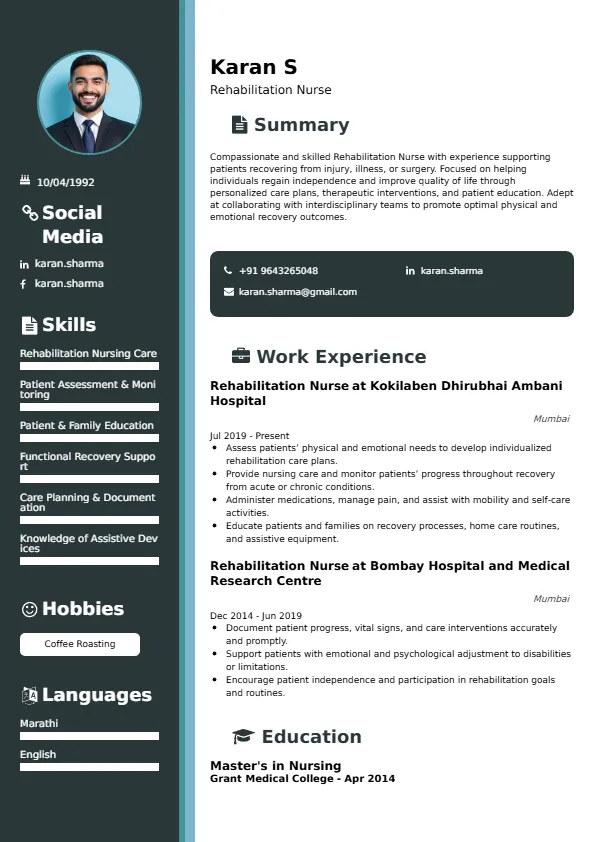
Rehabilitation Nurse
Welcome to our Rehabilitation Nurse resume sample page! This expertly crafted resume template is designed to showcase your expertise in providing holistic nursing care and education to patients with chronic illness or disability to promote functional independence, manage complex medical needs, and coordinate the interdisciplinary rehabilitation plan. Whether you work in inpatient rehab, long-term care, or home health, this sample highlights key skills like CRRN Certification, Functional Assessment (FIM), Patient/Family Education, Complex Bowel/Bladder Management, and Interdisciplinary Team Coordination tailored to meet top rehabilitation demands. Use this guide to create a polished, results-driven resume that stands out and secures your next career opportunity.
Superbresume.com empowers Rehabilitation Nurses to craft resumes that highlight their functional outcome orientation and specialized case management expertise. Our platform offers customizable templates tailored for specialty nursing roles, emphasizing skills like advanced wound/skin integrity management, ADL training support, complex medication management (Spasticity/Pain), and adherence to regulatory standards (CARF). With ATS-optimized formats, expert-written content suggestions, and real-time resume analysis, we ensure your resume aligns with job descriptions. Showcase your experience in successfully improving client functional independence scores, managing complex neurorehabilitation cases, or leading successful quality improvement initiatives focused on reducing patient readmissions with confidence. Superbresume.com helps you create a polished, results-driven resume that grabs hiring managers’ attention and lands interviews.
How to Write a Resume for a Rehabilitation Nurse
Craft a Targeted Summary: Write a 2-3 sentence summary highlighting your active RN licensure, expertise in rehabilitation nursing (CRRN), proficiency in functional assessment and complex chronic disease management, and commitment to promoting patient independence and interdisciplinary goal achievement.
Use Reverse-Chronological Format: List recent Rehabilitation, LTACH (Long-Term Acute Care Hospital), or relevant chronic care nursing roles first, focusing on measurable functional outcomes and case management achievements.
Highlight Certifications/Licensure: Include essential credentials like Certified Rehabilitation Registered Nurse (CRRN), Registered Nurse (RN) license, BLS/CPR, specialty training (e.g., Wound Care, Neurorehab), or relevant Bachelor’s/Master’s Degree to boost credibility.
Quantify Achievements: Use metrics, e.g., “Managed a caseload of 8-10 patients (e.g., CVA, SCI, Amputee), contributing to an average 10-point gain in FIM/IRF-PAI scores per episode of care,” or “Reduced pressure ulcer incidents by 20% through consistent skin assessment and turning protocol implementation,” to show impact.
Incorporate Keywords: Use terms like “CRRN Certified,” “Functional Assessment (FIM/IRF-PAI),” “Interdisciplinary Care Planning,” “Patient/Family Education (ADLs/Meds),” “Bowel & Bladder Management,” “Neurorehabilitation/Spinal Cord Injury (SCI),” or “Quality Improvement (QI)” from job descriptions for ATS.
Detail Clinical/Procedural Skills: List proficiency with specific procedures (e.g., complex wound care, tracheostomy care, G-tube feeding), EMR systems, rehabilitation equipment (lifts, ambulation aids), and strong documentation standards in a comprehensive skills section.
Showcase Quality/Program Initiatives: Highlight 3-4 key contributions, such as serving on the Rehabilitation Outcomes Committee, precepting new nurses, or leading a QI project focused on improving discharge planning compliance or reducing urinary tract infections (UTIs).
Emphasize Soft Skills: Include patience, motivational coaching, strong communication (patient/family/therapy team), functional outcomes orientation, and attention to detail.
Keep It Concise: Limit your resume to 1-2 pages, focusing on relevant rehabilitation nursing, functional independence, and case management experience.
Proofread Thoroughly: Eliminate typos or jargon for a professional document.
Functional Outcomes Tracking (IRF-PAI/FIM): Focus on expertise utilizing standardized assessment tools (IRF-PAI, FIM) to track and document measurable functional gains and justify ongoing rehabilitation services to payers.
Interdisciplinary Team (IDT) Leadership: Highlight experience leading or significantly contributing to the weekly IDT meeting, coordinating medical and therapy goals, and educating the patient on the comprehensive care plan.
Bowel and Bladder Retraining Programs: Showcase specialized knowledge and skills in managing complex neurogenic bowel and bladder dysfunction (e.g., intermittent catheterization, scheduled voiding), crucial for independence.
Patient and Family Education for Independence: Detail advanced proficiency in teaching patients and their families self-care skills, adaptive equipment use, medication management, and home exercise program adherence for successful discharge.
Specialized Neurorehabilitation Protocols: Emphasize clinical experience and training in managing patients with specific neurological deficits (e.g., stroke, TBI, SCI), applying neurorehabilitation principles.
Metrics-Driven Achievements: Use results like “Achieved 90% of patients discharged to home rather than a skilled nursing facility (SNF)” or “Increased patient self-management compliance of ostomy care by 20% through targeted education.”
Regulatory Compliance (CARF, CMS): Include experience adhering to the strict regulatory and accreditation standards set by organizations like CARF (Commission on Accreditation of Rehabilitation Facilities) and CMS.
Advanced Skin and Wound Management: Highlight expertise in preventing and treating pressure injuries, managing complex wound care protocols, and assessing nutritional status relevant to healing.
Choose Superbresume.com to craft a Rehabilitation Nurse resume that stands out in the specialized restorative care sector. Our platform offers tailored templates optimized for ATS, ensuring your skills in CRRN certification, functional assessment, and interdisciplinary coordination shine. With expert guidance, pre-written content, and real-time feedback, we help you highlight achievements like improving FIM scores or reducing pressure ulcer incidents. Whether you work in spinal cord injury or orthopedic rehab, our tools make it easy to create a polished, results-driven resume. Trust Superbresume.com to showcase your expertise in reliable, outcomes-focused, and compassionate restorative nursing. Start building your career today!
20 Key Skills for a Rehabilitation Nurse Resume
| Certified Rehabilitation Registered Nurse (CRRN) | Functional Assessment (FIM/IRF-PAI) & Goal Setting |
| Interdisciplinary Care Planning & Coordination (IDT) | Complex Bowel/Bladder Management |
| Patient/Family Education for Independence (ADLs) | Neurorehabilitation/Spinal Cord Injury (SCI) Care |
10 Do’s for a Rehabilitation Nurse Resume
Tailor Your Resume: Customize for the specific rehabilitation setting (e.g., acute inpatient rehab, skilled nursing, specialized outpatient).
Highlight Certifications/Licensure: List CRRN certification, active RN license, and relevant specialty training prominently.
Quantify Achievements: Include metrics on patient functional independence gain (FIM/IRF-PAI scores), pressure ulcer reduction rates, successful discharge to home percentage, or caseload size managed.
Use Action Verbs: Start bullet points with verbs like “rehabilitated,” “coordinated,” “educated,” “managed,” or “promoted.”
Showcase Functional Outcomes: Detail the methodology and the strategic, quantified functional independence result of 3-4 key nursing interventions.
Include Soft Skills: Highlight patience, motivational coaching, strong communication (IDT), and functional outcomes orientation.
Optimize for ATS: Use standard nursing section titles and incorporate key CRRN, functional, and regulatory terms.
Keep It Professional: Use a clean, consistent font and medical layout.
Emphasize IDT and Functional Goals: Clearly articulate expertise in working with therapists to maximize patient independence.
Proofread Thoroughly: Eliminate typos or jargon for a professional document.
10 Don’ts for a Rehabilitation Nurse Resume
Don’t Overload with Jargon: Avoid confusing, internal facility or unit acronyms; use standardized rehabilitation and functional assessment terminology (CARF).
Don’t Exceed Two Pages: Keep your resume concise, focusing on high-impact rehabilitation nursing and case management experience.
Don’t Omit Dates: Include full dates for education, licensure, and employment for credentialing purposes.
Don’t Use Generic Templates: Tailor your resume specifically to the specialized restorative and functional duties of a Rehabilitation Nurse.
Don’t List Irrelevant Skills: Focus on functional assessment, ADL training, chronic disease management, and team coordination.
Don’t Skip Metrics: Quantify results wherever possible; link clinical work to functional scores (FIM), complication rates, or discharge success.
Don’t Use Complex Formats: Avoid highly stylized elements or confusing graphics.
Don’t Ignore Regulatory Compliance: Include explicit experience adhering to CARF and CMS documentation standards.
Don’t Include Outdated Experience: Omit non-rehab or non-nursing jobs over 15 years old.
Don’t Forget to Update: Refresh for new CRRN certification, successful QI project results, or advanced specialty training.
5 FAQ's for a Rehabilitation Nurse Resume
Use specific scoring systems: "Improved patient FIM (Functional Independence Measure) scores by an average of 15 points through tailored mobility and self-care training."
Yes. Create a "Clinical Focus" section for Stroke, Spinal Cord Injury (SCI), Traumatic Brain Injury (TBI), and Orthopedic recovery.
The CRRN (Certified Rehabilitation Registered Nurse) is the industry standard and should be prominently displayed.
"Chaired weekly IDT (Interdisciplinary Team) meetings, coordinating care plans with OTs, PTs, SLPs, and Physiatrists."
Yes. These are core competencies in rehab. State your expertise in "implementing and managing neurogenic bowel and bladder protocols."
Get 5x more interviews with our crafted Resumes. We make resumes that land jobs.

Get a Free Customized Cover Letter with Resume Expert Advice
with every resume order placed, you will get a free Customized Cover letter.