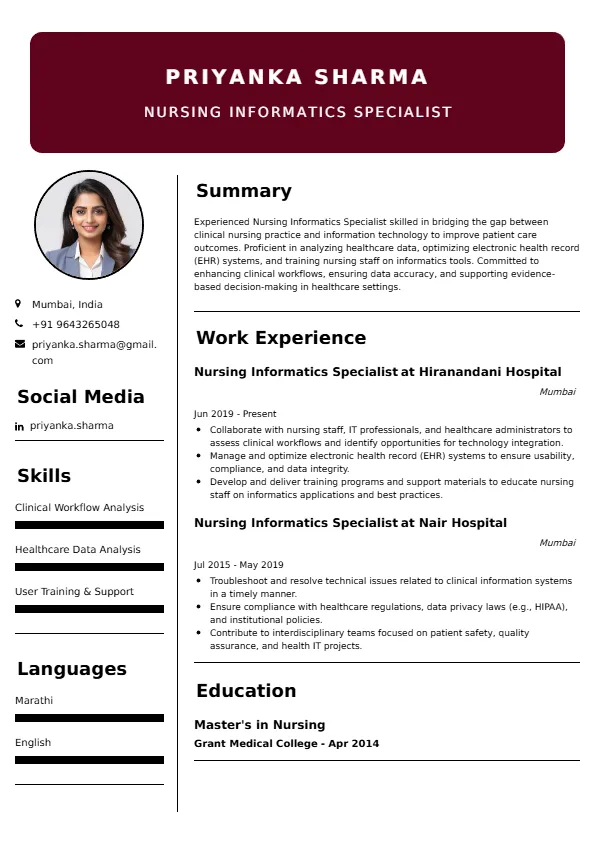
Nursing Informatics Specialist
Welcome to our Nursing Informatics Specialist resume sample page! This expertly crafted resume template is designed to showcase your expertise in integrating nursing science with computer science and information science to manage and communicate data, information, and knowledge in nursing practice. Whether you focus on EMR optimization, clinical documentation, or system implementation, this sample highlights key skills like EMR/EHR Configuration (Epic/Cerner), Clinical Workflow Design, Data Analysis (SQL/BI), Training & Adoption, and Regulatory Compliance (Meaningful Use/HIPAA) tailored to meet top hospital and health system demands. Use this guide to create a compelling resume that stands out and secures your next career opportunity.
Superbresume.com empowers Nursing Informatics Specialists to craft resumes that highlight their clinical workflow optimization and system implementation expertise. Our platform offers customizable templates tailored for health IT roles, emphasizing skills like clinical documentation template design, user acceptance testing (UAT), interoperability standards (HL7/FHIR), and data quality governance. With ATS-optimized formats, expert-written content suggestions, and real-time resume analysis, we ensure your resume aligns with job descriptions. Showcase your experience in successfully leading EMR module implementations, significantly reducing nursing documentation time, or improving clinical data capture accuracy that supported quality metrics with confidence. Superbresume.com helps you create a polished, results-driven resume that grabs hiring managers’ attention and lands interviews.
How to Write a Resume for a Nursing Informatics Specialist
Craft a Targeted Summary: Write a 2-3 sentence summary highlighting your active RN licensure, expertise in clinical informatics and EMR system configuration, and success in optimizing nursing workflow, improving data integrity, and driving clinical technology adoption.
Use Reverse-Chronological Format: List recent Informatics, Clinical Analyst, or IT nursing roles first, focusing on measurable system improvement and clinical workflow achievements.
Highlight Certifications/Training: Include credentials like Registered Nurse (RN) license, ANCC Board Certified in Informatics Nursing (RN-BC), CPHIMS, or EMR vendor-specific certifications (Epic/Cerner certification) to boost credibility.
Quantify Achievements: Use metrics, e.g., “Led the optimization of nursing documentation templates, reducing charting time by an average of 30 minutes per shift across 5 units,” or “Managed the implementation of a new EMR module (e.g., e-MAR), achieving 98% user adoption within 60 days,” to show impact.
Incorporate Keywords: Use terms like “EMR/EHR Configuration (Epic/Cerner),” “Clinical Workflow Optimization,” “Informatics Nursing (RN-BC),” “User Acceptance Testing (UAT),” “Data Quality & Governance,” “System Implementation & Training,” or “Interoperability (HL7/FHIR)” from job descriptions for ATS.
Detail Technical/Clinical Skills: List proficiency with specific EMR modules, project management methodology (Agile), data analysis tools (SQL/BI), clinical documentation standards, and strong communication (translating clinical needs to IT) in a dedicated skills section.
Showcase Informatics Projects: Highlight 3-4 key projects (e.g., EMR upgrade support, clinical decision support implementation, quality metric dashboard design), detailing the clinical challenge, the system solution implemented, and the quantified efficiency/quality result.
Emphasize Soft Skills: Include analytical problem-solving, strong communication (translator role), change management, attention to detail (system configuration), and clinical credibility.
Keep It Concise: Limit your resume to 1-2 pages, focusing on relevant informatics, system management, and clinical workflow expertise.
Proofread Thoroughly: Eliminate typos or jargon for a professional document.
Clinical Decision Support (CDS) Implementation: Focus on designing and configuring alerts, order sets, and documentation tools within the EMR to integrate evidence-based practice (EBP) and improve clinical outcomes (e.g., Sepsis alerts).
Interoperability and Data Exchange (FHIR): Highlight expertise managing data flow between systems (e.g., bedside devices, labs, external registries) and utilizing modern standards like HL7 and FHIR.
EMR Optimization for Nursing Efficiency: Showcase success in redesigning nursing documentation screens, medication administration workflows (e-MAR), and charting processes to maximize time at the bedside and reduce documentation burden.
Training and Change Management Leadership: Detail experience leading large-scale training efforts for EMR rollouts, utilizing adult learning principles, and managing clinical resistance to new technology adoption.
Data Quality and Reporting for Quality Metrics: Emphasize expertise ensuring clinical data is captured accurately at the point of care to support mandatory reporting (e.g., CMS Core Measures, Magnet status) and drive QI initiatives.
Metrics-Driven Achievements: Use results like “Improved compliance with a critical order set from 60% to 95% via EMR design changes” or “Reduced nursing shift documentation time by 20% through smart phrase development.”
Telehealth and Virtual Care Technology: Include experience supporting the technical implementation and training required for nurses to utilize virtual care platforms and remote patient monitoring tools.
Project Management and UAT Leadership: Highlight experience leading User Acceptance Testing (UAT) for system upgrades and utilizing project management methodologies (Agile/Waterfall) for system implementation projects.
Choose Superbresume.com to craft a Nursing Informatics Specialist resume that stands out in the competitive health IT sector. Our platform offers tailored templates optimized for ATS, ensuring your skills in RN-BC certification, EMR configuration, and clinical workflow design shine. With expert guidance, pre-written content, and real-time feedback, we help you highlight achievements like reducing charting time or improving clinical data accuracy. Whether you specialize in Epic or Cerner, our tools make it easy to create a polished, results-driven resume. Trust Superbresume.com to showcase your expertise in leveraging technology to optimize nursing practice and enhance patient care. Start building your career today!
20 Key Skills for a Nursing Informatics Specialist Resume
| Informatics Nursing (RN-BC) & Clinical Expertise | EMR/EHR Configuration (Epic/Cerner/Meditech) |
| Clinical Workflow Analysis & Optimization | Clinical Decision Support (CDS) Implementation |
| User Acceptance Testing (UAT) & Quality Assurance | System Implementation & Upgrade Support |
| Nursing Documentation Template Design | Training & User Adoption Strategy (Change Management) |
| Interoperability Standards (HL7/FHIR) | Data Quality & Governance (Clinical) |
| Project Management (Agile/Waterfall) | Data Analysis & Reporting (SQL/BI for Clinical Metrics) |
10 Do’s for a Nursing Informatics Specialist Resume
Tailor Your Resume: Customize for the specific EMR/EHR system (e.g., emphasize Epic certification, emphasize Cerner build experience) and the informatics focus (e.g., clinical documentation, analytics).
Highlight Certifications/Licensure: List Active RN license and Informatics Certification (RN-BC, CPHIMS) prominently.
Quantify Achievements: Include metrics on documentation time reduction, user adoption rate, compliance score improvement driven by system changes, or number of modules implemented.
Use Action Verbs: Start bullet points with verbs like “optimized,” “configured,” “implemented,” “led,” or “analyzed.”
Showcase Informatics Projects: Detail the methodology and the strategic, quantified efficiency/quality result of 3-4 key EMR/workflow projects.
Include Soft Skills: Highlight analytical problem-solving, strong communication (clinical/technical translation), change management, and clinical credibility.
Optimize for ATS: Use standard medical/IT section titles and incorporate key informatics, EMR, and regulatory terms.
Keep It Professional: Use a clean, consistent font and professional layout.
Emphasize Clinical and Technical Bridge: Clearly articulate expertise in bridging the gap between clinical needs and technical system solutions.
Proofread Thoroughly: Eliminate typos or jargon for a professional document.
10 Don’ts for a Nursing Informatics Specialist Resume
Don’t Overload with Jargon: Avoid confusing, internal hospital or system acronyms; use standardized EMR and informatics terminology.
Don’t Exceed Two Pages: Keep your resume concise, focusing on high-impact informatics, system management, and workflow achievements.
Don’t Omit Dates: Include employment dates for career context.
Don’t Use Generic Templates: Tailor your resume specifically to the specialized, dual role of a Nursing Informatics Specialist.
Don’t List Irrelevant Skills: Focus on nursing informatics, EMR configuration, workflow, data analysis, and system implementation.
Don’t Skip Metrics: Quantify results wherever possible; link achievements to efficiency, adoption rates, or quality data capture.
Don’t Use Complex Formats: Avoid highly stylized elements or confusing graphics.
Don’t Ignore Clinical Knowledge: Include explicit experience applying nursing knowledge to system design (EBP integration).
Don’t Include Outdated Experience: Omit non-nursing or low-level IT jobs over 15 years old.
Don’t Forget to Update: Refresh for new EMR certification, successful workflow optimization projects, or advanced data governance training.
5 FAQs for a Nursing Informatics Specialist Resume
Prioritize active RN license, Informatics Certification (RN-BC), EMR configuration (Epic/Cerner), clinical workflow analysis/optimization, and system implementation/UAT.
Use standard informatics/IT section titles, avoid graphics, and include keywords like “RN-BC,” “Clinical Workflow,” and “EMR Configuration.”
Yes, quantifying efficiency gains (time saved, cost reduction) or the size of the project budget managed demonstrates impact.
Detail the manual or inefficient clinical process, the EMR change implemented (e.g., customized template), and the resulting quantified time savings for nurses.
Use a reverse-chronological format to emphasize your most recent, high-impact informatics and system management achievements.
Get 5x more interviews with our crafted Resumes. We make resumes that land jobs.

Get a Free Customized Cover Letter with Resume Expert Advice
with every resume order placed, you will get a free Customized Cover letter.