Neonatal Nurse
Welcome to our Neonatal Nurse (NICU) resume sample page! This expertly crafted resume template is designed to showcase your expertise in providing specialized care for critically ill and premature newborns, managing complex medical technology, conducting advanced assessments, and supporting families in a Neonatal Intensive Care Unit (NICU). Whether you work in a Level II or Level IV NICU, this sample highlights key skills like NRP/ACLS Certified, Advanced Monitoring (Ventilators, Hemodynamics), Complex Infusion Management, Family-Centered Care, and Infection Control tailored to meet top hospital demands. Use this guide to create a compelling resume that stands out and secures your next career opportunity.
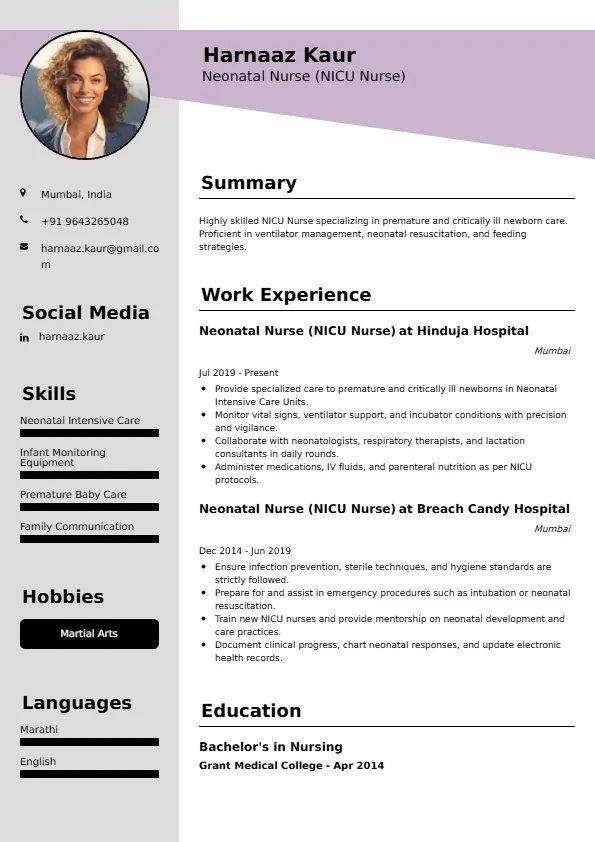
Superbresume.com empowers Neonatal Nurses to craft resumes that highlight their specialized critical care and advanced technology expertise. Our platform offers customizable templates tailored for high-acuity nursing roles, emphasizing skills like therapeutic hypothermia management, advanced ventilatory support (HFOV/Oscillator), infection prevention (CLABSI/CAUTI), and evidence-based practice (NANN/AWHONN). With ATS-optimized formats, expert-written content suggestions, and real-time resume analysis, we ensure your resume aligns with job descriptions. Showcase your experience in consistently achieving low complication rates, managing complex cases (e.g., extreme prematurity), or leading successful quality improvement initiatives with confidence. Superbresume.com helps you create a polished, results-driven resume that grabs hiring managers’ attention and lands interviews.
How to Write a Resume for a Neonatal Nurse
Craft a Targeted Summary: Write a 2-3 sentence summary highlighting your active RN licensure, extensive experience in high-acuity Neonatal Intensive Care (NICU), proficiency in advanced life support and complex technology management, and commitment to safe, family-centered patient outcomes.
Use Reverse-Chronological Format: List recent NICU, pediatric ICU, or critical care nursing roles first, focusing on patient acuity level and specialized procedural achievements.
Highlight Certifications/Licensure: Include essential credentials like Registered Nurse (RN) license, Neonatal Resuscitation Program (NRP) Certified, RNC-NIC (Neonatal Intensive Care Certification), ACLS/PALS (if relevant), or specialized training (e.g., ECLS/ECMO transport) to boost credibility.
Quantify Achievements: Use metrics, e.g., “Managed a caseload averaging 1:1 or 1:2 acuity (Level IV NICU), ensuring zero critical adverse events over 3 years,” or “Reduced CLABSI (Central Line-Associated Bloodstream Infection) rate by 30% through strict adherence to insertion and maintenance bundles,” to show impact.
Incorporate Keywords: Use terms like “Neonatal Intensive Care Unit (NICU),” “NRP Certified,” “Advanced Ventilatory Support (HFOV/Conventional),” “Complex Infusion Management (TPN, Vasoactives),” “Therapeutic Hypothermia,” “Family-Centered Care,” or “Level III/IV Acuity” from job descriptions for ATS.
Detail Clinical/Procedural Skills: List proficiency with specific procedures (e.g., umbilical catheterization assistance, chest tube monitoring, intubation assistance), EMR systems, advanced monitoring equipment, and specialized NICU protocols in a comprehensive skills section.
Showcase Quality/Safety Initiatives: Highlight 3-4 key contributions, such as serving on the Infection Control Committee, precepting new graduate nurses, or leading a QI project focused on feeding intolerance or skin integrity.
Emphasize Soft Skills: Include rapid, precise assessment, emotional support (for families), attention to detail (meds/drips), strong teamwork (with neonatologists/RTs), and resilience.
Keep It Concise: Limit your resume to 1-2 pages, focusing on relevant neonatal critical care, procedural, and safety experience.
Proofread Thoroughly: Eliminate typos or jargon for a professional document.
Extremely Low Birth Weight (ELBW) Care: Focus on advanced skills and experience managing the unique challenges (thermoregulation, fluid balance, nutrition) of extremely premature infants (ELBW).
Advanced Respiratory Support: Highlight expertise managing complex mechanical ventilation modes, high-frequency oscillatory ventilation (HFOV), and administering pulmonary vasodilators/surfactant.
Infection Prevention Protocols: Showcase leadership and compliance with NICU-specific infection prevention bundles (CLABSI, CAUTI, VAP), demonstrating success in achieving rates below national benchmarks.
Family-Centered Care (FCC): Emphasize involvement in fostering FCC principles, facilitating bonding, promoting parent education (feeding, safe sleep), and integrating families into the care team.
Therapeutic Hypothermia: Detail experience managing the cooling and rewarming protocols for newborns with hypoxic-ischemic encephalopathy (HIE).
Metrics-Driven Achievements: Use results like “Served as a clinical preceptor for 10 new NICU nurses over 2 years” or “Achieved a 95% compliance rate on the unit’s standardized feeding protocol, reducing NEC risk.”
Telehealth and Follow-up Support: Include experience utilizing virtual platforms for developmental follow-up appointments and family support post-discharge.
Medication Administration and Calculation: Highlight meticulous attention to high-risk medication administration (e.g., TPN, vasoactives) and competence in complex pediatric/neonatal dose calculations.
Choose Superbresume.com to craft a Neonatal Nurse resume that stands out in the specialized critical care transport sector. Our platform offers tailored templates optimized for ATS, ensuring your skills in RNC-NIC certification, advanced technology, and family-centered care shine. With expert guidance, pre-written content, and real-time feedback, we help you highlight achievements like reducing infection rates or managing extreme prematurity cases. Whether you work in a Level II or Level IV NICU, our tools make it easy to create a polished, results-driven resume. Trust Superbresume.com to showcase your expertise in decisive, compassionate, and high-quality neonatal critical care. Start building your career today!
20 Key Skills for a Neonatal Nurse Resume
| RNC-NIC Certification (Neonatal Intensive Care) | NRP (Neonatal Resuscitation Program) Certified |
| Advanced Ventilatory Support (HFOV/Conventional) | Complex Infusion & Medication Management (TPN/Drips) |
| Family-Centered Care (FCC) & Parent Education | Infection Prevention (CLABSI/CAUTI/Bundle Adherence) |
| Extreme Prematurity & ELBW Care | Hemodynamic Monitoring & Vasoactive Administration |
| Neonatal Assessment & Diagnostics | Therapeutic Hypothermia Protocol Management |
| Umbilical Catheter/Central Line Assistance | EMR Documentation & Flowsheet Management |
| Cross-Functional Collaboration (Neonatology/RT) | High-Acuity Triage & Stabilization |
10 Do’s for a Neonatal Nurse Resume
Tailor Your Resume: Customize for the specific NICU level (Level II, III, or IV) and patient population focus (e.g., surgical, cardiac).
Highlight Certifications/Licensure: List active RN license, RNC-NIC, and NRP certification prominently.
Quantify Achievements: Include metrics on patient acuity level managed, infection rate reduction (CLABSI/CAUTI), or successful QI project results.
Use Action Verbs: Start bullet points with verbs like “managed,” “stabilized,” “monitored,” “educated,” or “reduced.”
Showcase Advanced Care: Detail specific advanced skills required in the NICU (vent management, complex infusion, therapeutic hypothermia).
Include Soft Skills: Highlight rapid, precise assessment, emotional support (for families), and strong teamwork.
Optimize for ATS: Use standard nursing section titles and incorporate key neonatal, procedural, and certification terms.
Keep It Professional: Use a clean, consistent font and medical layout.
Emphasize Acuity and Technology: Clearly articulate expertise in caring for the most fragile newborns and operating complex life support equipment.
Proofread Thoroughly: Eliminate typos or jargon for a professional document.
10 Don’ts for a Neonatal Nurse Resume
Don’t Overload with Jargon: Avoid confusing, internal hospital or unit acronyms; use standardized neonatal and nursing terminology (NANN, AWHONN).
Don’t Exceed Two Pages: Keep your resume concise, focusing on high-acuity neonatal nursing and specialized procedural experience.
Don’t Omit Dates: Include full dates for education, licensure, and employment for credentialing purposes.
Don’t Use Generic Templates: Tailor your resume specifically to the high-stakes, specialized duties of a Neonatal Nurse.
Don’t List Irrelevant Skills: Focus on neonatal critical care, advanced technology, infection control, and family support.
Don’t Skip Metrics: Quantify results wherever possible; link clinical work to infection rates, acuity level, or successful QI projects.
Don’t Use Complex Formats: Avoid highly stylized elements or confusing graphics.
Don’t Ignore Family Support: Include explicit experience in providing family-centered care and education.
Don’t Include Outdated Experience: Omit non-critical care or non-nursing jobs over 15 years old.
Don’t Forget to Update: Refresh for new certification renewals, successful QI project results, or advanced specialty training.
5 FAQs for a Neonatal Nurse Resume
Prioritize active RNC-NIC certification, NRP certification, advanced ventilatory support (HFOV), complex infusion management, and infection prevention expertise.
Use standard nursing section titles, avoid graphics, and include keywords like “RNC-NIC,” “NRP,” and “CLABSI Prevention.”
Yes, listing the NICU level (Level III/IV) or the average patient acuity ratio demonstrates experience with high-stakes cases.
Detail a specific bundle or protocol you enforced (e.g., CLABSI prevention) and the resulting quantified reduction in the infection rate.
Use a reverse-chronological format to emphasize your most recent, high-acuity neonatal critical care and procedural achievements.
Get 5x more interviews with our crafted Resumes. We make resumes that land jobs.

Get a Free Customized Cover Letter with Resume Expert Advice
with every resume order placed, you will get a free Customized Cover letter.