Licensed Practical Nurse (LPN)
Welcome to our Licensed Practical Nurse (LPN) resume sample page! This expertly crafted resume template is designed to showcase your expertise in providing direct patient care, administering medications, monitoring vital signs, assisting with procedures, and performing accurate documentation under the supervision of an RN or physician. Whether you work in long-term care, clinics, or home health, this sample highlights key skills like Medication Administration, Vitals Monitoring, Basic Wound Care, EMR Documentation, and patient safety protocols tailored to meet top healthcare demands. Use this guide to create a compelling resume that stands out and secures your next career opportunity.
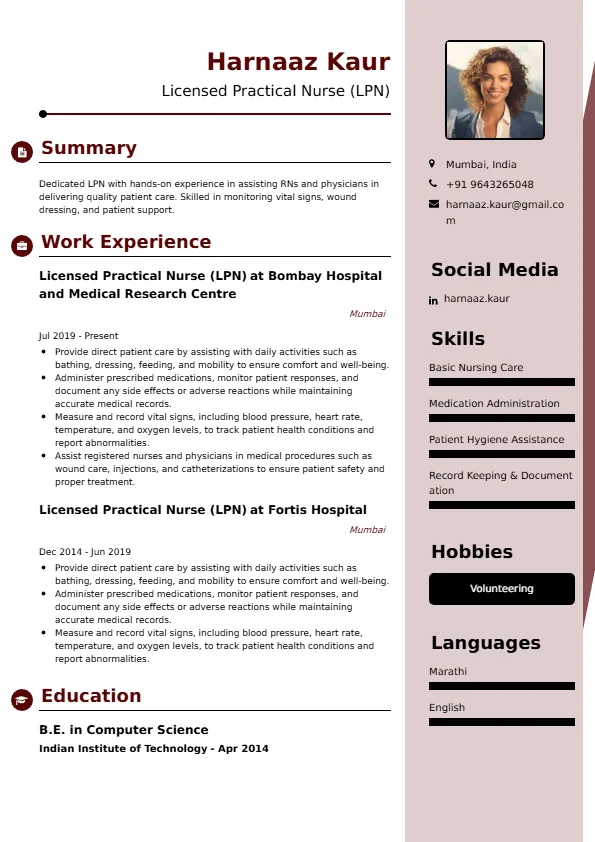
Superbresume.com empowers LPNs to craft resumes that highlight their competent direct patient care and medication administration expertise. Our platform offers customizable templates tailored for nursing roles, emphasizing skills like basic assessment, IV therapy initiation (where permitted), infection control, and communication with RNs/physicians. With ATS-optimized formats, expert-written content suggestions, and real-time resume analysis, we ensure your resume aligns with job descriptions. Showcase your experience in consistently achieving high patient satisfaction scores, maintaining flawless medication administration records, or managing a high volume of stable patients efficiently with confidence. Superbresume.com helps you create a polished, results-driven resume that grabs hiring managers’ attention and lands interviews.
How to Write a Resume for a Licensed Practical Nurse (LPN)
Craft a Targeted Summary: Write a 2-3 sentence summary highlighting your active LPN licensure, extensive experience in direct patient care (e.g., long-term care, clinic), proficiency in medication administration and basic assessment, and commitment to patient safety and accurate documentation.
Use Reverse-Chronological Format: List recent LPN, nursing assistant, or relevant clinical roles first, focusing on measurable patient care and procedural achievements.
Highlight Certifications/Licensure: Include essential credentials like Active LPN/LVN License (State-Specific), BLS/CPR Certification, IV Therapy Certification (if applicable), or specialized training (e.g., Wound Care, Phlebotomy) to boost credibility.
Quantify Achievements: Use metrics, e.g., “Administered medication to a 30-patient load per shift with 100% adherence to the five rights and zero errors,” or “Reduced wound care treatment time by 10% through streamlined supply management and documentation,” to show impact.
Incorporate Keywords: Use terms like “Medication Administration (Oral/IM/SubQ),” “Basic Patient Assessment,” “Vital Signs Monitoring,” “Wound Care (Basic),” “EMR Documentation (Chart Audits),” “LPN/LVN License,” or “Patient Safety Protocols” from job descriptions for ATS.
Detail Clinical/Procedural Skills: List proficiency with specific tasks (e.g., foley insertion, G-tube feeding, simple dressing changes, blood glucose monitoring), EMR systems, and infection control techniques in a comprehensive skills section.
Showcase Unit Contributions: Highlight 3-4 key responsibilities or projects, such as serving as charge nurse (if permitted), precepting new CNAs, or leading a quality improvement effort related to patient falls or pressure ulcers.
Emphasize Soft Skills: Include empathy, patience, strong observational skills, precise attention to detail (medication/vitals), and teamwork (with RNs/CNAs).
Keep It Concise: Limit your resume to 1-2 pages, focusing on relevant licensed nursing, procedural, and patient safety experience.
Proofread Thoroughly: Eliminate typos or jargon for a professional document.
EMR Documentation and Efficiency: Focus on proficiency utilizing Electronic Medical Records (EMR) for efficient charting, medication administration records (MAR), and accurate input of vital signs and patient observations.
IV Therapy Proficiency: Highlight specific training and state-authorized experience initiating IV fluids, monitoring sites, and administering non-IV push medications (where legally permitted).
Quality Metrics and Fall/Wound Prevention: Showcase involvement in implementing nursing protocols aimed at reducing common risks, such as fall prevention strategies or pressure ulcer monitoring/management.
Patient and Caregiver Education: Detail proficiency in teaching patients and their families about common disease management, medication schedules, and post-discharge care instructions.
Infection Control and Aseptic Technique: Emphasize strict adherence to hand hygiene, isolation protocols, and meticulous aseptic technique for wound care or catheter insertions.
Metrics-Driven Achievements: Use results like “Maintained zero medication errors over 3 consecutive years of practice” or “Increased patient satisfaction scores with pain management by 5 points.”
Telehealth and Remote Monitoring Support: If applicable, include experience assisting with setting up and monitoring stable patients using remote patient monitoring devices in home health or clinic settings.
Delegation and Supervision: Highlight experience (where legally permitted) in supervising Certified Nursing Assistants (CNAs) and delegating routine patient care tasks.
Choose Superbresume.com to craft an LPN resume that stands out in the essential healthcare workforce. Our platform offers tailored templates optimized for ATS, ensuring your skills in medication administration, basic assessment, and EMR documentation shine. With expert guidance, pre-written content, and real-time feedback, we help you highlight achievements like maintaining zero medication errors or managing a high patient load efficiently. Whether you work in long-term care or a clinical office, our tools make it easy to create a polished, results-driven resume. Trust Superbresume.com to showcase your expertise in providing reliable, compassionate, and precise patient care. Start building your career today!
20 Key Skills for a Licensed Practical Nurse (LPN) Resume
| Active LPN/LVN License & State Regulations | Medication Administration (Oral, IM, SubQ) |
| Basic Patient Assessment & Monitoring (Vitals, I&O) | EMR Documentation (Accurate & Timely) |
| Wound Care (Simple Dressings) & Aseptic Technique | Phlebotomy & Specimen Collection |
| IV Therapy Initiation & Monitoring (if certified) | Patient Safety (Fall/Pressure Ulcer Prevention) |
| Infection Control & Isolation Protocols | Diabetic Care (Glucose Monitoring, Insulin Admin) |
| G-Tube/NG Tube Feeding & Care | Catheter (Foley) Insertion & Care |
| BLS/CPR Certified | Supervision & Delegation (CNA) |
| Communication (RN/Physician Reporting) | Meticulous Attention to Detail |
10 Do’s for a Licensed Practical Nurse (LPN) Resume
Tailor Your Resume: Customize for the specific setting (e.g., long-term care, clinic, home health) and the typical patient acuity level.
Highlight Certifications/Licensure: List active LPN/LVN license, BLS, and relevant specialty certifications (IV, wound care) prominently.
Quantify Achievements: Include metrics on patient load managed, zero medication error streaks (timeframe), or efficiency gains in procedural time.
Use Action Verbs: Start bullet points with verbs like “administered,” “monitored,” “provided,” “documented,” or “assisted.”
Showcase Core Competencies: Detail specific procedures and medication administration responsibilities, emphasizing safety and accuracy.
Include Soft Skills: Highlight empathy, patience, strong observation skills, and disciplined adherence to protocols.
Optimize for ATS: Use standard nursing section titles and incorporate key licensure, procedural, and EMR terms.
Keep It Professional: Use a clean, consistent font and medical layout.
Emphasize Medication Safety: Clearly articulate experience and commitment to the "five rights" and maintaining accurate MARs.
Proofread Thoroughly: Ensure no typos or errors in medical terminology or documentation procedures.
10 Don’ts for a Licensed Practical Nurse (LPN) Resume
Don’t Overload with Jargon: Avoid confusing, internal facility or unit acronyms; use standardized medical and nursing terminology.
Don’t Exceed Two Pages: Keep your resume concise, focusing on relevant licensed nursing and procedural experience.
Don’t Omit Dates: Include full dates for education, licensure, and employment for credentialing purposes.
Don’t Use Generic Templates: Tailor your resume specifically to the scope of practice and duties of an LPN.
Don’t List Irrelevant Skills: Focus on direct patient care, medication administration, vitals monitoring, and documentation.
Don’t Skip Metrics: Quantify results wherever possible; link clinical work to patient load, error reduction, or quality metrics.
Don’t Use Complex Formats: Avoid highly stylized elements or confusing graphics.
Don’t Exceed Scope of Practice: Clearly define skills based on LPN scope, not RN duties (e.g., "Assisted with assessment," not "Conducted comprehensive assessment").
Don’t Include Outdated Experience: Omit non-clinical or non-medical jobs over 15 years old.
Don’t Forget to Update: Refresh for new certification renewals, successful quality improvement initiatives, or continued education/training.
5 FAQs for a Licensed Practical Nurse (LPN) Resume
Prioritize active LPN license, medication administration accuracy, basic patient assessment/vitals monitoring, and EMR documentation proficiency.
Use standard nursing section titles, avoid graphics, and include keywords like “Medication Administration,” “Basic Assessment,” and “IV Therapy (if certified).”
Yes, quantifying the number of patients or residents managed per shift demonstrates capacity.
State the number of years or volume of administrations completed with zero errors, emphasizing adherence to "five rights" protocols.
Use a reverse-chronological format to emphasize your most recent, high-impact licensed nursing and procedural achievements.
Get 5x more interviews with our crafted Resumes. We make resumes that land jobs.

Get a Free Customized Cover Letter with Resume Expert Advice
with every resume order placed, you will get a free Customized Cover letter.