Infection Control Nurse
Welcome to our Infection Control Nurse (ICN) resume sample page! This expertly crafted resume template is designed to showcase your expertise in designing, implementing, and monitoring hospital-wide infection prevention programs, conducting surveillance, leading outbreak investigations, and ensuring compliance with regulatory bodies (e.g., CDC, CMS, Joint Commission). Whether you're an ascending ICU nurse or a seasoned professional, this sample highlights key skills like Epidemiology (Basic), HAI surveillance, data analysis (NHSN), policy development, and staff education tailored to meet top hospital and public health demands. Use this guide to create a compelling resume that stands out and secures your next career opportunity.
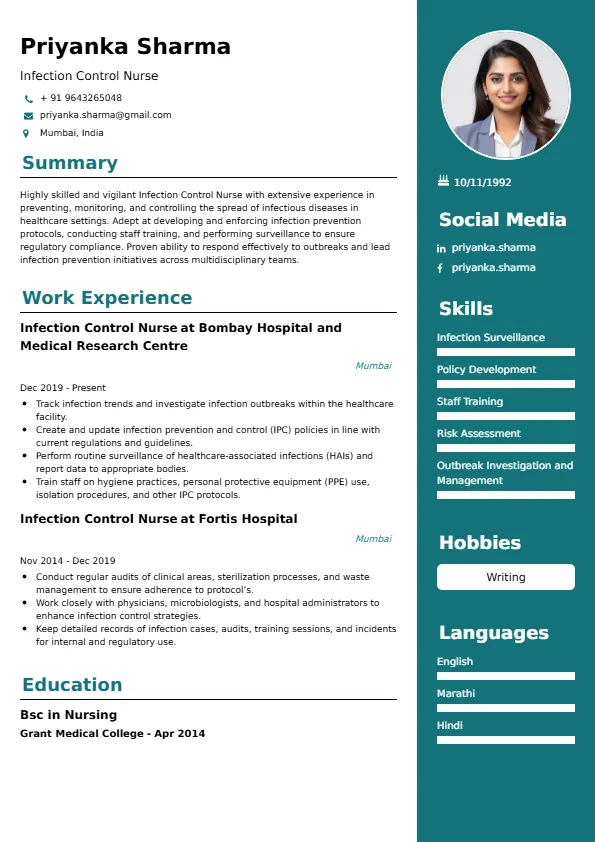
Superbresume.com empowers Infection Control Nurses to craft resumes that highlight their epidemiological surveillance and patient safety leadership. Our platform offers customizable templates tailored for specialized nursing roles, emphasizing skills like NHSN reporting mastery, policy development, outbreak investigation protocols, and multidisciplinary QI team leadership. With ATS-optimized formats, expert-written content suggestions, and real-time resume analysis, we ensure your resume aligns with job descriptions. Showcase your experience in significantly reducing Healthcare-Associated Infection (HAI) rates, leading successful hand hygiene campaigns, or maintaining flawless compliance during Joint Commission/CMS audits with confidence. Superbresume.com helps you create a polished, results-driven resume that grabs hiring managers’ attention and lands interviews.
How to Write a Resume for an Infection Control Nurse
Craft a Targeted Summary: Write a 2-3 sentence summary highlighting your active RN licensure, expertise in infection prevention and control (CIC), proficiency in HAI surveillance and data analysis (NHSN), and success in leading multidisciplinary teams to improve patient safety and compliance.
Use Reverse-Chronological Format: List recent infection control, quality improvement, or critical care nursing roles first, focusing on measurable HAI reduction and compliance achievements.
Highlight Certifications/Licensure: Include essential credentials like RN license, Certified in Infection Control (CIC®), Master’s Degree (MPH/MSN), or specialized training in epidemiology/public health to boost credibility.
Quantify Achievements: Use metrics, e.g., “Reduced CLABSI (Central Line-Associated Bloodstream Infection) rate by 40% over 18 months through protocol implementation and staff education,” or “Achieved 100% compliance in monthly NHSN reporting for all mandated Healthcare-Associated Infections (HAIs),” to show impact.
Incorporate Keywords: Use terms like “Infection Prevention & Control (IPC),” “HAI Surveillance (NHSN),” “Outbreak Investigation,” “CIC® Certification,” “Policy Development,” “Regulatory Compliance (CDC, CMS, Joint Commission),” or “Antimicrobial Stewardship Support” from job descriptions for ATS.
Detail Technical/Analytical Skills: List proficiency with specific surveillance databases (NHSN), statistical software (Excel/SPSS), policy writing, isolation protocols, and environmental cleaning standards in a comprehensive skills section.
Showcase QI/Outbreak Projects: Highlight 3-4 key initiatives (e.g., C. diff reduction project, flu outbreak response, hand hygiene campaign), detailing the methodology, the challenge, and the quantified HAI reduction or compliance result.
Emphasize Soft Skills: Include leadership (multidisciplinary teams), analytical rigor, strong communication (for policy education), attention to detail (surveillance/data), and crisis management.
Keep It Concise: Limit your resume to 1-2 pages, focusing on relevant infection prevention, epidemiological, and quality improvement experience.
Proofread Thoroughly: Eliminate typos or jargon for a professional document.
NHSN Data Reporting and Analysis: Focus on advanced proficiency in the National Healthcare Safety Network (NHSN) for accurate surveillance data submission, risk stratification, and benchmarking of HAIs (CLABSI, CAUTI, SSI).
Antimicrobial Stewardship (AMS) Support: Highlight experience collaborating with pharmacy and physicians to monitor antibiotic usage, reduce resistance, and educate staff on appropriate antimicrobial prescribing practices.
Epidemiological Investigation Skills: Showcase expertise in rapid identification of outbreak clusters, constructing epidemic curves, performing case tracing, and implementing immediate control measures to halt transmission.
Regulatory Audit Readiness: Detail experience preparing the facility and staff for stringent infection control surveys conducted by the Joint Commission, CMS, and state health departments.
Policy Development and EBP Integration: Emphasize translating complex evidence-based practice (EBP) guidelines (e.g., CDC, SHEA) into clear, actionable hospital policies and procedures.
Metrics-Driven Achievements: Use results like “Successfully implemented a hand hygiene monitoring system that increased compliance from 80% to 95%” or “Reduced the facility’s CAUTI (Catheter-Associated Urinary Tract Infection) rate to zero for 12 consecutive months.”
Telehealth and Outpatient Monitoring: Include knowledge of infection prevention challenges in outpatient and home health settings and associated mitigation strategies.
Environmental Cleaning and Disinfection: Highlight experience auditing and providing training on terminal cleaning, high-touch surface disinfection, and managing sterilization protocols.
20 Key Skills for an Infection Control Nurse Resume
| Certified in Infection Control (CIC®) | HAI Surveillance & Reporting (NHSN Mastery) |
| Outbreak Investigation & Control | Policy & Procedure Development (EBP) |
| Regulatory Compliance (Joint Commission, CMS) | Antimicrobial Stewardship (AMS) Collaboration |
| Epidemiology & Biostatistics (Basic) | Multidisciplinary QI Team Leadership |
| Infection Prevention Education & Training | Data Analysis (SPC Charts, Statistical Software) |
| Environmental Cleaning & Sterilization Auditing | Aseptic Technique Auditing (IV/Foley) |
| Hand Hygiene Monitoring | Risk Assessment & Mitigation |
| Communication (Staff/Public Health) | Crisis Management (Infectious Disease) |
10 Do’s for an Infection Control Nurse Resume
Tailor Your Resume: Customize for the specific facility type (e.g., acute care, long-term care, public health) and the complexity of the infection challenges.
Highlight Certifications/Licensure: List CIC® certification and active RN license prominently.
Quantify Achievements: Include metrics on percentage reduction in specific HAIs (CLABSI, CAUTI, SSI), compliance rates (hand hygiene), or successful audit results.
Use Action Verbs: Start bullet points with verbs like “reduced,” “implemented,” “investigated,” “monitored,” or “led.”
Showcase QI/Outbreak Success: Detail the methodology and the strategic, quantified HAI reduction or compliance result of 3-4 key projects.
Include Soft Skills: Highlight leadership, analytical rigor, strong communication (for policy education), and attention to detail.
Optimize for ATS: Use standard nursing/QI section titles and incorporate key regulatory and infection control terms.
Keep It Professional: Use a clean, consistent font and medical layout.
Emphasize Data and Policy: Clearly articulate expertise using NHSN data to inform policy and drive evidence-based change.
Proofread Thoroughly: Ensure no typos or errors in medical terminology, regulations, or metrics.10 Don’ts for an Infection Control Nurse Resume
Don’t Overload with Jargon: Avoid confusing, internal hospital or unit acronyms; use standardized CDC, CMS, and infection control terminology.
Don’t Exceed Two Pages: Keep your resume concise, focusing on high-impact infection prevention, surveillance, and QI leadership.
Don’t Omit Dates: Include employment dates and certification renewal dates for career context.
Don’t Use Generic Templates: Tailor your resume specifically to the epidemiological and regulatory duties of an ICN.
Don’t List Irrelevant Skills: Focus on infection control, epidemiology, surveillance, policy, and QI leadership.
Don’t Skip Metrics: Quantify results wherever possible; HAI reduction and compliance rates are critical metrics.
Don’t Use Complex Formats: Avoid highly stylized elements or confusing graphics.
Don’t Ignore Regulatory Requirements: Include explicit experience preparing for and managing Joint Commission/CMS audits.
Don’t Include Outdated Experience: Omit non-critical care or non-nursing jobs over 15 years old.
Don’t Forget to Update: Refresh for new CIC® certification, successful HAI reduction projects, or advanced epidemiological training.
5 FAQ's for an Infection Control Nurse Resume
The CIC® (Certified in Infection Control). Place it prominently in your header.
Use specific metrics: "Reduced CLABSI rates by 25% through the implementation of new central line bundles."
Yes. Mention "Administered facility-wide data entry and analysis within the National Healthcare Safety Network (NHSN)."
Mention "Led the epidemiological investigation and containment of a C. diff cluster in the ICU."
Very. Mention "Drafted and updated hospital-wide PPE and isolation protocols for high-risk respiratory seasons."
Get 5x more interviews with our crafted Resumes. We make resumes that land jobs.

Get a Free Customized Cover Letter with Resume Expert Advice
with every resume order placed, you will get a free Customized Cover letter.