Hospice / Palliative Care Nurse
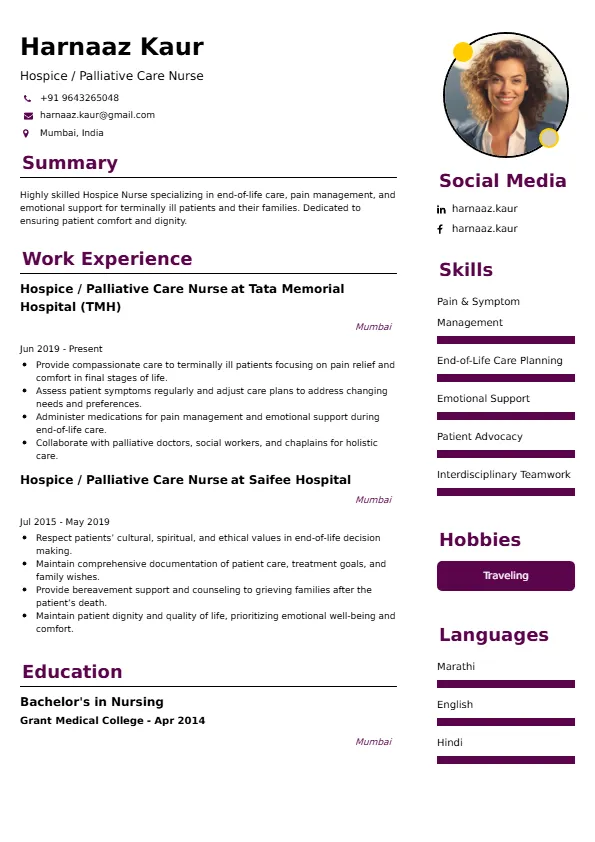
Welcome to our Hospice / Palliative Care Nurse resume sample page! This expertly crafted resume template is designed to showcase your expertise in providing holistic, autonomous care, expert symptom management, and emotional support to patients with serious illness and their families in home, inpatient, or hospital settings. Whether you're an ascending med-surg nurse or a seasoned professional, this sample highlights key skills like Certified Hospice and Palliative Nurse (CHPN), pain/symptom control, advance care planning (ACP), interdisciplinary team coordination, and grief counseling tailored to meet top agency and hospital demands. Use this guide to create a compelling resume that stands out and secures your next career opportunity.
How to Write a Resume for a Hospice / Palliative Care Nurse
Craft a Targeted Summary: Write a 2-3 sentence summary highlighting your active RN licensure, expertise in autonomous hospice/palliative care, proficiency in advanced symptom management (pain/dyspnea), and success in providing holistic support and excellent end-of-life care coordination.
Use Reverse-Chronological Format: List recent hospice, palliative care, oncology, or critical care roles first, focusing on autonomous clinical decision-making and patient/family support.
Highlight Certifications/Licensure: Include credentials like CHPN (Certified Hospice and Palliative Nurse), Registered Nurse (RN) license, Advanced Care Planning (ACP) facilitation training, or relevant specialty certifications to boost credibility.
Quantify Achievements: Use metrics, e.g., “Managed a complex caseload of 15-20 patients, achieving an average patient/family satisfaction score of 98%,” or “Implemented a revised dyspnea management protocol that reduced patient reported discomfort by 25%,” to show impact.
Incorporate Keywords: Use terms like “Hospice & Palliative Care,” “Symptom Management (Pain/Dyspnea),” “Advance Care Planning (ACP),” “Interdisciplinary Team Coordination,” “Grief & Bereavement Support,” “Medication Titration (Opioids),” or “Holistic Patient Care” from job descriptions for ATS.
Detail Clinical/Procedural Skills: List proficiency with specific procedures (e.g., continuous infusions, wound care, subcutaneous access/pump management), pain assessment tools, EMR systems, and regulatory documentation in a comprehensive skills section.
Showcase Case Management Success: Highlight 3-4 key responsibilities or projects (e.g., leading the interdisciplinary group, developing a crisis management plan, precepting new nurses), detailing the methodology and the patient/family outcome result.
Emphasize Soft Skills: Include advanced empathy, strong communication (SPIKES model/goals of care), emotional resilience, autonomous clinical decision-making, and patience.
Keep It Concise: Limit your resume to 1-2 pages, focusing on relevant autonomous nursing, symptom management, and holistic care experience.
Proofread Thoroughly: Eliminate typos or jargon for a professional document.
Complex Symptom Management (Opioids/Sedation): Focus on advanced skills in equianalgesic dosing, opioid titration, managing polypharmacy, and providing terminal sedation per protocol.
Advance Care Planning (ACP) Facilitation: Highlight formal training and expertise in leading goals of care discussions (e.g., using SPIKES model), documenting preferences (MOLST/POLST), and ensuring clear communication.
Telehealth and Remote Support: Showcase experience utilizing phone triage, secure messaging, and telemonitoring to support patients and families remotely, particularly during off-hours.
Grief and Psychosocial Support: Emphasize expertise providing direct emotional support and connecting patients/families with social workers, chaplains, and bereavement services.
Regulatory Compliance and Documentation: Detail meticulous adherence to the Medicare Hospice Benefit requirements, including eligibility criteria, recertification documentation, and level of care changes.
Metrics-Driven Achievements: Use results like “Successfully managed 98% of patient deaths at home, meeting patient preference” or “Led the interdisciplinary team (IDT) for 15+ patients weekly.”
Interdisciplinary Team (IDT) Leadership: Include experience coordinating the efforts of physicians, social workers, chaplains, and aides to ensure a unified and holistic plan of care.
Hospital-Based Palliative Consultation: If applicable, highlight experience working as part of a consultation team within a hospital setting to manage symptoms for seriously ill, non-hospice patients.
Choose Superbresume.com to craft a Hospice / Palliative Care Nurse resume that stands out in the compassionate, specialized nursing sector. Our platform offers tailored templates optimized for ATS, ensuring your skills in CHPN certification, symptom management, and advance care planning shine. With expert guidance, pre-written content, and real-time feedback, we help you highlight achievements like achieving high patient satisfaction or managing complex pain protocols. Whether you work in home health or inpatient units, our tools make it easy to create a polished, results-driven resume. Trust Superbresume.com to showcase your expertise in providing high-quality, dignified, and autonomous care for serious illness. Start building your career today!
20 Key Skills for a Hospice / Palliative Care Nurse Resume
| Certified Hospice and Palliative Nurse (CHPN) | Advanced Symptom Management (Pain/Dyspnea) |
| Advance Care Planning (ACP) Facilitation | Interdisciplinary Team (IDT) Coordination |
| Opioid Titration & Equianalgesic Dosing | Grief & Bereavement Support |
| Hospice/Medicare Benefit Compliance | Continuous Infusion Management (e.g., PCA) |
| Complex Case Management (Autonomy) | Subcutaneous Access (Butterfly) & Pump Management |
| Goals of Care Communication (SPIKES) | Wound Care (Basic Palliative) |
| Emotional Resilience & Empathy | EHR Documentation (Hospice Specific) |
| Crisis Management (Imminent Death/Family Crisis) | Medication Reconciliation (Polypharmacy) |
10 Do’s for a Hospice / Palliative Care Nurse Resume
Tailor Your Resume: Customize for the specific setting (e.g., home hospice, inpatient unit, hospital palliative consult team) and patient population.
Highlight Certifications/Licensure: List active RN license and specialized certifications (CHPN, ACP training) prominently.
Quantify Achievements: Include metrics on caseload size, patient/family satisfaction scores, percentage of patient deaths at home (if preferred), or efficiency in symptom resolution.
Use Action Verbs: Start bullet points with verbs like “managed,” “provided,” “facilitated,” “coordinated,” or “supported.”
Showcase Symptom Mastery: Detail advanced skills in pain, nausea, or dyspnea management, including medication titration and non-pharmacologic interventions.
Include Soft Skills: Highlight advanced empathy, strong communication (goals of care), emotional resilience, and autonomous decision-making.
Optimize for ATS: Use standard nursing section titles and incorporate key palliative, hospice, and communication terms.
Keep It Professional: Use a clean, consistent font and medical layout.
Emphasize Holistic Care: Clearly articulate experience addressing spiritual, emotional, and physical needs, especially through IDT collaboration.
Proofread Carefully: Ensure no typos or errors in medical terminology or certification names.
10 Don’ts for a Hospice / Palliative Care Nurse Resume
Don’t Overload with Jargon: Avoid confusing, internal agency or facility acronyms; use standardized hospice and palliative care terminology.
Don’t Exceed Two Pages: Keep your resume concise, focusing on high-impact autonomous nursing, symptom management, and holistic care.
Don’t Omit Dates: Include full dates for education, licensure, and employment for credentialing purposes.
Don’t Use Generic Templates: Tailor your resume specifically to the autonomous, complex emotional and clinical duties of a Hospice/Palliative Care Nurse.
Don’t List Irrelevant Skills: Focus on pain/symptom management, ACP, interdisciplinary coordination, and end-of-life care.
Don’t Skip Metrics: Quantify results wherever possible; link achievements to patient/family satisfaction or symptom resolution efficiency.
Don’t Use Complex Formats: Avoid highly stylized elements or confusing graphics.
Don’t Ignore Communication Skills: Include explicit experience leading sensitive goals of care discussions (ACP).
Don’t Include Outdated Experience: Omit non-nursing or non-medical jobs over 15 years old.
Don’t Forget to Update: Refresh for new CHPN certification, successful quality initiatives, or advanced communication training.
5 FAQs for a Hospice / Palliative Care Nurse Resume
Prioritize CHPN certification, advanced symptom management (pain/dyspnea), Advance Care Planning (ACP) facilitation, and interdisciplinary team coordination.
Use standard nursing section titles, avoid graphics, and include keywords like “CHPN,” “Symptom Management,” and “Advance Care Planning.”
Yes, if you have it, list it, as it demonstrates the foundational knowledge for complex symptom assessment and medication titration.
Detail training (e.g., ELNEC, VitalTalk) and experience in facilitating sensitive goals of care discussions with patients and families (e.g., using the SPIKES model).
Use a reverse-chronological format to emphasize your most recent, high-impact palliative care and symptom management roles.
Get 5x more interviews with our crafted Resumes. We make resumes that land jobs.

Get a Free Customized Cover Letter with Resume Expert Advice
with every resume order placed, you will get a free Customized Cover letter.