Flight Nurse
Welcome to our Flight Nurse resume sample page! This expertly crafted resume template is designed to showcase your expertise in providing critical care nursing during air medical transport (helicopter or fixed-wing), rapid assessment, advanced life support interventions, and managing high-acuity patients in resource-limited environments. Whether you're an ascending ER/ICU nurse or a seasoned professional, this sample highlights key skills like CFRN/CCRN certification, advanced airway management, trauma stabilization, flight physiology knowledge, and teamwork with paramedics/pilots tailored to meet top air medical transport demands. Use this guide to create a compelling resume that stands out and secures your next career opportunity.
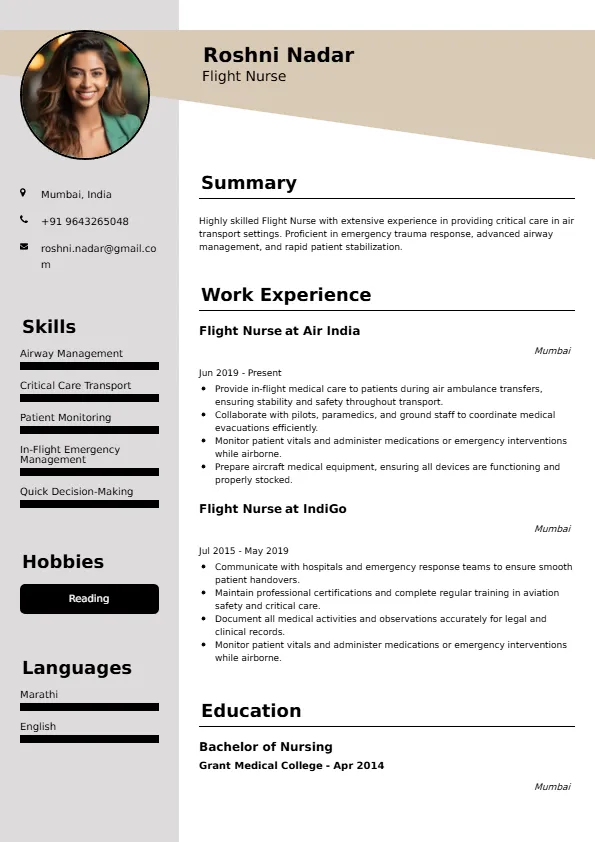
Superbresume.com empowers Flight Nurses to craft resumes that highlight their critical care competence and rapid transport expertise. Our platform offers customizable templates tailored for specialized nursing roles, emphasizing skills like advanced hemodynamic monitoring, mechanical ventilation management, trauma care protocols (TNCC), and adherence to strict aviation and medical regulatory standards. With ATS-optimized formats, expert-written content suggestions, and real-time resume analysis, we ensure your resume aligns with job descriptions. Showcase your experience in leading complex interfacility transfers, managing critically ill patients in transit, or maintaining flawless safety and compliance records with confidence. Superbresume.com helps you create a polished, results-driven resume that grabs hiring managers’ attention and lands interviews.
How to Write a Resume for a Flight Nurse
Use Reverse-Chronological Format: List recent flight, ICU, or ER nursing roles first, focusing on critical care scope, advanced procedures, and rapid intervention responsibilities.
Highlight Certifications/Licensure: Include essential credentials like CFRN (Certified Flight Registered Nurse), CCRN (Critical Care Registered Nurse), CEN, ACLS, PALS, and TNCC to boost credibility.
Quantify Achievements: Use metrics, e.g., “Completed 100+ successful interfacility and scene transports annually, maintaining a zero-incident safety record,” or “Managed and initiated mechanical ventilation for 90% of transport patients requiring advanced respiratory support,” to show impact.
Incorporate Keywords: Use terms like “Critical Care Transport,” “Flight Physiology,” “Advanced Airway Management (RSI),” “Mechanical Ventilation,” “Trauma Stabilization,” “Hemodynamic Monitoring,” or “Resource-Limited Environment” from job descriptions for ATS.
Detail Procedural Skills: List specific advanced procedures mastered (e.g., chest tube insertion, central line insertion, intubation assistance, ventilator management, balloon pump monitoring) in a comprehensive skills section.
Showcase Transport Experience: Highlight 3-4 key responsibilities, such as leading nursing care during scene calls, managing high-risk cardiac transfers, or coordinating with ground and air teams.
Emphasize Soft Skills: Include rapid, decisive decision-making, physical and emotional resilience, exceptional teamwork, crisis communication (to command center), and self-sufficiency.
Keep It Concise: Limit your resume to 1-2 pages, focusing on relevant critical care, advanced procedures, and air medical transport experience.
Proofread Thoroughly: Eliminate typos or jargon for a professional document.
Mechanical Circulatory Support (MCS): Highlight experience managing patients with IABP (Intra-Aortic Balloon Pump), ECMO, or VADs (Ventricular Assist Devices) during transport.
Flight Physiology and Altitude Effects: Showcase deep understanding of how altitude, pressure, and vibration affect patient conditions (e.g., gas laws, barotrauma) and how to mitigate those risks.
Trauma Certification and Protocols: Emphasize training and execution of pre-hospital and trauma center protocols (TNCC, PHTLS) for blunt and penetrating injuries.
Safety Culture and Aviation Regulations: Detail adherence to aviation safety protocols, Crew Resource Management (CRM), and regulatory standards (e.g., FAA, CAMTS accreditation).
Metrics-Driven Achievements: Use results like “Served as clinical lead for a rotor-wing program covering a 10,000 sq mile service area” or “Maintained 100% compliance on all medication storage and inventory checks.”
Interfacility Transfer Coordination: Include expertise in rapidly assessing patient needs, stabilizing the patient for transfer, and coordinating logistics between facilities and the flight crew.
Specialized Patient Care: Highlight experience in niches like high-risk obstetrics, complex pediatrics, or burn patient stabilization during transport.
Choose Superbresume.com to craft a Flight Nurse resume that stands out in the critical care transport sector. Our platform offers tailored templates optimized for ATS, ensuring your skills in CFRN/CCRN certification, trauma stabilization, and flight physiology shine. With expert guidance, pre-written content, and real-time feedback, we help you highlight achievements like leading successful resuscitations in transit or mastering advanced life support techniques. Whether you fly rotor-wing or fixed-wing, our tools make it easy to create a polished, results-driven resume. Trust Superbresume.com to showcase your expertise in decisive, autonomous, and high-quality patient care during transport. Start building your career today!
20 Key Skills for a Flight Nurse Resume
| CFRN/CCRN/CEN Certified | Critical Care Transport (Air/Ground) |
| Advanced Airway Management (RSI Protocols) | Mechanical Ventilation Management |
| Trauma Stabilization (TNCC/PHTLS) | Hemodynamic Monitoring & Vasoactive Drips |
| Flight Physiology & Altitude Effects | Intraosseous (IO) Access & Central Line Assistance |
| Intra-Aortic Balloon Pump (IABP) Monitoring | Advanced EKG Interpretation |
| Crew Resource Management (CRM) | Rapid Patient Assessment & Triage |
| Medication Administration (High-Risk/Emergent) | Crisis Communication & Teamwork |
| Self-Sufficiency in Resource-Limited Settings | Infection Control & Safety Protocols |
| Pre-Hospital Care & Scene Calls | EHR Documentation (Transport Focus) |
| Emotional Resilience & Pressure Management | Advanced Procedural Assistance |
10 Do’s for a Flight Nurse Resume
Tailor Your Resume: Customize for the specific platform (rotor-wing, fixed-wing) and patient population (e.g., trauma, cardiac) emphasized by the transport company.
Highlight Certifications/Licensure: List active RN license, CFRN, CCRN, and all life support courses (ACLS, PALS, TNCC) prominently.
Quantify Achievements: Include metrics on transport volume, safety record, advanced procedure performance (e.g., number of RSI assists), or years of critical care experience.
Use Action Verbs: Start bullet points with verbs like “stabilized,” “managed,” “intervened,” “co-piloted,” or “performed.”
Showcase Critical Care Transport: Detail the complexity and autonomy required in your role during high-acuity transfers.
Include Soft Skills: Highlight rapid, decisive critical thinking, emotional resilience, self-sufficiency, and effective team communication.
Optimize for ATS: Use standard nursing section titles and incorporate key flight, critical care, and procedural terms.
Keep It Professional: Use a clean, consistent font and medical layout.
Emphasize Advanced Skills: Clearly articulate expertise in advanced airway management, ventilator care, and hemodynamic monitoring in a confined space.
Proofread Carefully: Ensure no typos or errors in medical terminology or certification names.
10 Don’ts for a Flight Nurse Resume
Don’t Overload with Jargon: Avoid confusing, internal hospital or base acronyms; use standardized medical and aviation transport terminology (CAMTS, FAA).
Don’t Exceed Two Pages: Keep your resume concise, focusing on high-acuity nursing, advanced procedures, and flight-specific experience.
Don’t Omit Dates: Include full dates for education, licensure, and employment for credentialing purposes.
Don’t Use Generic Templates: Tailor your resume specifically to the high-stakes, autonomous duties of a Flight Nurse.
Don’t List Irrelevant Skills: Focus on critical care, advanced life support, trauma, flight physiology, and aviation safety.
Don’t Skip Metrics: Quantify results wherever possible; all achievements must link back to patient care outcomes, safety, or procedure volume.
Don’t Use Complex Formats: Avoid highly stylized elements or confusing graphics.
Don’t Ignore Safety and Teamwork: Include explicit experience with CRM and adherence to aviation safety protocols.
Don’t Include Outdated Experience: Omit non-critical care or non-nursing jobs over 15 years old.
Don’t Forget to Update: Refresh for new certifications (e.g., advanced cardiac management), successful transport volume data, or continued education/training.
5 FAQs for a Flight Nurse Resume
Prioritize CFRN/CCRN certification, advanced airway/RSI management, mechanical ventilation, trauma stabilization (TNCC), and knowledge of flight physiology.
Use standard nursing section titles, avoid graphics, and include keywords like “CFRN,” “Mechanical Ventilation,” and “Crew Resource Management.”
Yes, this is foundational. Highlight the acuity level (e.g., Level I Trauma Center, Tertiary ICU) and the advanced skills practiced there.
Detail responsibilities where you initiated independent protocols or made rapid, critical clinical decisions based on limited resources and immediate patient change.
Use a reverse-chronological format to emphasize your most recent, high-acuity critical care and air medical transport roles.
Get 5x more interviews with our crafted Resumes. We make resumes that land jobs.

Get a Free Customized Cover Letter with Resume Expert Advice
with every resume order placed, you will get a free Customized Cover letter.