Psychiatrist
Welcome to our Psychiatrist (Physician) resume sample page! This expertly crafted resume template is designed to showcase your expertise in diagnosing, treating, and managing mental illnesses and emotional disorders, including psychopharmacology, psychotherapy, and complex differential diagnosis. Whether you work in an inpatient hospital, outpatient clinic, or private practice, this sample highlights key skills like Psychopharmacology, DSM-5 Diagnosis, Psychotherapy (CBT/DBT), Crisis Intervention, and EMR Proficiency tailored to meet top healthcare demands. Use this guide to create a polished, results-driven resume that stands out and secures your next career opportunity.
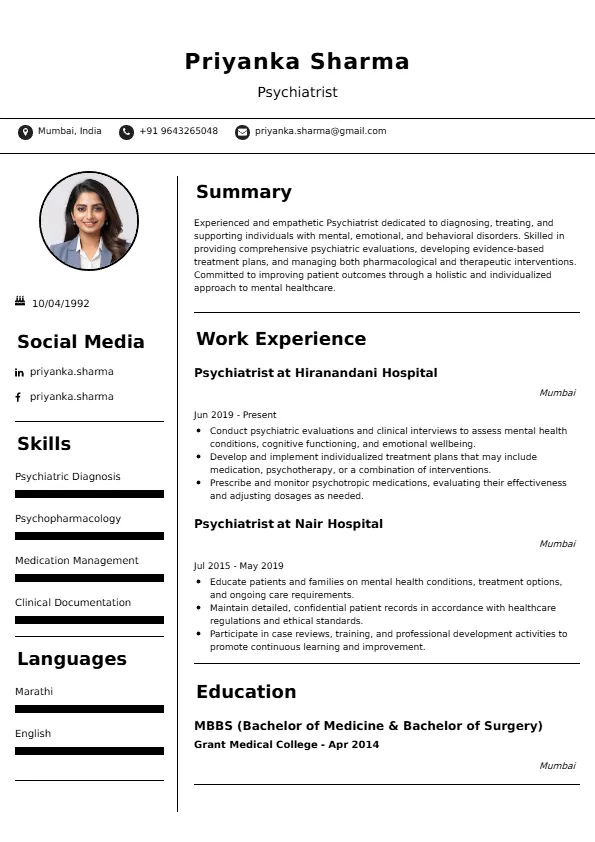
Superbresume.com empowers Psychiatrists to craft resumes that highlight their diagnostic rigor and therapeutic expertise. Our platform offers customizable templates tailored for medical roles, emphasizing skills like advanced psychopharmacology, complex differential diagnosis, adherence to clinical practice guidelines (APA), and multidisciplinary team leadership. With ATS-optimized formats, expert-written content suggestions, and real-time resume analysis, we ensure your resume aligns with job descriptions. Showcase your experience in successfully managing a large, complex patient panel, leading innovative treatment programs (e.g., ECT/TMS), or contributing to clinical research and medical education with confidence. Superbresume.com helps you create a polished, results-driven resume that grabs hiring managers’ attention and lands interviews.
How to Write a Resume for a Psychiatrist
Craft a Targeted Summary: Write a 2-3 sentence summary highlighting your Board Certification (ABPN/Psychiatry), extensive clinical experience, proficiency in psychopharmacology and diagnostic assessment, and commitment to evidence-based, compassionate mental health care.
Use Reverse-Chronological Format: List professional practice roles, fellowships, and residency first, focusing on clinical specialty, patient panel size, and academic contributions.
Highlight Certifications/Licensure: Include essential credentials like Board Certification (ABPN/Psychiatry), state medical licensure, DEA registration, ACLS/BLS, and subspecialty certifications (e.g., Child/Adolescent, Addiction) to boost credibility.
Quantify Achievements: Use metrics, e.g., “Managed an outpatient panel of 500+ adult patients with complex mood and psychotic disorders, achieving 90% adherence to prescribed medication regimens,” or “Reduced psychiatric patient length of stay (LOS) in the inpatient unit by 1.5 days through optimized discharge planning,” to show impact.
Incorporate Keywords: Use terms like “Psychopharmacology,” “Diagnostic Assessment (DSM-5),” “Psychotherapy (CBT/DBT),” “Crisis Intervention & Risk Assessment,” “Inpatient/Outpatient Management,” “EMR Proficiency (Epic/Cerner),” or “ABPN Certified” from job descriptions for ATS.
Detail Clinical/Procedural Skills: List specific procedures mastered (e.g., ECT, TMS, long-acting injectables), proficiency with advanced diagnostic tools, and managing controlled substances in a comprehensive skills section.
Showcase Research/Academic: Highlight involvement in clinical trials (PI/Co-I), peer-reviewed publications, teaching residents/students, or leading multidisciplinary treatment teams.
Emphasize Soft Skills: Include diagnostic acumen, empathy, strong therapeutic communication, ethical practice, crisis management, and interdisciplinary collaboration.
Keep It Concise: Limit your resume to 1-2 pages, focusing on medical training, clinical specialty practice, and procedural/academic contributions.
Proofread Thoroughly: Eliminate typos or jargon for a professional document.
Telepsychiatry and Virtual Care: Focus heavily on expertise delivering effective diagnostic and medication management services via secure telehealth platforms, particularly for remote or underserved populations.
Advanced Psychopharmacology: Highlight expertise managing complex psychotropic polypharmacy regimens, genetic testing integration, and utilizing advanced treatments like ECT (Electroconvulsive Therapy) or TMS (Transcranial Magnetic Stimulation).
Integrated Behavioral Health: Showcase experience collaborating with primary care physicians (PCPs) and other specialists in integrated care models to manage mental health conditions across the medical spectrum.
Crisis and Risk Management: Detail advanced skills in rapid risk assessment (suicide/homicide), utilizing commitment protocols, and leading crisis stabilization within the ED or inpatient unit.
Psychotherapy Modalities: Emphasize formal training and application of evidence-based psychotherapy techniques (CBT, DBT, ACT) in both individual and group settings, supplementing medication management.
Metrics-Driven Achievements: Use results like “Successfully led a protocol change that reduced restraint use in the inpatient unit by 20%” or “Increased patient compliance with follow-up appointments by 15% through improved outreach.”
Specialized Population/Disorder Focus: Include advanced training and high-volume experience in a specific niche (e.g., geriatric psychiatry, addiction medicine, forensic psychiatry).
EHR Optimization for Mental Health: Highlight proficiency leveraging EMR (Epic, Cerner) features customized for psychiatric workflow, including mandated documentation, medication order sets, and tracking outcomes (e.g., GAF/WHODAS scores).
Choose Superbresume.com to craft a Psychiatrist resume that stands out in the competitive behavioral health sector. Our platform offers tailored templates optimized for ATS, ensuring your skills in ABPN certification, psychopharmacology, and therapeutic expertise shine. With expert guidance, pre-written content, and real-time feedback, we help you highlight achievements like improving patient outcomes or leading specialized treatment programs. Whether you practice in a hospital or private clinic, our tools make it easy to create a polished, results-driven resume. Trust Superbresume.com to showcase your expertise in decisive, evidence-based, and compassionate mental health treatment. Start building your career today!
20 Key Skills for a Psychiatrist Resume
| Board Certification (ABPN/Psychiatry) | Psychopharmacology & Medication Management |
| Diagnostic Assessment (DSM-5/ICD-10) | Crisis Intervention & Risk Assessment (Suicide/Homicide) |
| Psychotherapy Modalities (CBT, DBT, ACT) | EMR/EHR Proficiency (Psychiatric Workflow) |
| Inpatient/Outpatient Management | Electroconvulsive Therapy (ECT)/TMS (Procedural) |
10 Do’s for a Psychiatrist Resume
Tailor Your Resume: Customize for the specific practice focus (e.g., academic, inpatient unit leadership, private telepsychiatry).
Highlight Certifications/Licensure: List Board Certification (ABPN), active state license, and subspecialty fellowships prominently.
Quantify Achievements: Include metrics on patient panel size, patient adherence rates, LOS reduction (inpatient), or research funding/publication count.
Use Action Verbs: Start bullet points with verbs like “diagnosed,” “treated,” “managed,” “prescribed,” or “led.”
Showcase Procedural/Therapeutic Mastery: Detail the complexity of cases managed and key procedures or therapeutic modalities mastered.
Include Soft Skills: Highlight diagnostic acumen, strong therapeutic communication, empathy, and ethical practice.
Optimize for ATS: Use standard medical section titles and incorporate key psychiatric, procedural, and research terms.
Keep It Professional: Use a clean, consistent font and medical/academic layout.
Emphasize Psychopharmacology and Diagnosis: Clearly state expertise in medication management and accurate DSM-5/ICD-10 diagnosis.
Proofread Thoroughly: Eliminate typos or jargon for a professional document.
10 Don’ts for a Psychiatrist Resume
Don’t Overload with Jargon: Avoid confusing, internal hospital or system acronyms; use standardized medical and psychiatric terminology (APA, DSM-5).
Don’t Exceed Two Pages: Keep your resume concise, focusing on high-level clinical specialty, procedural volume, and academic output.
Don’t Omit Dates: Include full dates for education, residency, fellowship, and practice for credentialing purposes.
Don’t Use Generic Templates: Tailor your resume specifically to the complex diagnostic and therapeutic duties of a Psychiatrist.
Don’t List Irrelevant Skills: Focus on mental health disorders, psychopharmacology, psychotherapy, crisis management, and research.
Don’t Skip Metrics: Quantify results wherever possible; link clinical work to patient volume, LOS reduction, or medication adherence.
Don’t Use Complex Formats: Avoid highly stylized elements or confusing graphics.
Don’t Ignore Crisis Skills: Include explicit experience in risk assessment and crisis intervention.
Don’t Include Outdated Experience: Omit non-medical or pre-residency jobs unless highly relevant to research or leadership.
Don’t Forget to Update: Refresh for new clinical trials, successful quality improvement initiatives, or continued education/certification renewals.
5 FAQ's for a Psychiatrist Resume
Create a "Clinical Expertise" section detailing your management of complex medication regimens (e.g., refractory depression, psychotic disorders).
Yes, specify modalities like CBT, DBT, or Psychoanalysis used in conjunction with medical treatment.
"Performed 200+ acute risk assessments (suicide/homicide) annually in a high-volume emergency psychiatry setting."
Very high value. "Delivered virtual care to a rural patient panel, achieving a 15% increase in appointment adherence."
Mention "Reduction in 30-day psychiatric readmission rates" or "consistently high patient satisfaction scores."
Get 5x more interviews with our crafted Resumes. We make resumes that land jobs.

Get a Free Customized Cover Letter with Resume Expert Advice
with every resume order placed, you will get a free Customized Cover letter.