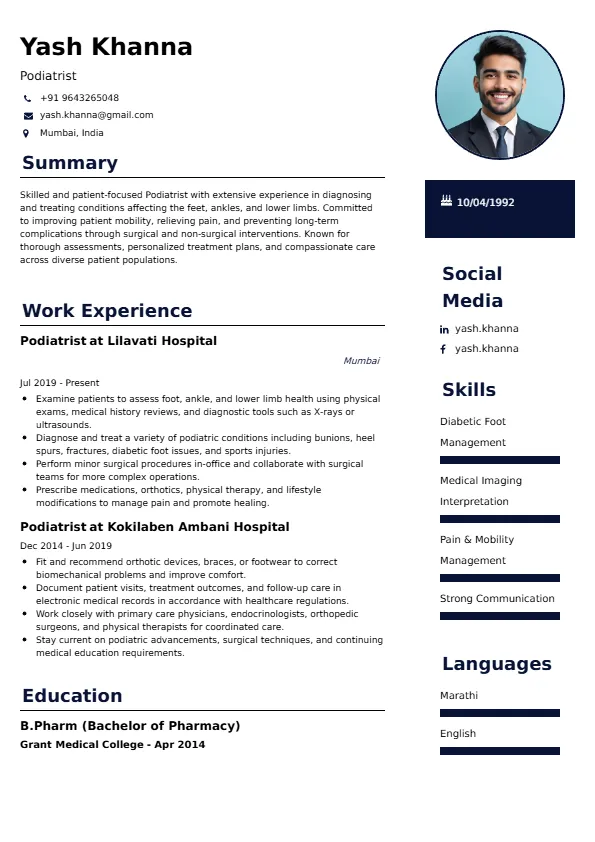
Podiatrist
Welcome to our Podiatrist (DPM) resume sample page! This expertly crafted resume template is designed to showcase your expertise in diagnosing and treating disorders of the foot, ankle, and lower leg, performing surgical procedures, managing chronic conditions (e.g., diabetic foot care), and providing preventive health services. Whether you specialize in surgery, wound care, or sports medicine, this sample highlights key skills like Foot & Ankle Surgery, Wound Care (Diabetic), Biomechanics/Gait Analysis, EMR Proficiency, and Surgical/Procedural Competence tailored to meet top clinic, hospital, and private practice demands. Use this guide to create a polished, results-driven resume that stands out and secures your next career opportunity.
How to Write a Resume for a Podiatrist
Craft a Targeted Summary: Write a 2-3 sentence summary highlighting your DPM licensure, extensive experience in comprehensive foot and ankle care, proficiency in surgical and procedural competence, and commitment to limb salvage and preventive medicine.
Use Reverse-Chronological Format: List professional practice roles, residencies/fellowships, and clinical experience first, focusing on procedural volume, specialty focus, and measurable patient outcome achievements.
Highlight Certifications/Licensure: Include essential credentials like DPM Degree, Board Certification (ABFAS/ABPM), state medical licensure, DEA registration, ACLS/BLS, and specialized certifications (e.g., wound care, hyperbaric medicine) to boost credibility.
Quantify Achievements: Use metrics, e.g., “Performed 150+ major foot and ankle surgical cases (elective/trauma) annually with a surgical site infection rate below 1%,” or “Reduced lower extremity amputation rate by 30% in diabetic patients through coordinated wound care protocols,” to show impact.
Incorporate Keywords: Use terms like “Foot & Ankle Surgery,” “Diabetic Wound Care (Limb Salvage),” “Biomechanics/Gait Analysis,” “Custom Orthotics/Bracing,” “Procedural Competence (Injections/Nail Surgery),” “EMR Proficiency,” or “ABFAS/ABPM Certified” from job descriptions for ATS.
Detail Procedural/Technical Skills: List specific procedures mastered (e.g., bunionectomy, ankle fracture fixation, advanced debridement, joint injections) and proficiency with diagnostic imaging interpretation and EMR systems in a comprehensive skills section.
Showcase Research/Academic: Highlight involvement in clinical trials, peer-reviewed publications, teaching residents/students, or leading quality improvement (QI) initiatives (e.g., fall prevention, diabetic foot screening).
Emphasize Soft Skills: Include diagnostic acumen, procedural precision, patient education (chronic disease/post-op), empathy, and interdisciplinary collaboration (vascular, endocrine).
Keep It Concise: Limit your resume to 1-2 pages, focusing on medical training, clinical specialty practice, and procedural/academic contributions.
Proofread Thoroughly: Eliminate typos or jargon for a professional document.
Diabetic Foot Care and Limb Salvage: Focus heavily on expertise managing complex diabetic foot ulcers, utilizing advanced wound care techniques (e.g., biological grafts, total contact casting), and working in multidisciplinary limb salvage teams.
Foot and Ankle Trauma/Reconstruction: Highlight high-volume experience in advanced surgical procedures for trauma, deformity correction, and arthroplasty (joint replacement) of the foot and ankle.
Biomechanics and Custom Orthotics: Showcase expertise conducting detailed gait analysis and designing/prescribing custom functional orthotics and bracing to address biomechanical deficiencies and prevent injury.
Minimally Invasive Surgery (MIS) Techniques: Detail experience utilizing advanced MIS approaches (e.g., endoscopic procedures, smaller incisions) to reduce patient morbidity and recovery time.
Telehealth and Remote Monitoring: Include experience utilizing virtual visits for follow-up, wound checks, and monitoring stable chronic patients, particularly in home health or remote clinic settings.
Metrics-Driven Achievements: Use results like “Maintained a 95% success rate for primary bunionectomy procedures with minimal recurrence” or “Successfully managed a wound care clinic that achieved 90% healing for Wagner Grade 1-2 ulcers.”
Integration with Interdisciplinary Teams: Emphasize collaboration with endocrinologists, vascular surgeons, and physical therapists for holistic management of complex patients.
EHR Optimization for Podiatry: Highlight proficiency leveraging EMR (e.g., Epic, specialized Podiatry software) templates customized for exams, procedures, and coding/billing.
Choose Superbresume.com to craft a Podiatrist resume that stands out in the competitive medical specialty field. Our platform offers tailored templates optimized for ATS, ensuring your skills in DPM licensure, surgical competence, and diabetic wound care shine. With expert guidance, pre-written content, and real-time feedback, we help you highlight achievements like achieving high surgical success rates or reducing amputation risk. Whether you specialize in surgery or primary foot care, our tools make it easy to create a polished, results-driven resume. Trust Superbresume.com to showcase your expertise in decisive, high-quality lower extremity health care. Start building your career today!
20 Key Skills for a Podiatrist Resume
| DPM Degree & State Licensure | Foot & Ankle Surgery (Elective & Trauma) |
| Diabetic Wound Care & Limb Salvage | Biomechanics & Gait Analysis |
| Custom Orthotics & Bracing Design | Procedural Competence (Nail, Skin Lesions, Injections) |
| EMR/EHR Proficiency (Surgical/Clinic Workflow) | Minimally Invasive Surgery (MIS) Techniques |
| Wound Debridement & Grafting | Diagnostic Imaging Interpretation (X-Ray, MRI) |
| Sports Medicine (Lower Extremity) | Interdisciplinary Team Collaboration (Vascular, Endo) |
10 Do’s for a Podiatrist Resume
Tailor Your Resume: Customize for the specific practice focus (e.g., academic wound care, private high-volume surgery, sports podiatry).
Highlight Certifications/Licensure: List DPM Degree, Board Certification (ABFAS/ABPM), and any specialized wound care/surgical training prominently.
Quantify Achievements: Include metrics on procedural volume (annual surgeries/biopsies), limb salvage rates, complication rate reduction, or successful wound healing percentage.
Use Action Verbs: Start bullet points with verbs like “performed,” “diagnosed,” “managed,” “designed,” or “reduced.”
Showcase Procedural Versatility: Detail the high-volume nature of your practice and key surgical/office procedures mastered.
Include Soft Skills: Highlight surgical precision, diagnostic acumen, strong patient education, and interdisciplinary collaboration.
Optimize for ATS: Use standard medical section titles and incorporate key podiatric, procedural, and specialization terms.
Keep It Professional: Use a clean, consistent font and medical/clinical layout.
Emphasize Surgery and Wound Care: Clearly state expertise in these two high-value, specialized areas of modern podiatry.
Proofread Thoroughly: Eliminate typos or jargon for a professional document.
10 Don’ts for a Podiatrist Resume
Don’t Overload with Jargon: Avoid confusing, internal clinic or hospital acronyms; use standardized medical and podiatric terminology.
Don’t Exceed Two Pages: Keep your resume concise, focusing on high-level clinical specialty, procedural volume, and academic output.
Don’t Omit Dates: Include full dates for education, residency, and practice for credentialing purposes.
Don’t Use Generic Templates: Tailor your resume specifically to the complex diagnostic and therapeutic duties of a Podiatrist.
Don’t List Irrelevant Skills: Focus on foot/ankle disorders, surgery, wound care, biomechanics, and specialty procedures.
Don’t Skip Metrics: Quantify results wherever possible; link clinical work to procedural volume, complication rates, and limb salvage success.
Don’t Use Complex Formats: Avoid highly stylized elements or confusing graphics.
Don’t Ignore Interdisciplinary Work: Include explicit experience collaborating with vascular and endocrine teams on diabetic limb care.
Don’t Include Outdated Experience: Omit non-medical or pre-residency jobs unless highly relevant to research or leadership.
Don’t Forget to Update: Refresh for new successful quality improvement initiatives, continued education/certification renewals, or advanced surgical training.
5 FAQs for a Podiatrist Resume
Prioritize Board Certification (ABFAS/ABPM), Foot & Ankle Surgery, Diabetic Wound Care/Limb Salvage, and Biomechanics/Orthotics expertise.
Use standard medical section titles, avoid graphics, and include keywords like “Limb Salvage,” “ABFAS,” and “Gait Analysis.”
Yes, quantifying the number of major surgical cases performed annually demonstrates competence and experience.
Detail a protocol you implemented or managed and the resulting quantified metric improvement (e.g., 30% reduction in amputation rate).
Use a reverse-chronological format to emphasize your most recent, high-level clinical specialty and procedural achievements.
Get 5x more interviews with our crafted Resumes. We make resumes that land jobs.

Get a Free Customized Cover Letter with Resume Expert Advice
with every resume order placed, you will get a free Customized Cover letter.