Endocrinologist
Welcome to our Endocrinologist (Physician) resume sample page! This expertly crafted resume template is designed to showcase your expertise in diagnosing and managing complex hormonal disorders, including diabetes, thyroid disease, osteoporosis, and pituitary/adrenal dysfunctions. Whether you are completing your fellowship or a seasoned attending, this sample highlights key skills like diabetes management (insulin pumps, CGMs), thyroid ultrasound/FNA, research, and chronic disease management tailored to meet top hospital and academic demands. Use this guide to create a compelling resume that stands out and secures your next career opportunity.Build a Standout Endocrinologist Resume with Superbresume.com
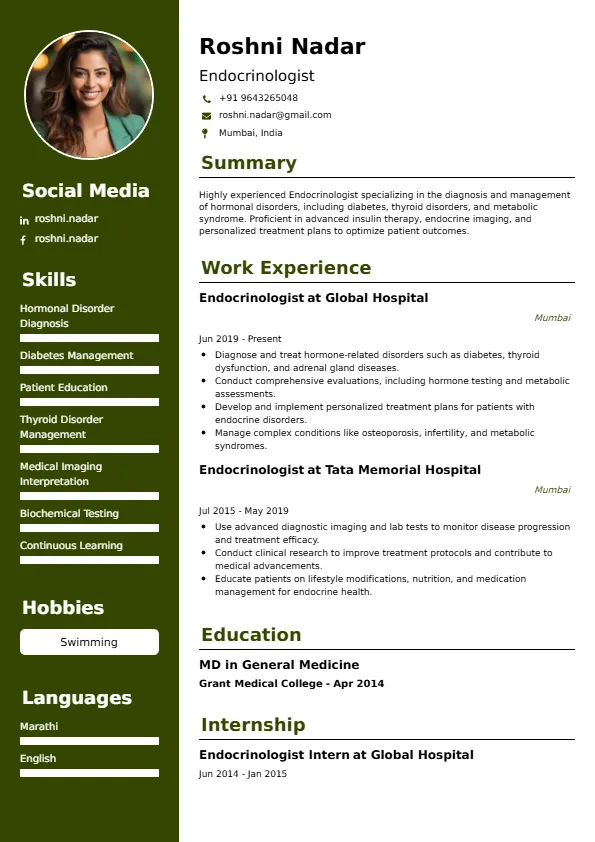
How to Write a Resume for an Endocrinologist
Use Reverse-Chronological Format: List professional practice roles, fellowships, and residency first, focusing on clinical specialty, patient panel size, and academic contributions.
Highlight Certifications/Licensure: Include essential credentials like Board Certification (ABIM/Endocrinology), state medical licensure, DEA registration, and specialized procedure certifications (e.g., ECNU for thyroid ultrasound) to boost credibility.
Quantify Achievements: Use metrics, e.g., “Managed a complex panel of 3,000+ patients with a focus on Type 1 and Type 2 diabetes,” or “Achieved an average HbA1c reduction of 1.5% in high-risk patients through intensive therapy,” to show impact.
Incorporate Keywords: Use terms like “Diabetes Management,” “Thyroid Ultrasound & FNA,” “Continuous Glucose Monitoring (CGM),” “Insulin Pump Therapy,” “Metabolic Disorders,” “Osteoporosis,” “Clinical Trials,” or “Endocrine Society Guidelines” from job descriptions for ATS.
Detail Procedural/Technical Skills: List specific procedures mastered (e.g., thyroid FNA, bone density interpretation) and proficiency with advanced diabetes technology and EHR systems in a comprehensive skills section.
Showcase Research/Academic: Highlight involvement in clinical trials (PI/Co-I), peer-reviewed publications, teaching residents/fellows, or leading grand rounds.
Emphasize Soft Skills: Include diagnostic acumen, patient education, empathy, interdisciplinary collaboration (with primary care/surgeons), and commitment to long-term chronic care.
Keep It Concise: Limit your resume to 1-2 pages, focusing on medical training, clinical specialty practice, and academic/research contributions.
Proofread Thoroughly: Eliminate typos or jargon for a professional document.
Tele-Endocrinology: Highlight proficiency utilizing virtual visits and remote data platforms (e.g., Diasend, Clarity) for chronic disease management and follow-up.
Thyroid Ultrasound and Biopsy (FNA): Showcase specific training and volume experience in thyroid nodule evaluation, ultrasound-guided fine-needle aspiration (FNA), and interpretation.
Metabolic Bone Health: Detail expertise in advanced therapeutics and bone density interpretation (DXA) for managing complex osteoporosis and parathyroid disorders.
Clinical Trial Participation: Emphasize involvement as an investigator in trials for new diabetes medications, weight loss drugs, or specialized hormonal therapies.
Metrics-Driven Achievements: Use results like “Maintained high patient adherence (95%) to CGM/pump usage protocols” or “Managed patient throughput achieving a 10% reduction in average wait time for new patient consults.”
Multidisciplinary Endocrine Tumor Boards: Highlight participation in collaborative boards (e.g., thyroid cancer, pituitary masses) with surgeons, oncologists, and radiologists.
EHR Proficiency and Clinical Informatics: Include experience leveraging EHR (e.g., Epic, Cerner) templates and dashboards for efficient specialty documentation and order sets.
Choose Superbresume.com to craft an Endocrinologist resume that stands out in the competitive specialty medicine field. Our platform offers tailored templates optimized for ATS, ensuring your skills in board certification, diabetes technology, and procedural competence shine. With expert guidance, pre-written content, and real-time feedback, we help you highlight achievements like improving chronic disease markers or leading impactful clinical research. Whether you practice in a large clinic or an academic setting, our tools make it easy to create a polished, results-driven resume. Trust Superbresume.com to showcase your expertise in managing complex hormonal health. Start building your career today!
20 Key Skills for an Endocrinologist Resume
| Board Certification (Endocrinology, Diabetes, Metabolism) | Diabetes Technology (CGM/Insulin Pumps) |
| Thyroid Ultrasound & FNA Biopsy | Chronic Disease Management (Diabetes, Osteoporosis) |
| Metabolic Disorders | Pituitary & Adrenal Disorders |
| EHR Documentation (Epic/Cerner) | Clinical Trials & Research (PI/Co-I) |
| Endocrine Society Guidelines Adherence | Thyroid Cancer Management |
| Bone Density Interpretation (DXA) | Patient Education & Adherence Counseling |
| Interdisciplinary Collaboration (Primary Care, Surgery) | Tele-Endocrinology & Remote Monitoring |
| Diagnostic Acumen | Hormonal Replacement Therapy (HRT) |
| Communication (Patient/Family) | Quality Improvement (QI) Initiatives |
10 Do’s for an Endocrinologist Resume
Tailor Your Resume: Customize for the specific practice focus (e.g., reproductive endocrinology, academic research, or general endocrine practice).
Highlight Certifications/Licensure: List Board Certification, active state license, and all relevant specialty certifications (e.g., ECNU) prominently.
Quantify Achievements: Include metrics on patient panel size, success rates in managing specific markers (e.g., HbA1c reduction), research funding, or publication count.
Use Action Verbs: Start bullet points with verbs like “managed,” “diagnosed,” “performed,” “published,” or “led.”
Showcase Procedural/Tech Skills: Detail specific advanced procedures (FNA) and mastery of diabetes management technology.
Include Soft Skills: Highlight diagnostic acumen, patient-centered communication, and ability to manage long-term chronic care relationships.
Optimize for ATS: Use standard medical section titles and incorporate key endocrine, procedural, and technology terms.
Keep It Professional: Use a clean, consistent font and medical/academic layout.
Emphasize Specialty Expertise: Clearly articulate your depth of knowledge in complex hormonal diseases beyond primary care scope.
Proofread Carefully: Ensure no typos or errors in medical terminology, hormonal names, or research citations.
10 Don’ts for an Endocrinologist Resume
Don’t Overload with Jargon: Avoid confusing, internal hospital or system acronyms; use standardized medical and endocrine terminology.
Don’t Exceed Two Pages: Keep your resume concise, focusing on high-level clinical specialty, procedural volume, and academic output.
Don’t Omit Dates: Include full dates for education, residency, fellowship, and practice for credentialing purposes.
Don’t Use Generic Templates: Tailor your resume specifically to the specialized, complex care duties of an Endocrinologist.
Don’t List Irrelevant Skills: Focus on hormonal disorders, metabolic bone health, diabetes management, and research/teaching.
Don’t Skip Metrics: Quantify results wherever possible; link clinical work to chronic disease outcome markers (e.g., HbA1c, T-score).
Don’t Use Complex Formats: Avoid highly stylized elements or confusing graphics.
Don’t Ignore Technology: Include expertise in modern diabetes devices and remote monitoring platforms.
Don’t Include Outdated Experience: Omit non-medical or pre-residency jobs unless highly relevant to research or leadership.
Don’t Forget to Update: Refresh for new clinical trials, successful quality improvement initiatives, or continued education/certification renewals.
5 FAQs for an Endocrinologist Resume
Prioritize Board Certification, expertise in diabetes technology (such as CGM and insulin pumps), thyroid FNA/ultrasound procedures, and clinical research or academic output.
Use standard medical section titles, avoid graphics, and include keywords like “CGM,” “Insulin Pump Therapy,” and “Metabolic Disorders.”
Yes—list the top 3–5 most relevant publications and provide a link to your full CV or Google Scholar profile.
Describe specific education programs or protocols you implemented, such as group teaching sessions or pump training, and include the resulting improvement in patient adherence or outcomes.
Use a reverse-chronological format to emphasize your most recent, high-level clinical specialty and academic contributions.
Get 5x more interviews with our crafted Resumes. We make resumes that land jobs.

Get a Free Customized Cover Letter with Resume Expert Advice
with every resume order placed, you will get a free Customized Cover letter.