Tailor Your Resume: Customize it for the specific practice type (academic, procedural, cosmetic, or general dermatology).
Highlight Certifications/Licensure: List board certification, state license, and any fellowship training prominently.
Quantify Achievements: Add metrics such as patient volume, surgical case counts, research funding, publications, or teaching load.
Use Action Verbs: Start statements with strong verbs like diagnosed, treated, performed, published, or managed.
Showcase Research/Teaching: Include details on research involvement, publications, conference presentations, and mentoring activities.
Include Soft Skills: Highlight patient-centered communication, empathy, and professionalism.
Optimize for ATS: Use standard medical section titles and specialty-relevant keywords for better scan results.
Keep It Professional: Maintain a clean, consistent, academic-style format.
Emphasize Procedural Volume: Clearly indicate the number and type of procedures performed (e.g., lasers, Mohs, excisions).
Proofread Carefully: Ensure complete accuracy in dates, terminology, credentials, and titles.
Dermatologist
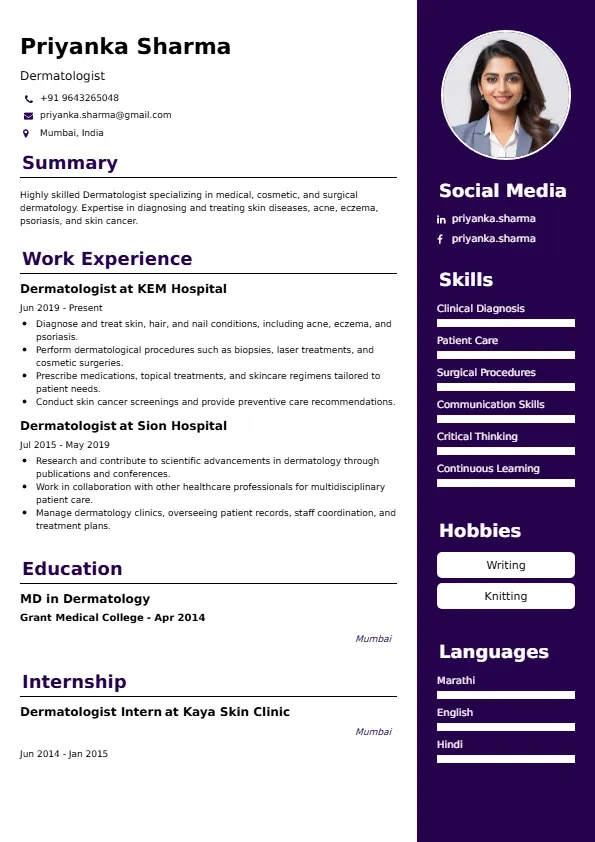
Welcome to our Dermatologist resume sample page! This expertly crafted resume template is designed to showcase your expertise in diagnosing and treating skin, hair, and nail disorders, performing surgical and cosmetic procedures, and managing clinical practice. Whether you are completing your residency or a seasoned practitioner, this sample highlights key skills like Mohs surgery, laser therapy, complex medical dermatology, and electronic health records (EHR) tailored to meet top hospital systems and private practices’ demands. Use this guide to create a compelling resume that stands out and secures your next career opportunity.
How to Write a Resume for a Dermatologist
Use Reverse-Chronological Format: List professional practice roles, residencies, and fellowships first, focusing on clinical duties and volume.
Highlight Certifications/Licensure: Include Board Certification (e.g., ABD), state medical licensure, DEA registration, and any specialized fellowship certifications (e.g., Mohs) to boost credibility.
Quantify Achievements: Use metrics, e.g., “Managed a panel of over 5,000 patients,” or “Successfully performed 500+ Mohs procedures with a 99% cure rate,” to show impact and volume.
Incorporate Keywords: Use terms like “Aesthetic Dermatology,” “Mohs Micrographic Surgery,” “Clinical Trials,” “Laser Therapy,” or “EHR/EMR proficiency” from job descriptions for ATS.
Detail Procedural Skills: List specific surgical (excisions, biopsies) and non-surgical procedures (Botox, Fillers, Lasers) in a comprehensive skills section.
Showcase Research/Publications: Highlight involvement in clinical trials, peer-reviewed publications, presentations, or academic teaching roles.
Emphasize Soft Skills: Include communication, empathy, and collaborative teamwork, demonstrated through effective patient consultation and interdisciplinary care.
Keep It Concise: Limit your resume to 1-2 pages, focusing on medical training, clinical experience, and academic contributions.
Proofread Thoroughly: Eliminate typos or jargon for a professional document; accuracy is paramount in medicine.
Aesthetic Technology Integration: Highlight proficiency with advanced non-invasive procedures, including new laser systems, injectables, and energy-based devices.
Complex Medical Dermatology: Showcase expertise in autoimmune diseases, severe inflammatory conditions, and co-managing systemic diseases with other specialists.
Data-Driven Practice Management: Detail using EHR data for quality improvement initiatives, outcome analysis, and optimizing practice flow.
Clinical Trial Participation: Emphasize involvement in Phases I-IV of drug or device clinical trials relevant to dermatologic conditions.
Metrics-Driven Achievements: Use results like “maintained 98% patient satisfaction scores” or “reduced average wait time for new patient appointments by 15%.”
EHR Mastery: Include proficiency with specific electronic health record systems (e.g., Epic, Cerner) relevant to the hiring system.
Focus on Value-Based Care: Highlight initiatives aimed at improving patient outcomes while managing healthcare costs effectively.
Choose Superbresume.com to craft a Dermatologist resume that stands out in the competitive healthcare field. Our platform offers tailored templates optimized for ATS, ensuring your skills in board certification, procedural expertise, and clinical leadership shine. With expert guidance, pre-written content, and real-time feedback, we help you highlight achievements like high patient volumes or successful surgical outcomes. Whether you’re finishing a fellowship or seeking a senior role, our tools make it easy to create a professional, results-driven resume. Trust Superbresume.com to showcase your expertise in medical, surgical, and cosmetic dermatology and land interviews with top hospitals and private groups. Start building your career today!
20 Key Skills for a Dermatologist Resume
| Board Certification (ABD) | EHR/EMR Proficiency (Epic) |
| Mohs Micrographic Surgery | Cosmetic Procedures (Botox, Fillers) |
| Laser Therapy & Energy Devices | Skin Cancer Diagnosis & Treatment |
| Complex Medical Dermatology | Teledermatology |
| Biopsy/Excision Procedures | Dermatopathology Review |
| Clinical Research & Trials | Patient Safety & Quality Improvement |
| Practice Management (for Partners) | Interdisciplinary Collaboration |
| Procedural Sedation/Anesthesia | Patient Education |
| Communication (Consultation) | Diagnostic Acumen |
| Acne/Psoriasis/Eczema Management | Dermoscopy |
10 Do’s for a Dermatologist Resume
10 Don’ts for a Dermatologist Resume
Don’t Exceed Two Pages: Keep your resume concise, focusing on key clinical, academic, and training achievements.
Don’t Omit Dates: Include full dates for education, residency, and practice for proper credentialing.
Don’t Use Generic Templates: Tailor your resume to highlight your medical specialization clearly.
Don’t List Irrelevant Skills: Focus only on clinical procedures, dermatology practice, research, and patient care.
Don’t Skip Metrics: Add measurable results such as patient volume, outcomes, or procedure success rates.
Don’t Use Complex Formats: Avoid overly stylized layouts; medical hiring often requires simple, professional formatting.
Don’t Ignore Subspecialties: Clearly indicate expertise in medical, surgical, cosmetic, or pediatric dermatology.
Don’t Include Outdated Experience: Remove non-medical or pre-med roles unless they show strong relevance.
Don’t Forget to Update: Include recent board re-certifications, new publications, or updated procedural training.
5 FAQs for a Dermatologist Resume
Prioritize Board Certification, procedural competence (Mohs, lasers), complex diagnostic skills, and EHR proficiency.
Use standard medical section titles, avoid graphics, and include keywords like “Mohs surgery,” “Teledermatology,” and “EHR (Epic/Cerner).”
It's best to include your top 3–5 most relevant publications and link to a full CV for the comprehensive list.
State the number of patients in your practice panel or the average number of patients seen per week in a busy clinical setting.
Use a reverse-chronological format, prioritizing your advanced medical training, licensure, and clinical practice history.
Get 5x more interviews with our crafted Resumes. We make resumes that land jobs.

Get a Free Customized Cover Letter with Resume Expert Advice
with every resume order placed, you will get a free Customized Cover letter.