Virtual Reality Developer
Welcome to our Virtual Reality (VR) Developer resume sample page! This expertly crafted resume template is designed to showcase your expertise in designing, developing, and deploying immersive interactive experiences (simulations, training, games) using game engines, specialized SDKs, and programming languages. Whether you focus on content creation, simulation, or core engine development, this sample highlights key skills like Unity/Unreal Engine, C#/C++, VR SDKs (Meta Quest/OpenXR), 3D Graphics/Shaders, and Interaction Design tailored to meet top tech, training, and entertainment demands. Use this guide to create a polished, results-driven resume that stands out and secures your next career opportunity.
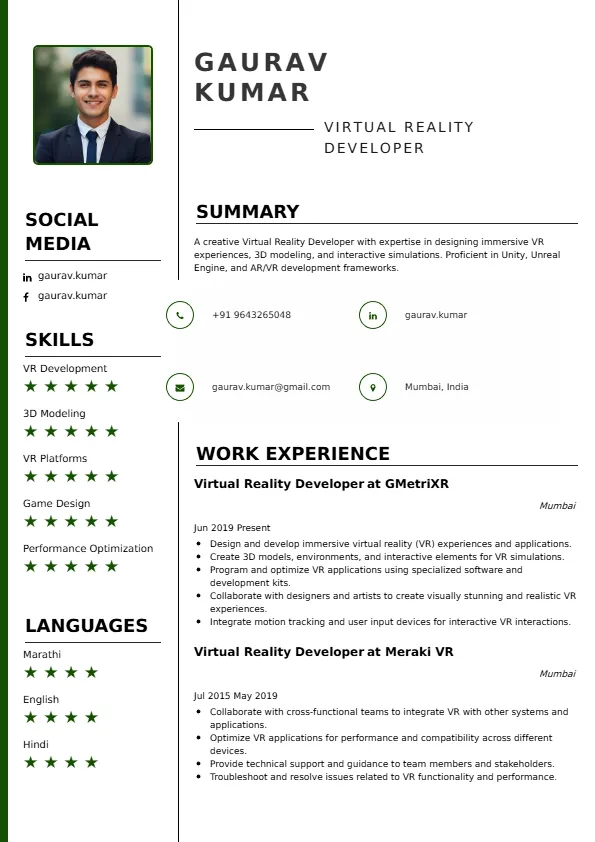
Superbresume.com empowers VR Developers to craft resumes that highlight their immersive experience design and performance optimization expertise. Our platform offers customizable templates tailored for simulation and interactive roles, emphasizing skills like VR interaction design, real-time rendering, optimization (frame rate/latency), and multi-user VR systems. With ATS-optimized formats, expert-written content suggestions, and real-time feedback, we ensure your resume aligns with job descriptions. Showcase your experience in successfully launching high-fidelity VR training simulations, optimizing application performance to maintain a stable frame rate, or contributing to a successful commercial VR title with confidence. Superbresume.com helps you create a polished, results-driven resume that grabs hiring managers’ attention and lands interviews.
How to Write a Resume for a Virtual Reality Developer
Craft a Targeted Summary: Write a 2-3 sentence summary highlighting your expertise in VR/AR development, proficiency in game engines (Unity/Unreal) and C++/C#, and success in designing and deploying immersive, high-performance interactive experiences with minimal latency.
Use Reverse-Chronological Format: List recent VR/AR development, game development, or simulation engineering roles first, focusing on measurable performance and feature delivery achievements.
Highlight Certifications/Portfolio: Include credentials like Unity/Unreal Certified Developer, specialized VR SDK training (Meta/Vive), or feature a GitHub/Portfolio link showcasing interactive demos/code to boost credibility.
Quantify Achievements: Use metrics, e.g., “Optimized rendering pipeline to maintain a stable 90 FPS frame rate on the Meta Quest 2 platform, reducing motion sickness,” or “Developed a safety training simulation that reduced real-world error rates by 20% among trainees,” to show impact.
Incorporate Keywords: Use terms like “Unity/Unreal Engine,” “Virtual Reality (VR)/AR Development,” “C#/C++ Programming,” “VR SDKs (Meta Quest, OpenXR),” “Interaction Design & UX,” “Performance Optimization (Frame Rate/Latency),” or “Simulation Development” from job roles for ATS.
Detail Technical Skills: List proficiency with specific engines, programming languages, VR/AR SDKs, graphics programming (Shaders), 3D math, optimization techniques, and version control (Git/Perforce) in a comprehensive skills section.
Showcase VR Projects: Highlight 3-4 key VR applications or features built, detailing the platform/headset targeted, the technical challenge solved (e.g., networking, physics, rendering), and the measurable business/user outcome.
Emphasize Soft Skills: Include creative problem-solving, technical rigor, attention to detail (motion sickness/fidelity), collaboration (design/artists), and performance consciousness.
Keep It Concise: Limit your resume to 1-2 pages, focusing on relevant VR development, optimization, and interactive experience experience.
Proofread Thoroughly: Eliminate typos or jargon for a professional document.
Performance Optimization for Mobile VR: Focus heavily on expertise optimizing code, assets, and rendering pipelines to achieve and maintain the high frame rates required for comfortable viewing on mobile/standalone headsets (Meta Quest, Pico).
Multi-User VR and Networking: Highlight experience designing and implementing networking solutions for synchronous, multi-user VR experiences (e.g., collaborative training, social platforms), utilizing specialized libraries/middleware.
Advanced Interaction Design: Showcase proficiency implementing complex, natural VR interactions, including hand tracking, haptic feedback integration, and physics-based interactions to enhance immersion.
Simulation and Training Applications: Detail expertise working on high-fidelity VR simulations for corporate training, medical procedures, or industrial safety, focusing on fidelity and measurable learning outcomes.
VR SDK and API Mastery: Emphasize deep knowledge and use of platform-specific SDKs (Meta/Oculus SDK, OpenXR) for implementing core features like tracking, input, and guardian/boundary systems.
Metrics-Driven Achievements: Use results like “Implemented a dynamic occlusion culling system that reduced draw calls by 40%” or “Led the development of a complex physics-based training scenario that achieved 90% positive user feedback on realism.”
C++ and Engine Core Development: Include deep technical skills in C++ (for Unreal) or low-level C# (for Unity) for core system development, physics, and rendering pipeline optimization.
Accessibility and Comfort Design: Highlight experience designing VR experiences that minimize motion sickness, adhere to VR accessibility standards, and prioritize user comfort.
20 Key Skills for a Virtual Reality Developer Resume
| Unity/Unreal Engine Development | VR SDKs (Meta Quest/OpenXR) & API Integration |
| C++/C# Programming (Optimization Focus) | VR Interaction Design & UX (Input/Haptics) |
| Performance Optimization (Frame Rate/Latency) | 3D Graphics & Shader Programming (Rendering Pipeline) |
10 Do’s for a Virtual Reality Developer Resume
Tailor Your Resume: Customize for the specific application (e.g., emphasize simulation rigor, emphasize multiplayer gaming).
Highlight Certifications/Portfolio: List Unity/Unreal certifications and include a link to a VR demo/video reel/codebase prominently.
Quantify Achievements: Include metrics on stable frame rate achieved (e.g., 90 FPS), latency reduction, memory usage optimization, or user performance/learning outcome improvement.
Use Action Verbs: Start bullet points with verbs like “developed,” “optimized,” “integrated,” “designed,” or “programmed.”
Showcase VR Projects: Detail the engine used, the target platform, the technical challenge solved (e.g., networking, rendering), and the measurable user/business outcome.
Include Soft Skills: Highlight creative problem-solving, technical rigor, performance consciousness, and collaboration.
Optimize for ATS: Use standard engineering section titles and incorporate key VR, engine, and programming terms.
Keep It Professional: Use a clean, consistent font and engineering layout.
Emphasize Performance and Immersion: Clearly articulate expertise in maintaining low latency and high fidelity for a comfortable, believable experience.
Proofread Thoroughly: Eliminate typos or jargon for a professional document.
10 Don’ts for a Virtual Reality Developer Resume
Don’t Overload with Jargon: Avoid confusing, internal company or project acronyms; use standardized VR/AR and engine terminology.
Don’t Exceed Two Pages: Keep your resume concise, focusing on high-impact VR development and optimization achievements.
Don’t Omit Dates: Include employment dates for career context.
Don’t Use Generic Templates: Tailor your resume specifically to the specialized immersive and technical duties of a VR Developer.
Don’t List Irrelevant Skills: Focus on engine programming, VR SDKs, graphics, optimization, and interaction design.
Don’t Skip Metrics: Quantify results wherever possible; frame rate, latency, and user comfort are key metrics.
Don’t Use Complex Formats: Avoid highly stylized elements or confusing graphics.
Don’t Ignore Optimization: Include explicit experience profiling and optimizing for VR performance constraints.
Don’t Include Outdated Experience: Omit non-VR or non-engineering jobs over 15 years old.
Don’t Forget to Update: Refresh for new SDK feature mastery, successful application launches, or advanced graphics/multi-user development.
5 FAQ's for a Virtual Reality Developer Resume
Clearly state if you are an expert in Unity (C#) or Unreal Engine (C++/Blueprints).
"Optimized rendering pipelines to maintain a consistent 90 FPS on standalone headsets (Meta Quest), reducing user motion sickness."
Yes. "Developed intuitive spatial UI and physics-based interaction systems for enterprise training simulations."
Mention experience with OpenXR, Oculus Integration, and SteamVR APIs.
Mandatory. Link to a GitHub repo or a video reel showing live gameplay or interactive demos.
Get 5x more interviews with our crafted Resumes. We make resumes that land jobs.

Get a Free Customized Cover Letter with Resume Expert Advice
with every resume order placed, you will get a free Customized Cover letter.