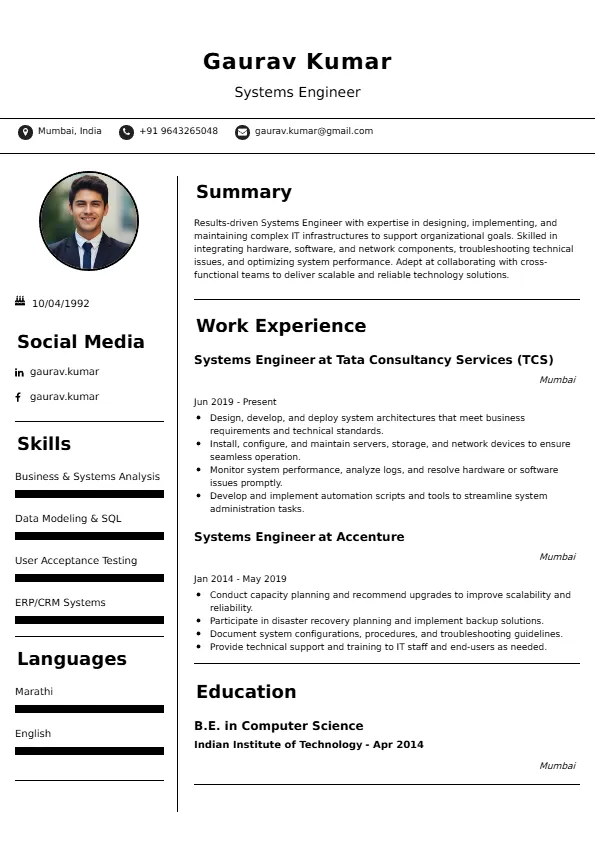
Systems Engineer
Welcome to our Systems Engineer resume sample page! This expertly crafted resume template is designed to showcase your expertise in designing, integrating, and managing complex, multi-disciplinary engineering systems (e.g., aerospace, defense, large-scale IT/Cloud infrastructure), ensuring all functional, performance, and safety requirements are met throughout the system lifecycle. Whether you focus on requirements analysis or system verification, this sample highlights key skills like Requirements Management (DOORS/JIRA), System Architecture (UML/SysML), Verification & Validation (V&V), Technical Trade Studies, and Cross-Functional Integration tailored to meet top engineering demands. Use this guide to create a polished, results-driven resume that stands out and secures your next career opportunity.
Superbresume.com empowers Systems Engineers to craft resumes that highlight their complex system design and integration expertise. Our platform offers customizable templates tailored for senior engineering roles, emphasizing skills like system modeling (MBSE/SysML), risk analysis (FMEA), technical baseline management, and adherence to industry standards (e.g., ISO 15288, INCOSE). With ATS-optimized formats, expert-written content suggestions, and real-time resume analysis, we ensure your resume aligns with job descriptions. Showcase your experience in successfully leading the design of mission-critical systems, significantly reducing integration risks, or achieving flawless compliance during formal V&V testing with confidence. Superbresume.com helps you create a polished, results-driven resume that grabs hiring managers’ attention and lands interviews.
How to Write a Resume for a Systems Engineer
Craft a Targeted Summary: Write a 2-3 sentence summary highlighting your expertise in complex system design and engineering lifecycle management, proficiency in requirements analysis and V&V, and success in leading cross-functional teams to integrate and verify highly reliable systems.
Use Reverse-Chronological Format: List recent Systems Engineer, Lead Architect, or technical project management roles first, focusing on measurable design, integration, and compliance achievements.
Highlight Certifications/Training: Include credentials like Certified Systems Engineering Professional (CSEP/ASEP - INCOSE), PMP Certification, relevant domain-specific certifications (e.g., Cloud Architect), or relevant Master’s Degree (Systems/EE/Aerospace) to boost credibility.
Quantify Achievements: Use metrics, e.g., “Led the requirements derivation and management for a $50M defense system, reducing requirements creep by 15% and achieving 99% traceability compliance,” or “Designed and executed the V&V plan for a complex hardware/software system, reducing integration defects by 30% before final test,” to show impact.
Incorporate Keywords: Use terms like “Requirements Engineering (DOORS/Jama),” “System Architecture & Design (SysML/UML),” “Verification & Validation (V&V),” “Technical Trade Studies,” “Cross-Functional Integration,” “System Lifecycle Management (ISO 15288),” or “Model-Based Systems Engineering (MBSE)” from job roles for ATS.
Detail Methodology/Tool Skills: List proficiency with specific tools (DOORS, JIRA, MagicDraw/Cameo, MATLAB/Simulink), requirements traceability, configuration management, risk analysis (FMEA), and strong technical specification writing in a dedicated skills section.
Showcase System Projects: Highlight 3-4 key systems engineered (e.g., aerospace control system, large-scale cloud infrastructure, complex medical device), detailing the system complexity, the challenge solved, and the quantified quality/performance result.
Emphasize Soft Skills: Include analytical rigor, strategic thinking, strong communication (translating requirements), cross-functional influence, and attention to detail (specifications).
Keep It Concise: Limit your resume to 1-2 pages, focusing on relevant systems engineering, architecture, and V&V experience.
Proofread Thoroughly: Eliminate typos or jargon for a professional document.
Model-Based Systems Engineering (MBSE): Focus heavily on expertise utilizing modeling languages (SysML/UML) and tools (Cameo Systems Modeler) to define system architecture, requirements, and interfaces, moving beyond traditional document-centric approaches.
Digital Engineering and Digital Thread: Highlight experience implementing digital engineering practices, ensuring traceability (the "digital thread") from high-level requirements through design, manufacturing, and verification (V&V).
Requirements Traceability and Management: Showcase advanced skills in managing and maintaining the bidirectional traceability matrix from stakeholder needs down to test cases using dedicated tools (DOORS, Jama).
System Integration and Interface Definition: Detail expertise defining and managing complex interfaces between hardware, software, electrical, and mechanical subsystems, minimizing integration risk.
Verification & Validation (V&V) Planning: Emphasize leadership in developing the V&V strategy, writing test plans, and coordinating formal testing (qualification/acceptance) to prove the system meets all requirements.
Metrics-Driven Achievements: Use results like “Implemented a requirements management process that reduced V&V cycle time by 15%” or “Identified 5 high-impact architectural trade-offs, leading to a system design that reduced operational latency by 20%.”
Agile Systems Engineering: Include experience adapting traditional SE processes to work within iterative/Agile development environments, providing necessary requirements and architecture guidance per sprint.
Safety and Reliability Analysis: Highlight expertise conducting formal safety analyses (FMEA, FTA, HAZOP) and reliability modeling to ensure the final system meets critical safety standards.
Choose Superbresume.com to craft a Systems Engineer resume that stands out in the essential technical leadership sector. Our platform offers tailored templates optimized for ATS, ensuring your skills in MBSE, requirements management, and V&V shine. With expert guidance, pre-written content, and real-time feedback, we help you highlight achievements like reducing integration risks or accelerating the system lifecycle. Whether you focus on aerospace or cloud infrastructure, our tools make it easy to create a polished, results-driven resume. Trust Superbresume.com to showcase your expertise in reliable, strategic, and high-quality complex system design. Start building your career today!
20 Key Skills for a Systems Engineer Resume
| Requirements Management (DOORS, JIRA) | System Architecture & Design (SysML/UML) |
| Verification & Validation (V&V) (Test Planning) | Model-Based Systems Engineering (MBSE) |
| Technical Trade Studies & Analysis | System Integration & Interface Definition |
10 Do’s for a Systems Engineer Resume
Tailor Your Resume: Customize for the specific domain (e.g., emphasize safety-critical standards for aerospace/medical, emphasize cloud scaling for IT infrastructure).
Highlight Certifications/Training: List CSEP/ASEP (INCOSE), PMP, and relevant MBSE/DOORS certifications prominently.
Quantify Achievements: Include metrics on project budget managed, V&V cycle time reduction, requirements creep reduction, or system reliability/performance improvement.
Use Action Verbs: Start bullet points with verbs like “designed,” “integrated,” “verified,” “analyzed,” or “managed.”
Showcase System Projects: Detail the methodology and the strategic, quantified quality/performance result of 3-4 key engineering projects.
Include Soft Skills: Highlight analytical rigor, strategic thinking, strong communication (specifications/reviews), and cross-functional influence.
Optimize for ATS: Use standard engineering section titles and incorporate key INCOSE, modeling, and V&V terms.
Keep It Professional: Use a clean, consistent font and engineering layout.
Emphasize Requirements and V&V: Clearly articulate expertise in managing the full chain of requirements and proving the system works through rigorous testing.
Proofread Thoroughly: Eliminate typos or jargon for a professional document.
10 Don’ts for a Systems Engineer Resume
Don’t Overload with Jargon: Avoid confusing, internal company or project acronyms; use standardized systems engineering terminology.
Don’t Exceed Two Pages: Keep your resume concise, focusing on high-impact system design and integration achievements.
Don’t Omit Dates: Include employment dates for career context.
Don’t Use Generic Templates: Tailor your resume specifically to the strategic, technical, and methodical duties of a Systems Engineer.
Don’t List Irrelevant Skills: Focus on system design, requirements, V&V, architecture, and technical risk analysis.
Don’t Skip Metrics: Quantify results wherever possible; requirements creep, V&V time, and reliability are key metrics.
Don’t Use Complex Formats: Avoid highly stylized elements or confusing graphics.
Don’t Ignore MBSE: Include explicit experience with system modeling languages (SysML) if applicable.
Don’t Include Outdated Experience: Omit non-engineering or low-level technical jobs over 15 years old.
Don’t Forget to Update: Refresh for new CSEP certification, successful system integrations, or advanced V&V training.
5 FAQ's for a Systems Engineer Resume
Focus on the V-Model: "Managed the full systems lifecycle from requirements derivation and architecture to V&V (Verification and Validation)."
Mention producing System Architecture Documents (SAD), Interface Control Documents (ICD), and CONOPS.
Yes. Whether it's Aerospace (DO-178C), Medical (ISO 13485), or Automotive (ISO 26262), compliance is king.
"Maintained rigorous configuration control for a system comprising 1,000+ hardware and software items."
"Utilized Model-Based Systems Engineering (MBSE) tools like Cameo or MagicDraw to create digital twins of complex system architectures."
Get 5x more interviews with our crafted Resumes. We make resumes that land jobs.

Get a Free Customized Cover Letter with Resume Expert Advice
with every resume order placed, you will get a free Customized Cover letter.