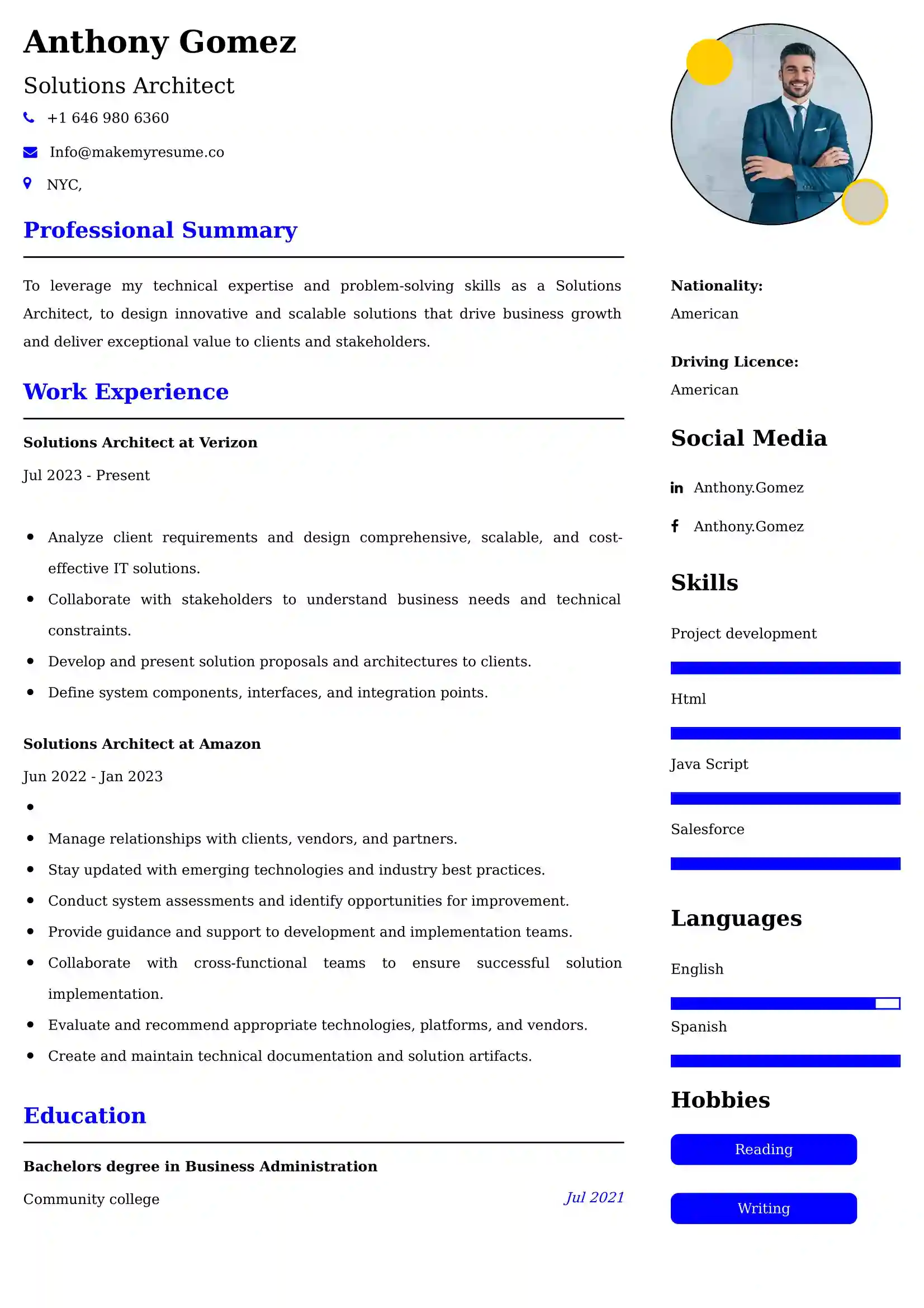
Solutions Architect
Welcome to our Solutions Architect (SA) resume sample page! This expertly crafted resume template is designed to showcase your expertise in designing and documenting end-to-end technical solutions, aligning technology architecture with business requirements, leading cross-functional design discussions, and ensuring system scalability and resilience. Whether you focus on software, cloud, or enterprise integration, this sample highlights key skills like Solution Design, Cloud Architecture (AWS/Azure/GCP), API/Microservices Strategy, Requirements Translation, and Technical Leadership tailored to meet top technology and corporate demands. Use this guide to create a polished, results-driven resume that stands out and secures your next career opportunity.
Superbresume.com empowers Solutions Architects to craft resumes that highlight their strategic design and technical leadership expertise. Our platform offers customizable templates tailored for senior engineering roles, emphasizing skills like architectural patterns (e.g., microservices, event-driven), total cost of ownership (TCO) analysis, security by design, and executive communication. With ATS-optimized formats, expert-written content suggestions, and real-time resume analysis, we ensure your resume aligns with job descriptions. Showcase your experience in successfully leading the architectural design for major product launches, optimizing cloud infrastructure for cost and performance, or driving the adoption of new, scalable technologies across development teams with confidence. Superbresume.com helps you create a polished, results-driven resume that grabs hiring managers’ attention and lands interviews.
How to Write a Resume for a Solutions Architect
Craft a Targeted Summary: Write a 2-3 sentence summary highlighting your expertise in end-to-end solution design and system architecture, proficiency in cloud platforms and modern architectural patterns, and success in aligning technical roadmaps with business strategy for measurable performance gains.
Use Reverse-Chronological Format: List recent Solutions Architect, Principal Engineer, or technical leadership roles first, focusing on measurable design, scalability, and strategic impact achievements.
Highlight Certifications/Training: Include credentials like AWS Certified Solutions Architect (Professional), Azure Solutions Architect Expert, Certified Kubernetes Administrator (CKA), or relevant Master’s Degree/Enterprise Architecture certifications to boost credibility.
Quantify Achievements: Use metrics, e.g., “Designed the microservices architecture for a new platform that scaled to support 10M+ daily users, reducing provisioning time by 40% using Terraform,” or “Led the architectural refactoring of a core service, reducing cloud infrastructure TCO by 25% through optimization and serverless adoption,” to show impact.
Incorporate Keywords: Use terms like “Solution Design & Documentation,” “Cloud Architecture (AWS/Azure/GCP),” “Microservices/Event-Driven Architecture,” “Technical Requirements Translation,” “System Scalability & Resilience,” “API Strategy & Governance,” or “Proof-of-Concept (POC)” from job roles for ATS.
Detail Technical/Architecture Skills: List proficiency with specific cloud services, container orchestration (Kubernetes), IaC (Terraform), programming languages (Go, Python), architecture patterns (Saga, CQRS), and strong communication (UML/sequence diagrams) in a comprehensive skills section.
Showcase Architecture Projects: Highlight 3-4 key systems or platforms architected, detailing the business challenge, the architectural pattern chosen, the technology stack, and the quantified performance/cost outcome.
Emphasize Soft Skills: Include strategic thinking, technical leadership, strong communication (translating technical decisions to business leaders), complex problem-solving, and cross-functional influence.
Keep It Concise: Limit your resume to 1-2 pages, focusing on relevant system architecture, strategic design, and technical leadership experience.
Proofread Thoroughly: Eliminate typos or jargon for a professional document.
Cloud-Native and Multi-Cloud Architecture: Focus on expertise designing highly available, cost-optimized solutions using serverless, containers (GKE/EKS), and managed services, often spanning hybrid or multi-cloud environments.
API and Integration Strategy: Highlight leadership in defining the API strategy (REST/GraphQL/gRPC), ensuring API governance, and architecting robust system-to-system data integration using messaging queues (Kafka) and event-driven patterns.
Security by Design (DevSecOps): Showcase advanced skills embedding security controls (IAM, Zero Trust, encryption) directly into the architectural design and implementation pipeline from the start.
Data Architecture and AI/ML Ops: Detail expertise designing the data flow and infrastructure required for large-scale data lakes (Snowflake, BigQuery) and supporting the operationalization of Machine Learning models (MLOps).
Total Cost of Ownership (TCO) and FinOps: Emphasize designing solutions that optimize cloud spending, accurately forecast TCO, and implement cost governance strategies using Infrastructure as Code (IaC).
Metrics-Driven Achievements: Use results like “Reduced the deployment time for new services from weeks to minutes using a Kubernetes-based pipeline” or “Provided the reference architecture for platform modernization that resulted in $X cost avoidance.”
Technical Documentation and Modeling: Include expertise using architecture description languages (ADLs) or standard notation (UML, C4 Model) to produce clear, maintainable architecture documents for engineering teams.
Proof-of-Concept (POC) Leadership: Highlight experience leading rapid technical feasibility studies and building working POCs to validate new technology choices and architectural approaches.
Choose Superbresume.com to craft a Solutions Architect resume that stands out in the competitive tech leadership sector. Our platform offers tailored templates optimized for ATS, ensuring your skills in cloud architecture, system design, and strategic technical alignment shine. With expert guidance, pre-written content, and real-time feedback, we help you highlight achievements like optimizing TCO or leading complex platform integrations. Whether you specialize in enterprise cloud or software systems, our tools make it easy to create a polished, results-driven resume. Trust Superbresume.com to showcase your expertise in reliable, scalable, and high-value solution engineering. Start building your career today!
20 Key Skills for a Solutions Architect Resume
| Cloud Architecture (AWS/Azure/GCP) & TCO Analysis | Solution Design & Documentation (UML/C4 Model) |
| Microservices & Event-Driven Architecture | API Strategy & Governance (REST/GraphQL/gRPC) |
| System Scalability & Resilience (HA/DR) | Requirements Translation & Stakeholder Management |
10 Do’s for a Solutions Architect Resume
Tailor Your Resume: Customize for the specific domain (e.g., emphasize data/AI architecture, emphasize enterprise application integration).
Highlight Certifications/Training: List AWS Solutions Architect (Pro), Azure Expert, or CKA certifications prominently.
Quantify Achievements: Include metrics on cost reduction (TCO), latency reduction, scalability (user volume), or efficiency gains (deployment speed).
Use Action Verbs: Start bullet points with verbs like “designed,” “architected,” “led,” “optimized,” or “governed.”
Showcase Architecture Projects: Detail the pattern used, the challenge solved, and the strategic, quantified result of 3-4 key architecture projects.
Include Soft Skills: Highlight strategic thinking, technical leadership, strong communication (business/technical translation), and complex problem-solving.
Optimize for ATS: Use standard engineering/architecture section titles and incorporate key cloud, pattern, and framework terms.
Keep It Professional: Use a clean, consistent font and engineering layout.
Emphasize Design and TCO: Clearly articulate expertise in architecting solutions and ensuring financial/operational efficiency.
Proofread Thoroughly: Eliminate typos or jargon for a professional document.
10 Don’ts for a Solutions Architect Resume
Don’t Overload with Jargon: Avoid confusing, internal company acronyms; use standardized architecture and cloud terminology.
Don’t Exceed Two Pages: Keep your resume concise, focusing on high-impact strategic design and architecture achievements.
Don’t Omit Dates: Include employment dates for career context.
Don’t Use Generic Templates: Tailor your resume specifically to the strategic, complex, and leadership duties of a Solutions Architect.
Don’t List Irrelevant Skills: Focus on architecture, cloud, design patterns, integration, and security.
Don’t Skip Metrics: Quantify results wherever possible; cost, latency, and scalability are key metrics.
Don’t Use Complex Formats: Avoid highly stylized elements or confusing graphics.
Don’t Ignore Requirements Translation: Include explicit experience translating business needs into technical specifications.
Don’t Include Outdated Experience: Omit low-level development or non-architecture jobs over 15 years old.
Don’t Forget to Update: Refresh for new cloud certification mastery, successful architecture deployments, or advanced API governance experience.
5 FAQ's for a Solutions Architect Resume
Focus on the business outcome of your designs: "Architected a cloud migration strategy that reduced infrastructure costs by 30% while increasing system uptime."
Mention your ability to create high-level design (HLD) and low-level design (LLD) documents using tools like Lucidchart or Visio.
Yes. Be explicit about your mastery of AWS, Azure, or GCP, including specific services like Lambda, S3, or Kubernetes.
Describe your role as the bridge: "Translated complex technical requirements into actionable roadmaps for executive stakeholders and engineering teams."
Very. If you have experience moving monoliths to microservices, describe the transition and the resulting scalability gains.
Get 5x more interviews with our crafted Resumes. We make resumes that land jobs.

Get a Free Customized Cover Letter with Resume Expert Advice
with every resume order placed, you will get a free Customized Cover letter.