Prompt Optimization Engineer
Welcome to our Prompt Optimization Engineer resume sample page! This expertly crafted resume template is designed to showcase your expertise in systematically improving prompt performance through experimentation, benchmarking, and data-driven iteration. Whether you specialize in reducing costs, improving accuracy, or minimizing latency, this sample highlights key skills like Automated Evaluation Pipelines, A/B Testing, Token Efficiency, Statistical Analysis, and Model Benchmarking tailored to meet the demands of performance-focused AI teams. Use this guide to create a compelling resume that stands out and secures your next career opportunity.
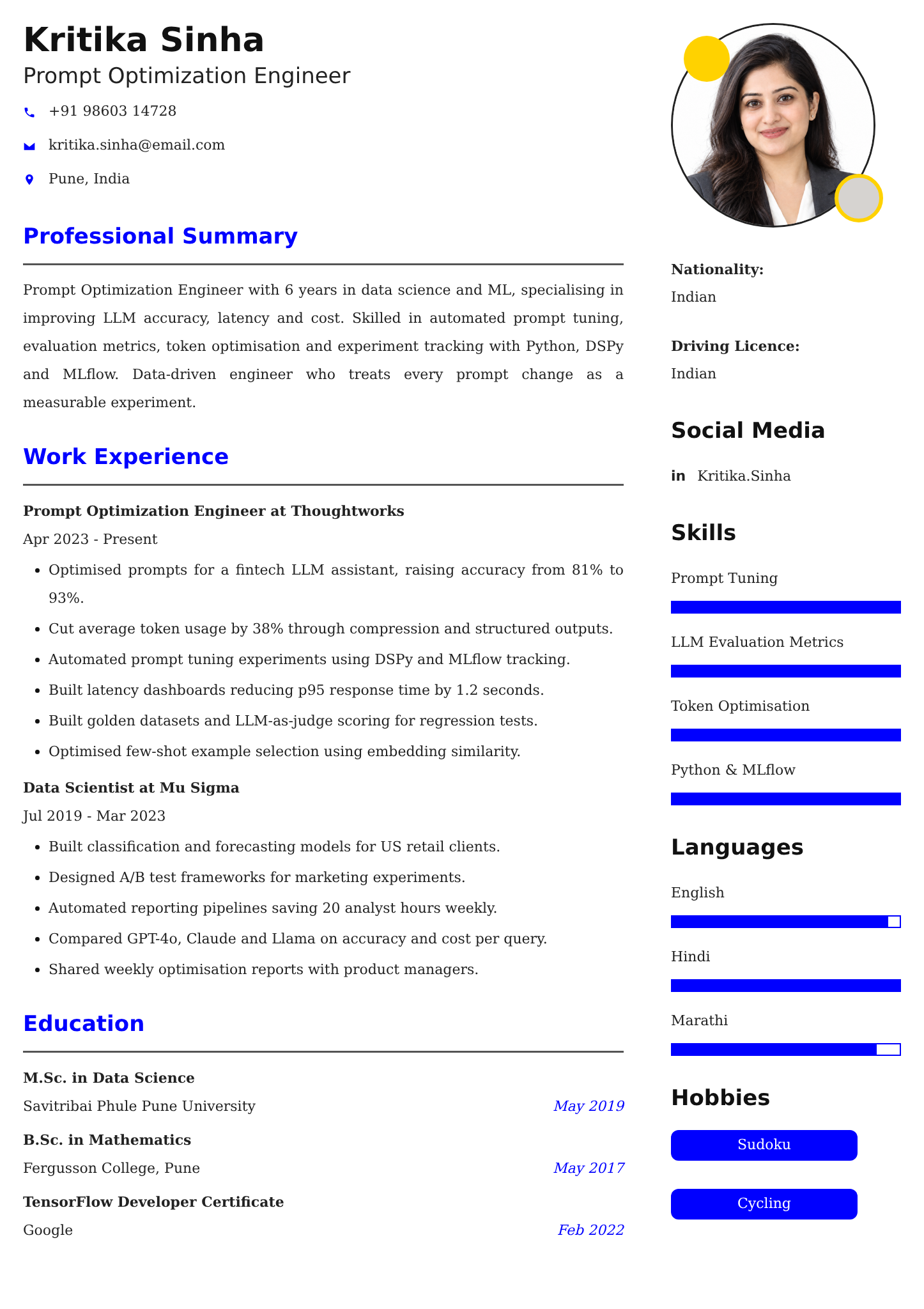
Superbresume.com empowers Prompt Optimization Engineers to craft resumes that highlight their data-driven approach to improving AI performance. Our platform offers customizable templates tailored for optimization roles, emphasizing skills like automated testing pipelines, statistical benchmarking, token/cost efficiency, and cross-model comparison. With ATS-optimized formats, expert-written content suggestions, and real-time resume analysis, we ensure your resume aligns with job descriptions. Showcase your experience in cutting inference costs, improving benchmark accuracy, or building scalable evaluation frameworks with confidence. Superbresume.com helps you create a polished, results-driven resume that grabs hiring managers' attention and lands interviews.
How to Write a Resume for a Prompt Optimization Engineer
Craft a Targeted Summary: Write a 2-3 sentence summary highlighting your expertise in systematic prompt optimization, proficiency in evaluation frameworks, and measurable improvements in cost, speed, or accuracy.
Use Reverse-Chronological Format: List recent optimization, ML engineering, or prompt engineering roles first, focusing on measurable performance gains.
Highlight Certifications/Degrees: Include a degree in Computer Science, Data Science, or a related field, plus relevant machine learning or statistics certifications.
Quantify Achievements: Use metrics, e.g., "Reduced average token usage by 45% while maintaining 98% output accuracy" or "Cut model inference latency by 30% through prompt restructuring," to show impact.
Incorporate Keywords: Use terms like "Prompt Optimization," "A/B Testing Frameworks," "Automated Evaluation Pipelines," "Token Efficiency," "Statistical Analysis," "Model Benchmarking," or "Cost-Performance Tradeoffs" from job descriptions for ATS.
Detail Technical Skills: List proficiency with Python, statistical analysis tools, experiment tracking platforms, and LLM APIs in a comprehensive skills section.
Showcase Key Projects: Highlight 3-4 optimization initiatives, detailing the baseline metrics, your testing methodology, and the final measurable improvement.
Emphasize Soft Skills: Include analytical rigor, systematic experimentation mindset, and clear technical communication.
Keep It Concise: Limit your resume to 1-2 pages, focusing on relevant optimization and performance achievements.
Proofread Thoroughly: Eliminate typos or inconsistent formatting for a professional document.
Automated Evaluation at Scale: Focus on expertise building pipelines that continuously test and score prompt variations across thousands of examples.
Cost-Performance Tradeoffs: Highlight experience balancing model quality against compute and API costs for production-scale deployments.
Statistical Rigor: Showcase proficiency applying statistical significance testing and confidence intervals to prompt experiment results.
Fine-Tuning vs. Prompting Analysis: Detail expertise evaluating when prompt optimization outperforms or complements fine-tuning approaches.
Multi-Model Benchmarking: Emphasize experience comparing prompt performance across different LLM providers and model versions.
Metrics-Driven Achievements: Use results like "Improved benchmark accuracy from 81% to 96% through iterative prompt refinement" or "Reduced monthly API spend by $50K via token-efficient prompt redesign."
Continuous Monitoring: Include experience setting up dashboards and alerts to detect prompt performance drift in production.
Collaboration with Data Science: Highlight proficiency partnering with data scientists and ML engineers to align optimization efforts with broader model strategy.
Choose Superbresume.com to craft a Prompt Optimization Engineer resume that stands out in the performance-driven AI sector. Our platform offers tailored templates optimized for ATS, ensuring your skills in automated testing, statistical analysis, and cost efficiency shine. With expert guidance, pre-written content, and real-time feedback, we help you highlight achievements like reducing costs or improving benchmark accuracy. Whether you specialize in enterprise AI or consumer applications, our tools make it easy to create a polished, results-driven resume. Trust Superbresume.com to showcase your expertise in data-driven AI optimization. Start building your career today!
20 Key Skills for a Prompt Optimization Engineer Resume
| Prompt Optimization & Iteration | Automated Evaluation Pipelines |
| A/B Testing & Statistical Analysis | Token & Cost Efficiency |
| Model Benchmarking (Multi-LLM) | Python & Data Analysis Tools |
| Latency & Performance Tuning | Experiment Tracking & Monitoring |
| Fine-Tuning vs. Prompting Analysis | Production Drift Detection |
| LLM-as-a-Judge Evaluation | Prompt Compression Techniques |
| Caching & Batching Strategies | Evaluation Metrics Design |
| DSPy & Automated Prompt Optimization | Regression Testing for Prompts |
| Model Routing & Selection | Cost-Performance Trade-off Analysis |
| Dashboarding & Reporting | Reproducible Experimentation |
10 Do's for a Prompt Optimization Engineer Resume
Tailor Your Resume: Customize for the specific optimization focus (e.g., emphasize cost reduction for enterprise roles, accuracy for research roles).
Highlight Certifications/Degrees: List relevant technical degrees and data science certifications prominently.
Quantify Achievements: Include metrics on cost savings, accuracy improvements, or latency reductions.
Use Action Verbs: Start bullet points with verbs like "optimized," "benchmarked," "analyzed," "reduced," or "automated."
Showcase Key Projects: Detail the baseline, methodology, and quantified result of 3-4 optimization initiatives.
Include Soft Skills: Highlight analytical rigor and cross-functional collaboration with data science teams.
Optimize for ATS: Use standard technical section titles and incorporate key optimization and statistics terms.
Keep It Professional: Use a clean, consistent font and modern technical layout.
Emphasize Measurable Impact: Clearly articulate the quantified business and technical impact of your optimizations.
Proofread Thoroughly: Eliminate typos or jargon inconsistencies for a professional document.
10 Don'ts for a Prompt Optimization Engineer Resume
Don't Overload with Jargon: Avoid confusing internal acronyms; use standardized ML and statistics terminology.
Don't Exceed Two Pages: Keep your resume concise, focusing on high-impact optimization achievements.
Don't Omit Dates: Include employment dates for career context.
Don't Use Generic Templates: Tailor your resume specifically to the analytical rigor of optimization work.
Don't List Irrelevant Skills: Focus on prompting, evaluation, statistics, and performance tuning.
Don't Skip Metrics: Quantify results wherever possible; cost, latency, and accuracy are key metrics.
Don't Use Complex Formats: Avoid highly stylized elements or confusing graphics.
Don't Ignore Technical Skills: Include explicit experience with Python, statistical tools, and evaluation frameworks.
Don't Include Outdated Experience: Omit non-technical or irrelevant jobs over 15 years old.
Don't Forget to Update: Refresh for new optimization techniques, tools, or model benchmarks mastered.
5 FAQs for a Prompt Optimization Engineer Resume
Recruiters want to see your experience systematically improving prompt accuracy, cost, and latency through experimentation and data, backed by measurable results. Work keywords such as prompt optimization, A/B testing, automated evaluation, token efficiency, and model benchmarking naturally into your summary, skills, and experience so ATS filters rank you highly.
Accuracy, cost per request, latency, and regression rates are the core metrics. Present them as before-and-after figures so employers can see exactly how much value your optimization delivered.
Yes—name tools like DSPy, promptfoo, OpenAI Evals, or custom pipelines in Python. These signal that your optimizations are measured systematically, not by trial and error.
Consider data science or ML certifications, cloud AI certifications, or statistics coursework. Place them in a dedicated certifications section, including the issuing body and year.
Explain which models you benchmarked, the criteria you used, and the decision that followed. For example, routing simple queries to a smaller model while keeping complex ones on a larger model to cut costs by 40%. A well-structured, ATS-friendly template from Superbresume.com can help you present this clearly.
Get 5x more interviews with our crafted Resumes. We make resumes that land jobs.

Get a Free Customized Cover Letter with Resume Expert Advice
with every resume order placed, you will get a free Customized Cover letter.