Machine Learning Engineer
Welcome to our Machine Learning (ML) Engineer resume sample page! This expertly crafted resume template is designed to showcase your expertise in designing, building, and deploying scalable machine learning models into production environments, focusing on robustness, performance, and MLOps principles. Whether you're an entry-level candidate or a seasoned professional, this sample highlights key skills like Python (Scikit-learn, TensorFlow/PyTorch), MLOps/DevOps (Kubeflow, MLflow), cloud infrastructure (AWS/Azure/GCP), API development for inference, and advanced data processing tailored to meet top tech and AI demands. Use this guide to create a compelling resume that stands out and secures your next career opportunity.
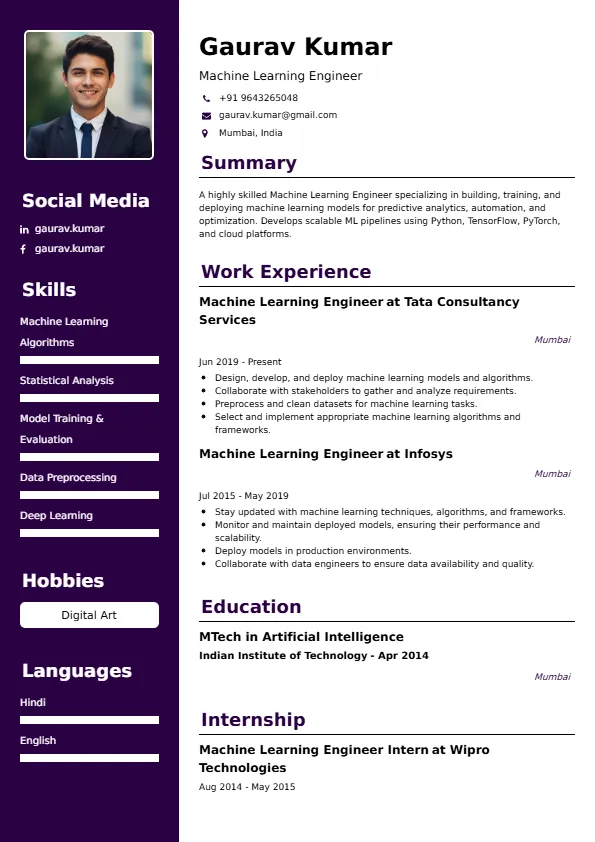
Superbresume.com empowers Machine Learning Engineers to craft resumes that highlight their production deployment and model scalability expertise. Our platform offers customizable templates tailored for AI roles, emphasizing skills like model versioning, containerization (Docker/Kubernetes), real-time inference serving, and end-to-end MLOps pipeline construction. With ATS-optimized formats, expert-written content suggestions, and real-time resume analysis, we ensure your resume aligns with job descriptions. Showcase your experience in successfully deploying high-impact models that drove revenue, optimizing model latency for real-time applications, or building a robust, automated retraining pipeline with confidence. Superbresume.com helps you create a polished, results-driven resume that grabs hiring managers’ attention and lands interviews.
How to Write a Resume for a Machine Learning Engineer
Craft a Targeted Summary: Write a 2-3 sentence summary highlighting your expertise in building and deploying scalable ML models to production, proficiency in Python, cloud platforms, and MLOps tools, and success in driving business value through robust, high-performance AI solutions.
Use Reverse-Chronological Format: List recent ML engineering, MLOps, or data science roles first, focusing on measurable production deployment and model performance achievements.
Highlight Certifications/Portfolio: Include credentials like AWS Certified Machine Learning Specialty, Google Cloud Professional ML Engineer, Master’s Degree (CS/AI), or feature a GitHub/Portfolio link showcasing production models/pipelines to boost credibility.
Quantify Achievements: Use metrics, e.g., “Deployed a predictive model that improved sales forecasting accuracy by 15%, resulting in a $1M reduction in inventory costs,” or “Optimized model inference API latency by 50% (to sub-100ms) to support a real-time recommendation engine,” to show impact.
Incorporate Keywords: Use terms like “MLOps (Deployment/Monitoring),” “Python (TensorFlow/PyTorch/Scikit-learn),” “Production Machine Learning,” “Model Versioning & Serving,” “Cloud Infrastructure (AWS/GCP/Azure),” “Containerization (Docker/Kubernetes),” or “Advanced Data Processing (Spark)” from job descriptions for ATS.
Detail Technical Skills: List proficiency with specific ML frameworks, MLOps tools (MLflow, Kubeflow, Sagemaker), container tools, API development (Flask/FastAPI), SQL/NoSQL databases, and CI/CD pipelines in a comprehensive skills section.
Showcase ML Projects: Highlight 3-4 key models or pipelines built, detailing the model type (e.g., classification, deep learning), the deployment architecture, the MLOps challenge solved, and the measurable business/user outcome.
Emphasize Soft Skills: Include analytical rigor, systematic problem-solving (data/model drift), security consciousness, strong communication (with Data Scientists/Software Engineers), and commitment to reproducible work.
Keep It Concise: Limit your resume to 1-2 pages, focusing on relevant ML engineering, deployment, and MLOps experience.
Proofread Thoroughly: Eliminate typos or jargon for a professional document.
Full-Cycle MLOps Pipeline: Focus heavily on expertise building and managing the entire pipeline: from feature store management and model training to deployment (CI/CD/CT), monitoring (data/model drift), and automated retraining.
Cloud MLOps Platforms: Highlight proficiency utilizing managed cloud services like AWS SageMaker, Azure ML, or Google Vertex AI for scalable, integrated MLOps workflows.
Real-Time and Low-Latency Serving: Showcase experience deploying models for real-time inference using API services (e.g., Kubernetes, serverless endpoints) and optimizing model serialization/serving for sub-millisecond latency.
Containerization and Orchestration: Detail deep experience packaging models and inference services using Docker and orchestrating them with Kubernetes for scalable, fault-tolerant production environments.
Model Explainability and Ethical AI: Emphasize implementing tools and techniques (SHAP, LIME) to ensure model predictions are explainable, fair, and adhere to ethical AI guidelines.
Metrics-Driven Achievements: Use results like “Implemented a fraud detection model that reduced false positives by 20% while maintaining detection rate” or “Reduced model retraining time from 6 hours to 30 minutes via optimized data processing (Spark).”
Feature Store and Data Engineering: Include expertise collaborating with data engineers to design and utilize a centralized feature store to ensure consistency between training and serving data.
Model Monitoring and Alerting: Highlight experience setting up monitoring dashboards (Prometheus, Grafana) and automated alerts for model performance degradation or data quality issues in production.
Choose Superbresume.com to craft a Machine Learning Engineer resume that stands out in the competitive AI and software sector. Our platform offers tailored templates optimized for ATS, ensuring your skills in production deployment, MLOps, and model scalability shine. With expert guidance, pre-written content, and real-time feedback, we help you highlight achievements like optimizing inference latency or building robust training pipelines. Whether you specialize in deep learning or classical ML, our tools make it easy to create a polished, results-driven resume. Trust Superbresume.com to showcase your expertise in engineering and deploying high-impact AI solutions. Start building your career today!
20 Key Skills for a Machine Learning Engineer Resume
| Python (TensorFlow, PyTorch, Scikit-learn) | MLOps (CI/CD, Deployment, Monitoring) |
| Containerization (Docker/Kubernetes) | Cloud ML Platforms (SageMaker/Vertex AI/Azure ML) |
| API Development for Inference (Flask/FastAPI) | Data Preprocessing & Feature Engineering (Spark) |
| Model Versioning & Experiment Tracking (MLflow) | Cloud Infrastructure (AWS, GCP, Azure) |
| Advanced Algorithms (Classification, Regression, NLP) | Real-Time Inference & Low Latency Optimization |
10 Do’s for a Machine Learning Engineer Resume
Tailor Your Resume: Customize for the specific model type (e.g., emphasize NLP and Transformers for an AI company, emphasize classical ML for a FinTech risk role).
Highlight Certifications/Training: List AWS ML Specialty, Google ML Engineer, or relevant Master’s/Ph.D. degrees prominently.
Quantify Achievements: Include metrics on model accuracy improvement, inference latency reduction, deployment speed, or business value generated (revenue/cost savings).
Use Action Verbs: Start bullet points with verbs like “deployed,” “engineered,” “optimized,” “modeled,” or “architected.”
Showcase Production MLOps: Detail the methodology and the strategic, quantified performance/reliability result of 3-4 key deployment pipelines.
Include Soft Skills: Highlight analytical rigor, security consciousness, systematic problem-solving, and cross-functional collaboration.
Optimize for ATS: Use standard engineering/data science section titles and incorporate key MLOps, framework, and cloud terms.
Keep It Professional: Use a clean, consistent font and engineering layout.
Emphasize Deployment and Scale: Clearly articulate expertise in moving models from research/notebooks into high-performance, scalable production environments.
Proofread Thoroughly: Eliminate typos or jargon for a professional document.
10 Don’ts for a Machine Learning Engineer Resume
Don’t Overload with Jargon: Avoid confusing, internal company or niche academic acronyms; use standardized ML and MLOps terminology.
Don’t Exceed Two Pages: Keep your resume concise, focusing on high-impact production ML and system engineering achievements.
Don’t Omit Dates: Include employment dates for career context.
Don’t Use Generic Templates: Tailor your resume specifically to the technical deployment and MLOps duties of an ML Engineer.
Don’t List Irrelevant Skills: Focus on ML frameworks, cloud platforms, MLOps, deployment tools, and data engineering/processing.
Don’t Skip Metrics: Quantify results wherever possible; latency, accuracy, and business impact are critical metrics.
Don’t Use Complex Formats: Avoid highly stylized elements or confusing graphics.
Don’t Ignore Data/DevOps: Include explicit experience with data pipeline tools (Spark) and CI/CD for model code.
Don’t Include Outdated Experience: Omit non-ML or non-software engineering jobs over 15 years old.
Don’t Forget to Update: Refresh for new cloud MLOps platform mastery, successful model deployments, or advanced performance optimization techniques.
5 FAQs for a Machine Learning Engineer Resume
Prioritize Python/ML frameworks (PyTorch/TensorFlow), MLOps principles/tools (Kubeflow/SageMaker), containerization (Docker/K8s), API development for inference, and advanced data processing.
Use standard engineering/data science section titles, avoid graphics, and include keywords like “MLOps,” “Kubeflow,” and “Real-Time Inference.”
Yes, a link to GitHub showcasing production-ready pipelines, Dockerfiles, and model code is mandatory.
Detail the metric (e.g., accuracy, precision) and the improvement achieved, or detail the system performance metric (e.g., latency, throughput) and the reduction achieved via optimization.
Use a reverse-chronological format to emphasize your most recent, high-impact MLOps and production deployment achievements.
Get 5x more interviews with our crafted Resumes. We make resumes that land jobs.

Get a Free Customized Cover Letter with Resume Expert Advice
with every resume order placed, you will get a free Customized Cover letter.