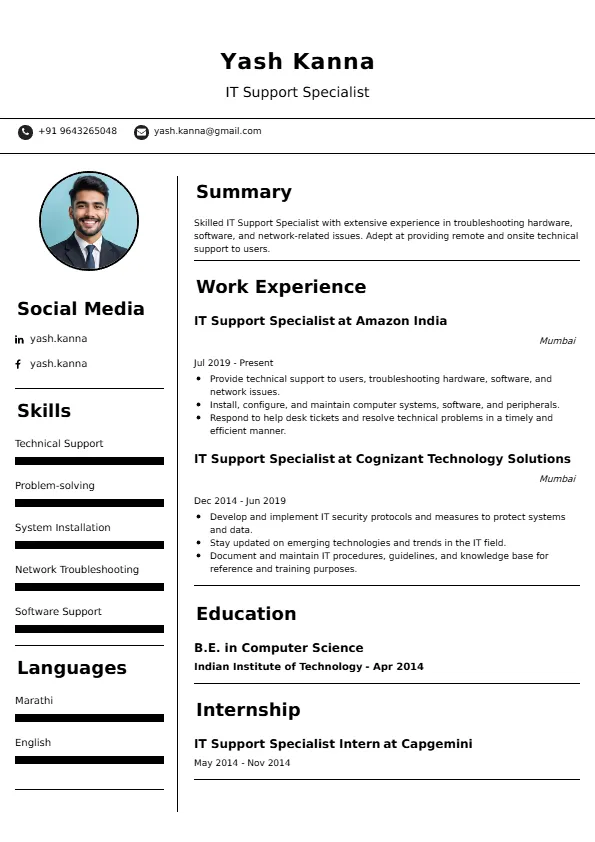
IT Support Specialist
Welcome to our IT Support Specialist resume sample page! This expertly crafted resume template is designed to showcase your expertise in providing technical support (Tier 1/2), troubleshooting hardware/software issues, managing user accounts, and maintaining IT infrastructure and service quality. Whether you're an entry-level candidate or a seasoned professional, this sample highlights key skills like Ticketing Systems (ServiceNow), Windows/Mac OS troubleshooting, Active Directory (AD), remote support, and hardware break/fix tailored to meet top corporate and client demands. Use this guide to create a compelling resume that stands out and secures your next career opportunity.
Superbresume.com empowers IT Support Specialists to craft resumes that highlight their technical problem-solving and user satisfaction expertise. Our platform offers customizable templates tailored for IT support roles, emphasizing skills like First Call Resolution (FCR), ITIL principles, user provisioning/deprovisioning, and hardware/software rollout support. With ATS-optimized formats, expert-written content suggestions, and real-time resume analysis, we ensure your resume aligns with job descriptions. Showcase your experience in consistently achieving high user satisfaction scores, reducing Mean Time to Resolution (MTTR), or successfully managing large-scale hardware deployments with confidence. Superbresume.com helps you create a polished, results-driven resume that grabs hiring managers’ attention and lands interviews.
How to Write a Resume for an IT Support Specialist
Craft a Targeted Summary: Write a 2-3 sentence summary highlighting your expertise in technical support (Tier 1/2), proficiency in troubleshooting operating systems and managing user access (AD), and success in achieving high user satisfaction and fast resolution rates.
Use Reverse-Chronological Format: List recent IT support, help desk, or technical administration roles first, focusing on measurable resolution and customer service achievements.
Highlight Certifications/Training: Include credentials like CompTIA A+, ITIL Foundation, Microsoft Certified Desktop Support Technician (MCDST), or relevant networking/security certifications to boost credibility.
Quantify Achievements: Use metrics, e.g., “Consistently maintained a First Call Resolution (FCR) rate of 85% for Tier 1 issues,” or “Reduced Mean Time to Resolution (MTTR) for critical incidents by 30 minutes through improved diagnostic procedures,” to show impact.
Incorporate Keywords: Use terms like “Ticketing Systems (ServiceNow/Jira),” “Active Directory (AD) User Management,” “First Call Resolution (FCR),” “Remote Desktop Support,” “Hardware/Software Troubleshooting,” “SLA/MTTR Management,” or “Customer Service” from job roles for ATS.
Detail Technical Skills: List proficiency with specific ticketing systems, operating systems (Windows/Mac), networking basics (TCP/IP), Microsoft 365/Exchange, VPN/security tools, and hardware break/fix procedures in a comprehensive skills section.
Showcase Support Success: Highlight 3-4 key projects or responsibilities (e.g., leading a new employee tech onboarding process, managing a company-wide O365 migration support, creating a self-service knowledge base), detailing the scope and the efficiency/user satisfaction result.
Emphasize Soft Skills: Include patience, clear communication (for non-technical users), rapid problem-solving, attention to detail (documentation), and strong customer service orientation.
Keep It Concise: Limit your resume to 1 page, focusing on relevant technical support, problem-solving, and service experience.
Proofread Thoroughly: Eliminate typos or jargon for a professional document.
Multi-Channel Support (Chat/Walk-up/Phone): Focus on expertise providing consistent, high-quality support across diverse channels, including remote support using tools like SCCM/Intune and remote desktop software.
ITIL and Service Desk Process: Highlight knowledge of ITIL principles (Incident/Request Management) and experience adhering to service desk processes to ensure efficient ticket flow and accurate SLA reporting.
Cloud Productivity Suite Support: Showcase deep proficiency troubleshooting issues related to Microsoft 365 (Teams, OneDrive, SharePoint) and supporting hybrid identity environments (Azure AD integration).
Cybersecurity First Responder: Detail experience acting as the first line of defense, identifying and responding to basic security threats (e.g., malware, phishing attempts, suspicious activity), and adhering to incident escalation procedures.
Automation for Support: Include basic scripting skills (PowerShell/Bash) to automate user provisioning, machine setup, or repetitive troubleshooting steps to improve efficiency.
Metrics-Driven Achievements: Use results like “Achieved a Customer Satisfaction (CSAT) rating of 96% for service quality” or “Reduced recurring ticket volume by 10% by creating 5 new knowledge base articles.”
Hardware Lifecycle Management: Highlight experience assisting with the entire lifecycle of end-user devices, including imaging, deployment, tracking inventory, and secure de-provisioning.
VOIP and Video Conferencing Support: Detail expertise troubleshooting issues related to VOIP telephony, meeting room technology, and video conferencing applications (Zoom/Teams).
Choose Superbresume.com to craft an IT Support Specialist resume that stands out in the competitive end-user services field. Our platform offers tailored templates optimized for ATS, ensuring your skills in FCR, Active Directory, and customer satisfaction shine. With expert guidance, pre-written content, and real-time feedback, we help you highlight achievements like reducing resolution time or maintaining high user satisfaction. Whether you support internal staff or external clients, our tools make it easy to create a polished, results-driven resume. Trust Superbresume.com to showcase your expertise in reliable, efficient, and user-centric technical support. Start building your career today!
20 Key Skills for an IT Support Specialist Resume
| Ticketing Systems (ServiceNow, Jira, Zendesk) | First Call Resolution (FCR) & MTTR Management |
| Active Directory (User/Group Management) | Windows/Mac OS Troubleshooting |
| Remote Desktop Support (VPN, RDP, Intune) | Microsoft 365/Exchange/Teams Support |
| Hardware Break/Fix & Troubleshooting | Network Troubleshooting (Basic TCP/IP, DNS) |
| Customer Service & User Communication | ITIL Principles (Incident/Request) |
| SLA Adherence | Hardware Imaging & Deployment |
| Knowledge Base (KB) Documentation | Security Incident Triage (Phishing) |
| Problem-Solving (Systematic) | Time Management & Prioritization |
10 Do’s for an IT Support Specialist Resume
Tailor Your Resume: Customize for the specific platform focus (e.g., emphasize Mac OS/JAMF for a design company, emphasize Windows/GPO for a finance firm).
Highlight Certifications/Training: List CompTIA A+, ITIL Foundation, or relevant Microsoft certifications prominently.
Quantify Achievements: Include metrics on FCR rate, MTTR reduction, Customer Satisfaction (CSAT) scores, or daily ticket volume managed.
Use Action Verbs: Start bullet points with verbs like “resolved,” “troubleshooted,” “managed,” “provisioned,” or “supported.”
Showcase Support Success: Detail projects or processes where your intervention measurably improved user efficiency or reduced recurring issues.
Include Soft Skills: Highlight clear communication, patience, rapid problem-solving, and strong customer service orientation.
Optimize for ATS: Use standard IT support section titles and incorporate key system and metric terms.
Keep It Concise: Limit your resume to one page, focusing on relevant technical support, system management, and service experience.
Emphasize FCR and Customer Service: Clearly articulate experience resolving issues quickly and effectively while maintaining high satisfaction.
Proofread Thoroughly: Ensure no typos or errors in technical terms, software names, or metrics.
10 Don’ts for an IT Support Specialist Resume
Don’t Overload with Jargon: Avoid confusing, internal company acronyms; use standardized ITIL, network, and application terminology.
Don’t Exceed One Page: Keep your resume sharp and focused on the most relevant, measurable support duties.
Don’t Omit Dates: Include employment dates for career context.
Don’t Use Generic Templates: Tailor your resume specifically to the technical troubleshooting and customer-facing duties of an IT Support Specialist.
Don’t List Irrelevant Skills: Focus on operating systems, network basics, ticketing systems, Active Directory, and hardware/software support.
Don’t Skip Metrics: Quantify results wherever possible; FCR, CSAT, and MTTR are critical metrics.
Don’t Use Complex Formats: Avoid highly stylized elements or confusing graphics.
Don’t Ignore Documentation: Include experience contributing to or managing the knowledge base.
Don’t Include Outdated Experience: Omit non-IT or irrelevant administrative jobs over 10 years old.
Don’t Forget to Update: Refresh for new certification mastery, successful software rollout support, or advanced troubleshooting techniques.
5 FAQs for an IT Support Specialist Resume
Prioritize high FCR/MTTR, Active Directory user management, ticketing system proficiency (ServiceNow), Windows/Mac OS troubleshooting, and CompTIA A+ certification.
Use standard IT support section titles, avoid graphics, and include keywords like “FCR,” “Active Directory,” and “Ticketing Systems.”
Yes, quantifying customer satisfaction (CSAT) demonstrates a user-centric approach and is highly valued.
Detail a process change or tool implementation that resulted in a quantified reduction in time (e.g., Mean Time to Resolution, MTTR).
Use a reverse-chronological format to emphasize your most recent, high-impact technical support and user service achievements.
Get 5x more interviews with our crafted Resumes. We make resumes that land jobs.

Get a Free Customized Cover Letter with Resume Expert Advice
with every resume order placed, you will get a free Customized Cover letter.