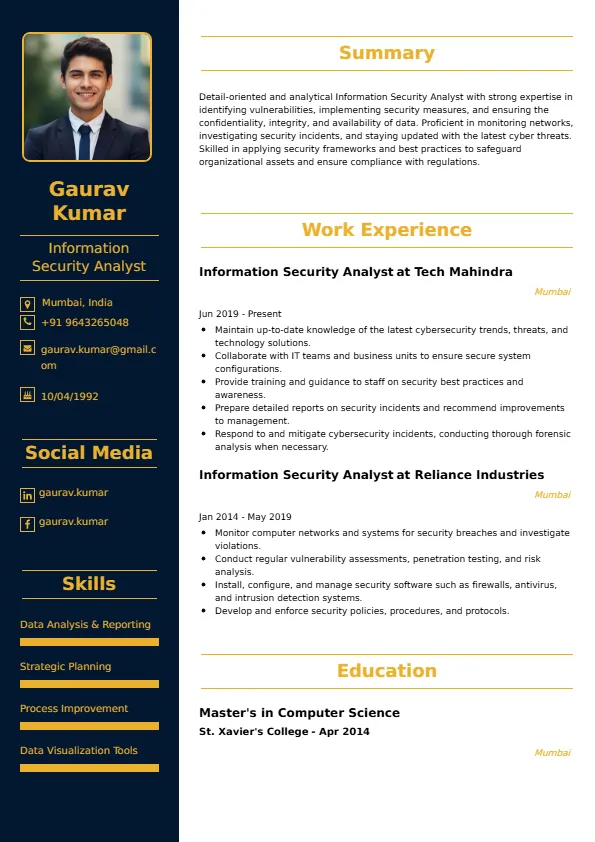
Information Security Analyst
Welcome to our Information Security (InfoSec) Analyst resume sample page! This expertly crafted resume template is designed to showcase your expertise in monitoring, detecting, analyzing, and responding to cyber threats and security incidents, performing vulnerability assessments, and managing security tools (SIEM/IDS/IPS). Whether you're an entry-level candidate or a seasoned professional, this sample highlights key skills like SIEM operations, threat intelligence, vulnerability scanning, incident response (IR), penetration testing (basic), and regulatory compliance (e.g., ISO 27001, NIST) tailored to meet top corporate IT and security demands. Use this guide to create a compelling resume that stands out and secures your next career opportunity.
Superbresume.com empowers Information Security Analysts to craft resumes that highlight their threat detection and incident response expertise. Our platform offers customizable templates tailored for cybersecurity roles, emphasizing skills like log analysis, threat hunting, security operations center (SOC) processes, and security tool configuration. With ATS-optimized formats, expert-written content suggestions, and real-time resume analysis, we ensure your resume aligns with job descriptions. Showcase your experience in consistently reducing mean time to detect (MTTD) and mean time to respond (MTTR) to incidents, successfully mitigating major vulnerabilities, or managing compliance controls (NIST/ISO) with confidence. Superbresume.com helps you create a polished, results-driven resume that grabs hiring managers’ attention and lands interviews.
How to Write a Resume for an Information Security Analyst
Craft a Targeted Summary: Write a 2-3 sentence summary highlighting your expertise in cyber threat analysis and incident response, proficiency in SIEM/security tools, and success in performing vulnerability assessments and maintaining regulatory compliance.
Use Reverse-Chronological Format: List recent InfoSec analyst, SOC, or IT security roles first, focusing on measurable security efficacy and incident handling achievements.
Highlight Certifications/Training: Include credentials like CompTIA Security+, Certified Information Systems Security Professional (CISSP), Certified Ethical Hacker (CEH), or relevant cloud security certifications to boost credibility.
Quantify Achievements: Use metrics, e.g., “Reduced Mean Time to Detect (MTTD) security incidents by 20% through optimization of SIEM correlation rules,” or “Successfully mitigated 50+ critical vulnerabilities identified via weekly scanning, ensuring 95% compliance with patch cycles,” to show impact.
Incorporate Keywords: Use terms like “Security Information and Event Management (SIEM),” “Incident Response (IR),” “Vulnerability Assessment,” “Threat Intelligence (TI),” “NIST/ISO 27001 Compliance,” “Firewall/IDS/IPS Management,” or “Log Analysis” from job descriptions for ATS.
Detail Technical Skills: List proficiency with specific SIEM platforms (e.g., Splunk, Sentinel, QRadar), vulnerability scanners (Nessus, Qualys), endpoint detection and response (EDR) tools, networking basics, and scripting (Python) in a comprehensive skills section.
Showcase Security Projects: Highlight 3-4 key projects (e.g., SIEM rule development, incident playbook creation, major phishing campaign response), detailing the methodology, the challenge, and the quantified security efficacy or compliance result.
Emphasize Soft Skills: Include critical thinking, systematic problem-solving, rapid decision-making (during incidents), attention to detail (log analysis), and strong written communication (for reports).
Keep It Concise: Limit your resume to 1-2 pages, focusing on relevant security operations, analysis, and compliance experience.
Proofread Thoroughly: Eliminate typos or jargon for a professional document.
Cloud Security Monitoring: Focus on expertise monitoring and securing cloud environments (AWS, Azure, GCP), including using native security tools and understanding cloud security posture management (CSPM).
Threat Hunting and MITRE ATT&CK: Highlight experience proactively searching for threats that bypass existing defenses, utilizing the MITRE ATT&CK framework for TTP (Tactics, Techniques, and Procedures) analysis.
SOAR/Automation Tools: Showcase proficiency utilizing Security Orchestration, Automation, and Response (SOAR) platforms to automate repetitive IR tasks and accelerate response times.
Endpoint Detection and Response (EDR): Detail deep experience configuring, monitoring, and responding to alerts generated by modern EDR tools (e.g., CrowdStrike, SentinelOne) for endpoint threat mitigation.
Compliance Frameworks (NIST, CIS): Emphasize experience mapping and auditing security controls against formal frameworks like NIST CSF, ISO 27001, or the CIS Controls.
Metrics-Driven Achievements: Use results like “Reduced the average cost of security incidents by 15% through rapid containment” or “Developed 10 new, high-fidelity SIEM correlation rules, reducing false positives by 20%.”
Phishing and User Awareness: Include experience designing and running simulated phishing campaigns and providing security awareness training to end-users.
Basic Penetration Testing/Red Team: Highlight foundational knowledge or assistance with internal penetration testing and vulnerability exploitation techniques.
Choose Superbresume.com to craft an Information Security Analyst resume that stands out in the critical cybersecurity sector. Our platform offers tailored templates optimized for ATS, ensuring your skills in SIEM, incident response, and vulnerability management shine. With expert guidance, pre-written content, and real-time feedback, we help you highlight achievements like reducing detection time or mitigating critical vulnerabilities. Whether you focus on SOC operations or compliance, our tools make it easy to create a polished, results-driven resume. Trust Superbresume.com to showcase your expertise in protecting data and infrastructure from evolving cyber threats. Start building your career today!
20 Key Skills for an Information Security Analyst Resume
| SIEM (Splunk/Sentinel/QRadar) Operation | Incident Response (IR) & Forensics (Basic) |
| Vulnerability Assessment & Management (Nessus/Qualys) | Threat Intelligence (TI) & Threat Hunting |
| Firewall/IDS/IPS Configuration & Monitoring | Log Analysis & Correlation Rule Development |
| Endpoint Detection and Response (EDR) Tools | NIST/ISO 27001/CIS Controls Compliance |
| Networking & TCP/IP Fundamentals | Security Operations Center (SOC) Procedures |
| Scripting (Python/PowerShell) for Automation | Phishing Simulation & User Awareness |
| Cloud Security Monitoring (AWS/Azure/GCP) | Malware Analysis (Triage) |
| Critical Thinking & Systematic Problem-Solving | Digital Forensics Chain of Custody |
10 Do’s for an Information Security Analyst Resume
Tailor Your Resume: Customize for the specific security domain (e.g., emphasize threat hunting for a SOC role, emphasize NIST/ISO for a compliance role).
Highlight Certifications/Training: List Security+, CISSP, CEH, or relevant cloud security certifications prominently.
Quantify Achievements: Include metrics on MTTD/MTTR reduction, number of incidents handled, percentage reduction in false positives, or vulnerability mitigation rates.
Use Action Verbs: Start bullet points with verbs like “monitored,” “responded,” “analyzed,” “mitigated,” or “optimized.”
Showcase Security Projects: Detail the methodology and the strategic, quantified efficacy result of 3-4 key security analysis or IR projects.
Include Soft Skills: Highlight critical thinking, rapid decision-making, attention to detail (log analysis), and communication (incident reports).
Optimize for ATS: Use standard security section titles and incorporate key SIEM, tool, and framework terms.
Keep It Professional: Use a clean, consistent font and professional layout.
Emphasize Tools and IR: Clearly articulate hands-on experience with core security tools and following incident response playbooks.
Proofread Thoroughly: Ensure no typos or errors in technical terms, regulations, or metrics.
10 Don’ts for an Information Security Analyst Resume
Don’t Overload with Jargon: Avoid confusing, internal company acronyms; use standardized security and regulatory terminology.
Don’t Exceed Two Pages: Keep your resume concise, focusing on high-impact security operations, analysis, and risk mitigation achievements.
Don’t Omit Dates: Include employment dates for career context.
Don’t Use Generic Templates: Tailor your resume specifically to the analytical, high-stakes duties of an InfoSec Analyst.
Don’t List Irrelevant Skills: Focus on security tools, incident handling, threat analysis, vulnerability management, and compliance.
Don’t Skip Metrics: Quantify results wherever possible; speed (MTTD/MTTR) and efficacy are critical metrics.
Don’t Use Complex Formats: Avoid highly stylized elements or confusing graphics.
Don’t Ignore Compliance: Include explicit experience working within frameworks like NIST, ISO, or PCI DSS.
Don’t Include Outdated Experience: Omit non-security or irrelevant IT roles over 15 years old.
Don’t Forget to Update: Refresh for new certification mastery, successful IR case closures, or advanced threat hunting/SOAR automation skills.
5 FAQs for an Information Security Analyst Resume
Prioritize SIEM operation (Splunk/Sentinel), Incident Response (IR) protocols, vulnerability assessment (Nessus/Qualys), and Security+ or CISSP certification.
Use standard security section titles, avoid graphics, and include keywords like “SIEM,” “Vulnerability Assessment,” and “MTTR.”
Yes, listing Python or PowerShell for automation and data analysis (SIEM logs) is highly valuable.
Detail a high-priority incident (e.g., malware, phishing) where you were the primary responder, detailing the steps of containment, eradication, and post-mortem analysis.
Use a reverse-chronological format to emphasize your most recent, high-impact security operations and analytical achievements.
Get 5x more interviews with our crafted Resumes. We make resumes that land jobs.

Get a Free Customized Cover Letter with Resume Expert Advice
with every resume order placed, you will get a free Customized Cover letter.