FPGA Engineer
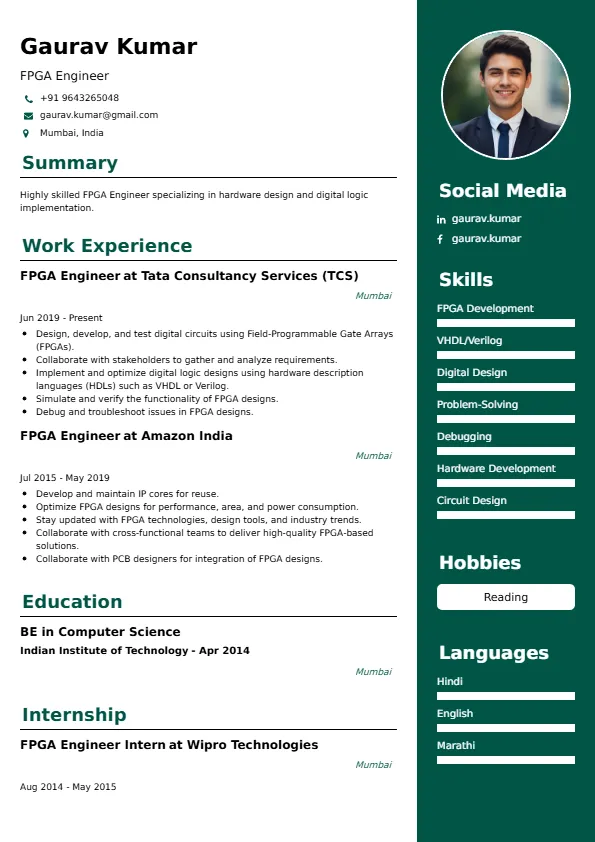
Welcome to our FPGA Engineer resume sample page! This expertly crafted resume template is designed to showcase your expertise in designing, simulating, implementing, and verifying complex digital hardware designs using Hardware Description Languages (HDLs) for Field-Programmable Gate Arrays (FPGAs). Whether you're an entry-level candidate or a seasoned professional, this sample highlights key skills like VHDL/Verilog, synthesis/place-and-route tools, digital signal processing (DSP), high-speed serial protocols, and hardware verification (UVM/SystemVerilog) tailored to meet top semiconductor, aerospace, telecom, and defense demands. Use this guide to create a compelling resume that stands out and secures your next career opportunity.
Superbresume.com empowers FPGA Engineers to craft resumes that highlight their high-speed digital design and verification rigor. Our platform offers customizable templates tailored for specialized hardware roles, emphasizing skills like timing closure, constrained design, high-speed interfaces (PCIe, Ethernet), and embedded processor integration (Soft-core/Hard-core). With ATS-optimized formats, expert-written content suggestions, and real-time resume analysis, we ensure your resume aligns with job descriptions. Showcase your experience in achieving demanding timing requirements, optimizing logic utilization, or successfully implementing custom DSP algorithms with confidence. Superbresume.com helps you create a polished, results-driven resume that grabs hiring managers’ attention and lands interviews.
How to Write a Resume for an FPGA Engineer
Craft a Targeted Summary: Write a 2-3 sentence summary highlighting your expertise in full lifecycle FPGA development, proficiency in VHDL/Verilog and major vendor toolchains (Xilinx/Intel), and success in implementing high-performance, resource-optimized digital designs.
Use Reverse-Chronological Format: List recent FPGA development, hardware engineering, or digital ASIC/VLSI roles first, focusing on technical depth and measurable performance achievements.
Highlight Certifications/Portfolio: Include credentials like Xilinx/Intel Developer Certifications, Master’s Degree (EE/Comp Eng), or feature a GitHub/Portfolio link showcasing VHDL/Verilog projects to boost credibility.
Quantify Achievements: Use metrics, e.g., “Implemented a custom data acquisition system achieving 5 Gbps throughput and 100% timing closure at 500 MHz,” or “Reduced FPGA logic utilization by 20% through efficient RTL code optimization and pipelining,” to show impact.
Incorporate Keywords: Use terms like “VHDL/Verilog,” “FPGA Design,” “Timing Closure,” “Digital Signal Processing (DSP),” “High-Speed Serial (PCIe/SerDes),” “Verification (SystemVerilog/UVM),” or “Xilinx/Intel Toolchains” from job descriptions for ATS.
Detail Technical Skills: List proficiency with specific HDLs, vendor tools (Vivado, Quartus), simulation tools (ModelSim, Questa), verification languages (SystemVerilog), and hardware protocols (DDR, PCIe) in a comprehensive skills section.
Showcase Projects/Algorithms: Highlight 3-4 key FPGA implementations (e.g., custom controller, filter bank, communication protocol core), detailing the architecture, the optimization challenge (area/speed), and the final performance metric.
Emphasize Soft Skills: Include analytical rigor, meticulous attention to detail (timing analysis), systematic debugging, and cross-functional collaboration (with board designers/software teams).
Keep It Concise: Limit your resume to 1-2 pages, focusing on relevant hardware description, implementation, and verification experience.
Proofread Thoroughly: Eliminate typos or jargon for a professional document.
High-Speed Serial and Memory Interfaces: Focus on expertise implementing and debugging high-speed interfaces like PCIe Gen4/5, 10G/40G Ethernet MACs, and external DDR4/5 memory controllers.
Embedded Processing and SoC Design: Highlight proficiency integrating and programming hard-core (Zynq, Arria) or soft-core (MicroBlaze, Nios II) processors within the FPGA fabric and developing firmware for them.
High-Level Synthesis (HLS): Showcase experience utilizing C/C++ or other high-level languages (e.g., using Vivado HLS or Vitis) to accelerate development and optimize resource usage.
Advanced Verification (SystemVerilog/UVM): Detail experience building reusable, object-oriented verification environments (UVM) to ensure complex designs are rigorously tested before tape-out/release.
Signal Processing Algorithms (DSP): Emphasize implementation of custom digital filters, FFTs, forward error correction (FEC), or other computationally intensive algorithms on FPGA resources (DSP slices).
Metrics-Driven Achievements: Use results like “Achieved a 50% increase in computational density by optimizing data path architecture” or “Reduced signal processing latency below 1 microsecond.”
Low-Latency and Deterministic Design: Include experience designing systems where timing predictability and minimal latency are critical (e.g., financial trading, control systems).
Power Optimization for FPGA: Highlight techniques used to reduce dynamic and static power consumption in the final FPGA bitstream.
Choose Superbresume.com to craft an FPGA Engineer resume that stands out in the specialized hardware design field. Our platform offers tailored templates optimized for ATS, ensuring your skills in VHDL/Verilog, timing closure, and high-speed protocols shine. With expert guidance, pre-written content, and real-time feedback, we help you highlight achievements like achieving challenging clock frequencies or optimizing complex DSP algorithms. Whether you design for telecom or aerospace, our tools make it easy to create a polished, results-driven resume. Trust Superbresume.com to showcase your expertise in delivering high-performance, reliable digital hardware solutions. Start building your career today!
20 Key Skills for an FPGA Engineer Resume
| VHDL/Verilog (RTL Design) | FPGA Architecture & Implementation |
| Timing Closure & Static Timing Analysis (STA) | Digital Signal Processing (DSP) Implementation |
| High-Speed Serial Protocols (PCIe, SerDes, Ethernet) | Verification (SystemVerilog, UVM, Testbench) |
| Synthesis & Place-and-Route Tools (Vivado/Quartus) | Embedded Processors (Zynq, MicroBlaze) |
| High-Level Synthesis (HLS) (C/C++) | Finite State Machine (FSM) Design |
| DDR/External Memory Controller Integration | Simulation (ModelSim/Questa) |
| Hardware Debugging (I/O, Oscilloscope, Logic Analyzer) | Clock Domain Crossing (CDC) Techniques |
| Low-Latency/Deterministic Design | Python/Tcl Scripting (Tool Automation) |
| RTL Optimization (Area/Speed) | Requirements Traceability |
10 Do’s for an FPGA Engineer Resume
Tailor Your Resume: Customize for the specific domain (e.g., emphasize DSP and SerDes for telecom, emphasize verification for security).
Highlight Certifications/Training: List vendor-specific certifications (Xilinx, Intel) and advanced degrees/training prominently.
Quantify Achievements: Include metrics on clock frequency achieved, throughput (Gbps), logic utilization reduction, or successful timing closure results.
Use Action Verbs: Start bullet points with verbs like “designed,” “implemented,” “verified,” “optimized,” or “integrated.”
Showcase Projects/Cores: Detail the complexity of the digital logic or algorithm implemented, emphasizing the technical constraints overcome.
Include Soft Skills: Highlight analytical rigor, meticulous detail, systematic debugging, and cross-functional hardware/software collaboration.
Optimize for ATS: Use standard engineering section titles and incorporate key HDLs, vendor tools, and protocol names.
Keep It Professional: Use a clean, consistent font and engineering layout.
Emphasize RTL and Synthesis: Clearly articulate experience writing high-quality RTL code and achieving successful synthesis/timing closure.
Proofread Carefully: Ensure no typos or errors in code names, technical specifications, or metrics.
10 Don’ts for an FPGA Engineer Resume
Don’t Overload with Jargon: Avoid confusing, internal company acronyms; use standardized HDL, verification, and protocol terminology.
Don’t Exceed Two Pages: Keep your resume concise, focusing on high-impact FPGA design and verification achievements.
Don’t Omit Dates: Include employment dates for career context.
Don’t Use Generic Templates: Tailor your resume specifically to the specialized hardware description and implementation duties of an FPGA Engineer.
Don’t List Irrelevant Skills: Focus on digital design, HDLs, timing analysis, verification, and embedded systems.
Don’t Skip Metrics: Quantify results wherever possible; performance metrics (frequency, throughput, latency) are critical.
Don’t Use Complex Formats: Avoid highly stylized elements or confusing graphics.
Don’t Ignore Verification: Include explicit experience in writing testbenches and verifying complex designs, ideally using SystemVerilog/UVM.
Don’t Include Outdated Experience: Omit non-digital design or irrelevant software jobs over 15 years old.
Don’t Forget to Update: Refresh for new protocol standards (e.g., PCIe Gen5), advanced HLS tool mastery, or successful implementation of complex DSP algorithms.
5 FAQs for an FPGA Engineer Resume
Prioritize VHDL/Verilog mastery, timing closure/STA expertise, high-speed protocol implementation (PCIe, Ethernet), and proficiency in vendor toolchains (Vivado/Quartus).
Use standard engineering section titles, avoid graphics, and include keywords like “RTL Design,” “UVM,” and “Embedded Processor (Zynq).”
Yes, modern FPGA development requires strong verification skills; emphasize SystemVerilog/UVM if you have that experience.
Detail the target clock frequency, the number of constraints managed, and the resulting success (e.g., “Achieved zero timing violations at 400 MHz”).
Use a reverse-chronological format to emphasize your most recent, high-impact digital hardware design and implementation achievements.
Get 5x more interviews with our crafted Resumes. We make resumes that land jobs.

Get a Free Customized Cover Letter with Resume Expert Advice
with every resume order placed, you will get a free Customized Cover letter.