Embedded Systems Engineer
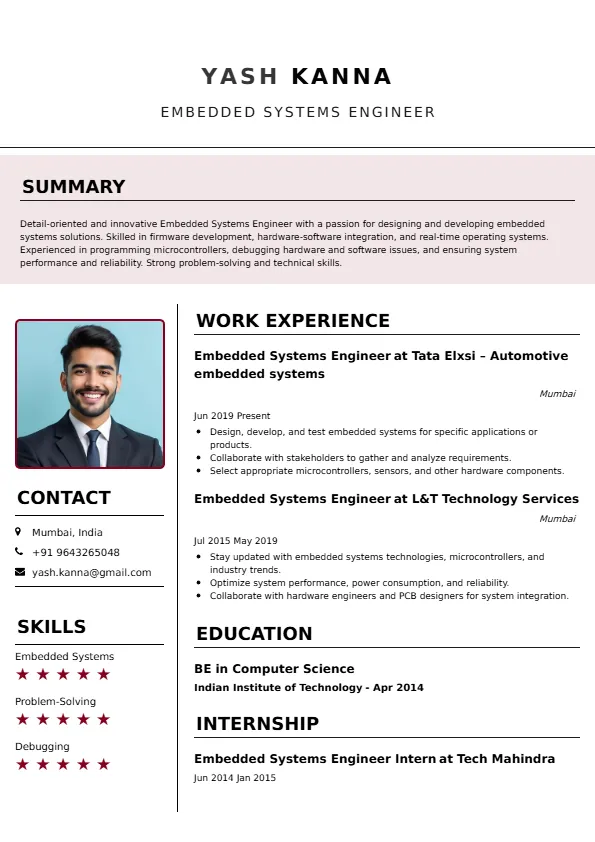
Welcome to our Embedded Systems Engineer resume sample page! This expertly crafted resume template is designed to showcase your expertise in designing, developing, and debugging software and hardware for microcontrollers (MCUs), real-time operating systems (RTOS), and resource-constrained devices. Whether you're an entry-level candidate or a seasoned professional, this sample highlights key skills like C/C++ programming, hardware/software integration, communication protocols (SPI, I2C), and low-level driver development tailored to meet top IoT, automotive, medical device, and consumer electronics demands. Use this guide to create a compelling resume that stands out and secures your next career opportunity.
Superbresume.com empowers Embedded Systems Engineers to craft resumes that highlight their low-level programming and resource optimization expertise. Our platform offers customizable templates tailored for specialized engineering roles, emphasizing skills like RTOS kernel management, bare-metal programming, custom board bring-up, and real-time performance tuning. With ATS-optimized formats, expert-written content suggestions, and real-time resume analysis, we ensure your resume aligns with job descriptions. Showcase your experience in optimizing memory usage, reducing boot time, integrating sensor systems, or developing safety-critical firmware with confidence. Superbresume.com helps you create a polished, results-driven resume that grabs hiring managers’ attention and lands interviews.
How to Write a Resume for an Embedded Systems Engineer
Use Reverse-Chronological Format: List recent embedded systems, firmware, or hardware-software integration roles first, focusing on technical depth and measurable system improvements.
Highlight Certifications/Portfolio: Include credentials like Certified LabVIEW Developer, relevant vendor certifications (e.g., ARM), or feature a GitHub/Portfolio link showcasing code/projects to boost credibility.
Quantify Achievements: Use metrics, e.g., “Optimized firmware boot time by 50ms using custom low-level drivers,” or “Reduced device power consumption by 30% by implementing a multi-state power management solution,” to show impact.
Incorporate Keywords: Use terms like “Microcontroller (MCU),” “Real-Time Operating System (RTOS),” “C/C++,” “Bare-Metal Programming,” “Communication Protocols (SPI/I2C/UART),” “Hardware/Software Integration,” or “Low-Power Design” from job descriptions for ATS.
Detail Technical Skills: List proficiency with specific MCUs/processors (e.g., ARM Cortex, PIC), RTOS kernels (e.g., FreeRTOS, Zephyr), debugging tools (e.g., JTAG, oscilloscopes), and version control (Git) in a comprehensive skills section.
Showcase Projects/Products: Highlight 3-4 key products or embedded features developed, detailing the processor, the RTOS used, the programming language, and the measurable system improvement achieved.
Emphasize Soft Skills: Include meticulous attention to detail (debugging), analytical problem-solving (hardware/software conflicts), systems thinking, and collaboration (with hardware engineers).
Keep It Concise: Limit your resume to 1-2 pages, focusing on relevant embedded development, optimization, and integration experience.
Proofread Thoroughly: Eliminate typos or jargon for a professional document.
Safety-Critical and Functional Safety (FuSa): Highlight experience developing embedded systems compliant with industry standards like ISO 26262 (Automotive) or IEC 62304 (Medical Devices).
Security at the Edge: Showcase expertise in implementing hardware security modules (HSM), secure boot, and cryptographic routines on resource-constrained devices.
Real-Time Machine Learning (TinyML): Detail experience optimizing and deploying ML inference models (e.g., image/voice recognition) to MCUs using frameworks like TensorFlow Lite Micro.
Linux Kernel and Driver Development: Emphasize expertise in developing and modifying custom device drivers or tailoring the Linux kernel for embedded platforms.
Metrics-Driven Achievements: Use results like “Successfully integrated 5 new sensors on the custom PCB with zero hardware bugs reported post-launch” or “Achieved 99.999% system availability in deployed devices.”
Hardware Bring-Up and Debugging: Include hands-on experience using oscilloscopes, logic analyzers, and debuggers (e.g., JTAG/SWD) to bring up custom boards and diagnose complex issues.
Low-Power and Battery Management: Highlight specific design techniques used to extend battery life in resource-constrained or battery-operated devices.
Choose Superbresume.com to craft an Embedded Systems Engineer resume that stands out in the specialized hardware-software integration field. Our platform offers tailored templates optimized for ATS, ensuring your skills in C/C++, RTOS, low-power design, and hardware integration shine. With expert guidance, pre-written content, and real-time feedback, we help you highlight achievements like reducing memory footprint or optimizing real-time performance. Whether you develop IoT devices or mission-critical controls, our tools make it easy to create a polished, results-driven resume. Trust Superbresume.com to showcase your expertise in building efficient and reliable intelligence into hardware. Start building your career today!
20 Key Skills for an Embedded Systems Engineer Resume
| C/C++ Programming (Embedded) | Microcontroller (MCU) Programming (ARM Cortex) |
| Real-Time Operating Systems (RTOS) (FreeRTOS/Zephyr) | Hardware/Software Integration |
| Communication Protocols (SPI, I2C, UART) | Low-Power Design & Power Management |
| Debugging Tools (JTAG/SWD, Oscilloscope) | Bare-Metal Programming |
| IoT Connectivity (BLE, Wi-Fi, MQTT) | Sensor Integration & Driver Development |
| Version Control (Git) | Linux Kernel/Device Drivers |
| Functional Safety (e.g., ISO 26262) | Digital Signal Processing (DSP) (if applicable) |
| Unit Testing & QA (Embedded) | Circuit Schematic Reading |
| Real-Time Performance Tuning | Hardware Bring-Up & Diagnostics |
| Systems Thinking | Security (Secure Boot, Cryptography) |
10 Do’s for an Embedded Systems Engineer Resume
Tailor Your Resume: Customize it for the industry (Automotive, Medical, Consumer IoT) and the core technology focus (low power, high-speed RTOS, Linux).
Highlight Certifications/Portfolio: List relevant vendor certifications and include links to code, technical blogs, or project demos.
Quantify Achievements: Include metrics such as memory/power reduction, latency improvement, boot time reduction, or the volume and complexity of devices managed.
Use Action Verbs: Begin statements with verbs like developed, integrated, optimized, debugged, or designed.
Showcase Projects/Products: Detail the processor, RTOS, communication challenges, and measurable system improvements achieved in key projects.
Include Soft Skills: Highlight precision, problem-solving across the hardware/software boundary, and attention to safety and reliability.
Optimize for ATS: Use standard engineering section titles and include key processor, RTOS, and protocol terminology.
Keep It Professional: Maintain a clean font, consistent layout, and engineering-focused presentation.
Emphasize Low-Level Expertise: Clearly articulate experience with memory management, registers, drivers, and bare-metal programming.
Proofread Carefully: Ensure all code names, technical specifications, and metrics are accurate and error-free.
10 Don’ts for an Embedded Systems Engineer Resume
Don’t Overload with Jargon: Avoid confusing internal company acronyms; use standardized embedded systems and protocol terminology.
Don’t Exceed Two Pages: Keep your resume concise, focusing on high-impact embedded development and optimization achievements.
Don’t Omit Dates: Include employment dates to provide clear career context.
Don’t Use Generic Templates: Tailor your resume specifically to the specialized, resource-constrained nature of embedded systems.
Don’t List Irrelevant Skills: Focus on C/C++, hardware integration, RTOS, protocols, and debugging tools.
Don’t Skip Metrics: Quantify results wherever possible; resource optimization (memory, power, time) is the primary measure of success.
Don’t Use Complex Formats: Avoid highly stylized layouts or graphics that distract from technical expertise.
Don’t Ignore the Hardware Interface: Highlight experience reading schematics, using test equipment, and collaborating with hardware teams.
Don’t Include Outdated Experience: Omit high-level IT or non-embedded software roles over 15 years old.
Don’t Forget to Update: Regularly refresh your resume for new processor family experience, successful product launches, or advanced RTOS/safety certification training.
5 FAQs for an Embedded Systems Engineer Resume
Prioritize C/C++ programming for embedded devices, RTOS experience (such as FreeRTOS or Zephyr), low-level communication protocols (SPI/I2C), and hardware/software integration.
Use standard engineering section titles, avoid graphics, and include keywords like “Microcontroller,” “Bare-Metal,” and “Functional Safety.”
Highlight hardware integration and debugging (using oscilloscopes or logic analyzers) rather than full PCB design, unless applying for a hybrid role.
Include the initial power draw, describe the techniques used (such as deep sleep modes or power gating), and provide the resulting quantified reduction in power consumption or increase in battery life.
Use a reverse-chronological format to emphasize your most recent, high-impact embedded development and optimization achievements.
Get 5x more interviews with our crafted Resumes. We make resumes that land jobs.

Get a Free Customized Cover Letter with Resume Expert Advice
with every resume order placed, you will get a free Customized Cover letter.