Tailor Your Resume: Customize for each job, emphasizing the DL domain (e.g., Vision, NLP, or Generative AI) relevant to the role.
Highlight Certifications/Publications: List relevant degrees, cloud AI certs, and research papers (with links) prominently.
Quantify Achievements: Include metrics on model performance (accuracy, F1 score) and production impact (latency, throughput).
Use Action Verbs: Start bullet points with verbs like “developed,” “designed,” “optimized,” “trained,” or “deployed.”
Showcase Projects/Research: Detail specific model architectures and the underlying math or logic behind them.
Include Soft Skills: Highlight deep analytical skills, research ability, and cross-functional teamwork.
Optimize for ATS: Use standard section titles and incorporate key framework and model names throughout the document.
Keep It Professional: Use a clean, consistent font and layout.
Add a GitHub/Portfolio Link: Include a link to relevant code samples, research demos, or project repositories.
Proofread Carefully: Ensure technical accuracy in model names, metrics, and theoretical concepts.
Deep Learning Engineer
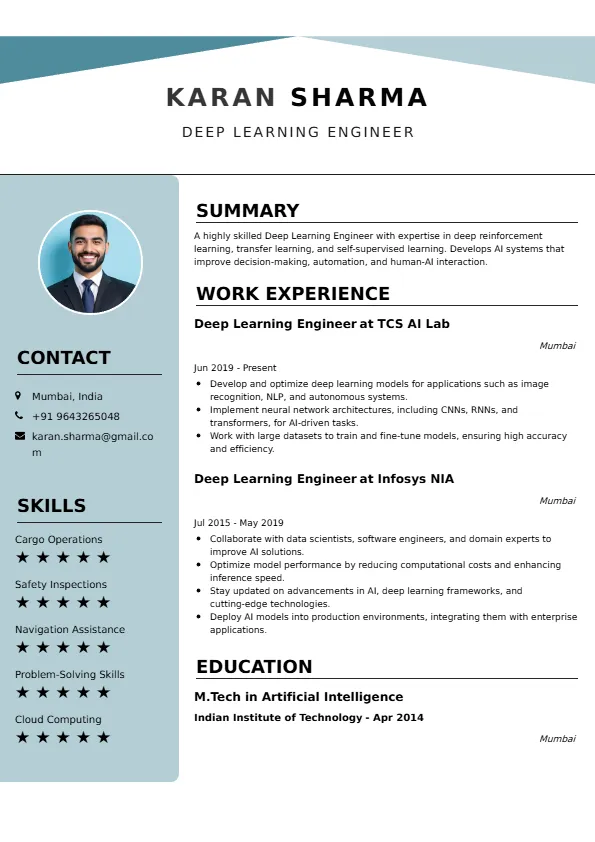
Welcome to our Deep Learning (DL) Engineer resume sample page! This expertly crafted resume template is designed to showcase your expertise in neural networks, model development, MLOps, and applied AI research in fast-paced tech environments. Whether you're an entry-level candidate or a seasoned professional, this sample highlights key skills like PyTorch/TensorFlow, NLP/Computer Vision, distributed training, and cloud AI platforms tailored to meet top employers’ demands. Use this guide to create a compelling resume that stands out and secures your next career opportunity.Build a Standout Deep Learning Engineer Resume with Superbresume.com
How to Write a Resume for a Deep Learning Engineer
Use Reverse-Chronological Format: List recent DL or AI engineering roles/research positions first, focusing on model development and deployment.
Highlight Certifications/Publications: Include advanced degrees (e.g., M.S., Ph.D.), relevant cloud AI certifications (e.g., AWS Machine Learning Specialty), and notable research papers/conferences to boost credibility.
Quantify Achievements: Use metrics, e.g., “Improved model accuracy by 5% using Transformer architecture,” or “Reduced model inference latency by 30%,” to show impact.
Incorporate Keywords: Use terms like “PyTorch,” “TensorFlow,” “Transformer,” “Computer Vision,” “NLP,” “Generative AI,” or “distributed training” from job descriptions for ATS.
Detail Technical Skills: List frameworks (PyTorch, Keras), cloud platforms (SageMaker, Vertex AI), MLOps tools (MLflow, Kubeflow), and languages (Python, C++) in a skills section.
Showcase Projects/Models: Highlight specific model architectures developed, datasets used, and the production environment they were deployed into, with clear outcomes.
Emphasize Soft Skills: Include research aptitude, complexity reduction, and collaboration, demonstrated through team-based model development or paper writing.
Keep It Concise: Limit your resume to 1-2 pages, focusing on relevant AI/Deep Learning development, research, and deployment experience.
Proofread Thoroughly: Eliminate typos or jargon for a professional document.
Efficient/Edge AI: Highlight skills in model compression, quantization, and deployment on resource-constrained devices (e.g., using ONNX, TensorRT).
MLOps and Productionization: Emphasize using MLOps tools (MLflow, Kubeflow) and cloud platforms to manage the full model lifecycle, including monitoring and retraining.
Distributed Training: Showcase experience using frameworks like PyTorch Distributed or Horovod for large-scale, multi-GPU/multi-node training.
Reinforcement Learning (RL): Include experience applying RL techniques to areas like robotics, optimization, or game theory.
Metrics-Driven Achievements: Use results like “achieved 98% recall on object detection task” or “deployed model to production supporting 1 million users daily.”
Vector Databases/RAG: Detail knowledge of retrieval-augmented generation (RAG) and using vector databases (e.g., Pinecone, Milvus) for LLM applications.
Ethical AI/Model Explainability (XAI): Include experience implementing fairness checks, bias detection, and explainability methods (e.g., SHAP, LIME).
Choose Superbresume.com to craft a Deep Learning Engineer resume that stands out in the cutting-edge AI industry. Our platform offers tailored templates optimized for ATS, ensuring your skills in neural network architecture, PyTorch/TensorFlow, and MLOps shine. With expert guidance, pre-written content, and real-time feedback, we help you highlight achievements like boosting model accuracy or deploying complex AI systems to production. Whether you’re transitioning from academia or seeking a senior role, our tools make it easy to create a professional, results-driven resume. Trust Superbresume.com to showcase your expertise in advanced AI engineering and land interviews with top research labs and tech companies. Start building your career today!
20 Key Skills for a Deep Learning Engineer Resume
| PyTorch/TensorFlow | Convolutional Neural Networks (CNN) |
| Natural Language Processing (NLP) | Computer Vision |
| Transformer Architectures | Generative AI (LLMs) |
| MLOps (MLflow/Kubeflow) | Distributed Training (Horovod) |
| Python/NumPy/Pandas | Cloud AI Platforms (SageMaker/Vertex AI) |
| Model Optimization/Quantization | C++/CUDA |
| Recurrent Neural Networks (RNN) | Reinforcement Learning (RL) |
| Model Evaluation Metrics | AWS/Azure/GCP |
| Data Preprocessing | Research Aptitude |
| Complexity Reduction | Algorithm Design |
10 Do’s for a Deep Learning Engineer Resume
10 Don’ts for a Deep Learning Engineer Resume
Don’t Exceed Two Pages: Keep your resume concise, focusing on high-impact DL development and research.
Don’t Omit Dates: Include employment and academic dates for context.
Don’t Use Generic Templates: Tailor your resume specifically to the Deep Learning specialization.
Don’t List Irrelevant Skills: Focus only on machine learning, deep learning, MLOps, and related tools.
Don’t Skip Metrics: Quantify results wherever possible; performance is the ultimate measure of success in DL.
Don’t Use Complex Formats: Avoid highly graphical elements or complex tables that might confuse ATS.
Don’t Ignore Productionization: Include examples of deploying models (MLOps) beyond the research phase.
Don’t Include Outdated Experience: Omit non-ML jobs over 10–15 years old unless they demonstrate core engineering skills.
Don’t Forget to Update: Refresh for the latest trends in Generative AI, LLMs, and efficient model deployment.
5 FAQs for a Deep Learning Engineer Resume
Prioritize expertise in PyTorch/TensorFlow, advanced neural network architectures (especially Transformers), MLOps, and proficiency in Python.
Use standard section titles, avoid graphics, and include keywords like “NLP,” “Computer Vision,” “Generative AI,” and specific cloud AI tools.
Yes, publications, especially at major conferences (e.g., NeurIPS, ICML, CVPR, ACL), are highly valuable and should be listed.
Detail the initial model size/latency, the specific techniques used (e.g., pruning, quantization), and the quantified reduction in latency or memory footprint.
Use a reverse-chronological format to emphasize recent, high-impact model development and deployment achievements.
Get 5x more interviews with our crafted Resumes. We make resumes that land jobs.

Get a Free Customized Cover Letter with Resume Expert Advice
with every resume order placed, you will get a free Customized Cover letter.