Conversational AI Engineer
Welcome to our Conversational AI Engineer resume sample page! This expertly crafted resume template is designed to showcase your expertise in building the technical backbone of chatbots and voice assistants, including natural language understanding (NLU), intent recognition, and dialogue management systems. Whether you specialize in enterprise virtual assistants, customer support automation, or voice-based interfaces, this sample highlights key skills like NLU/NLP Development, Dialogue Management, API Integration, Intent Classification, and System Architecture tailored to meet the demands of top conversational AI teams. Use this guide to create a compelling resume that stands out and secures your next career opportunity.
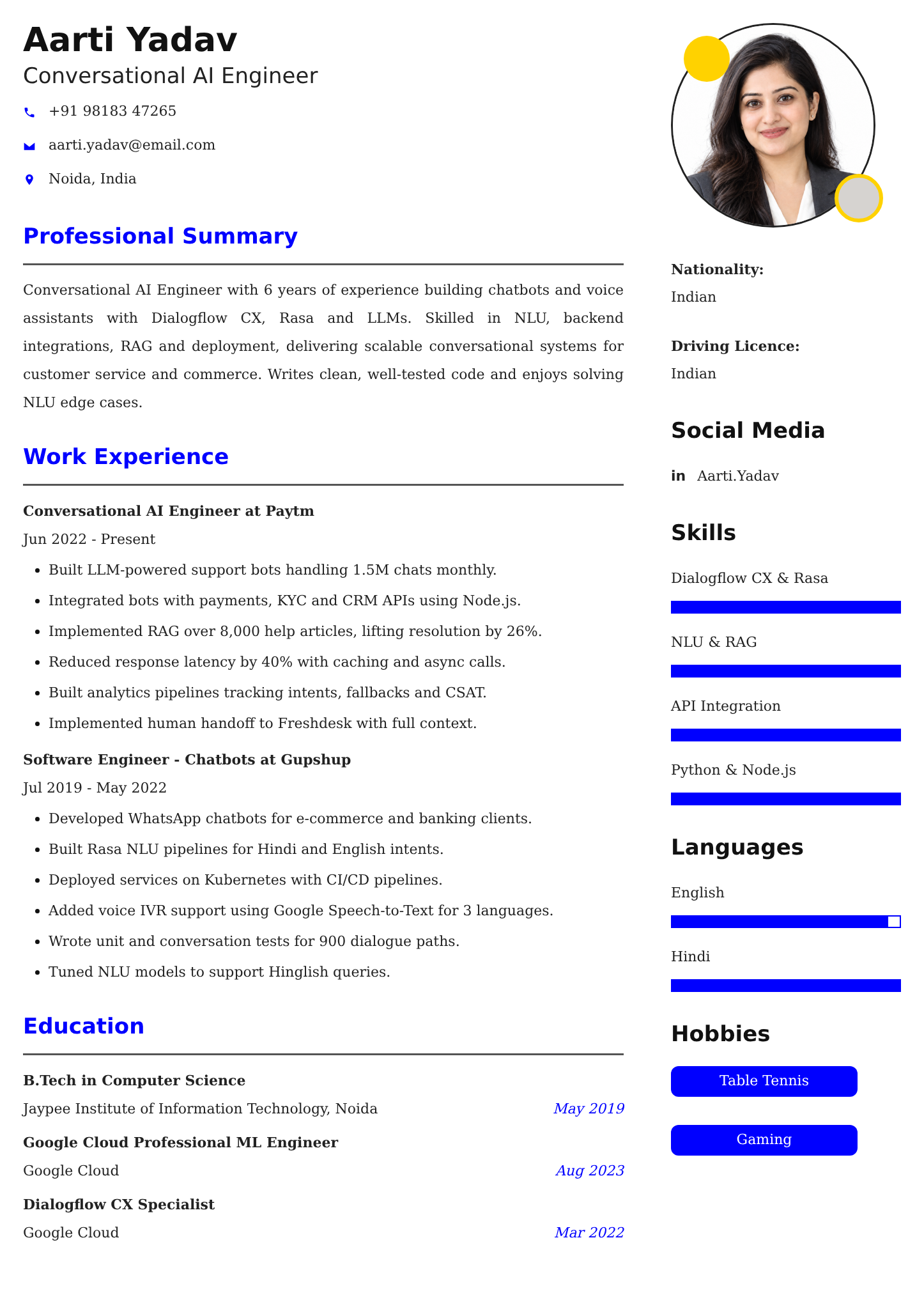
Superbresume.com empowers Conversational AI Engineers to craft resumes that highlight their technical expertise in building intelligent dialogue systems. Our platform offers customizable templates tailored for conversational AI roles, emphasizing skills like NLU model development, dialogue state management, API/backend integration, and scalable system architecture. With ATS-optimized formats, expert-written content suggestions, and real-time resume analysis, we ensure your resume aligns with job descriptions. Showcase your experience in improving intent recognition accuracy, reducing response latency, or architecting systems that handle millions of conversations with confidence. Superbresume.com helps you create a polished, results-driven resume that grabs hiring managers' attention and lands interviews.
How to Write a Resume for a Conversational AI Engineer
Craft a Targeted Summary: Write a 2-3 sentence summary highlighting your expertise in building NLU/dialogue systems, proficiency with conversational AI frameworks, and measurable improvements in accuracy or scalability.
Use Reverse-Chronological Format: List recent conversational AI, NLP, or backend engineering roles first, focusing on measurable technical outcomes.
Highlight Certifications/Degrees: Include a degree in Computer Science, Computational Linguistics, or a related field, plus relevant NLP or machine learning certifications.
Quantify Achievements: Use metrics, e.g., "Improved intent recognition accuracy from 85% to 97% across 50+ intents" or "Scaled dialogue system to handle 1M+ daily conversations with 99.95% uptime," to show impact.
Incorporate Keywords: Use terms like "Natural Language Understanding (NLU)," "Dialogue Management," "Intent Classification," "Entity Extraction," "Rasa/Dialogflow," "API Integration," or "System Architecture" from job descriptions for ATS.
Detail Technical Skills: List proficiency with programming languages (Python, Java), NLP frameworks (Rasa, spaCy, Dialogflow), and cloud platforms in a comprehensive skills section.
Showcase Key Projects: Highlight 3-4 engineering projects, detailing the technical challenge, your architecture/implementation, and the measurable performance result.
Emphasize Soft Skills: Include analytical rigor, systematic debugging, and clear technical documentation.
Keep It Concise: Limit your resume to 1-2 pages, focusing on relevant conversational AI engineering achievements.
Proofread Thoroughly: Eliminate typos or inconsistent formatting for a professional document.
LLM-Powered Dialogue Systems: Focus on expertise integrating large language models into traditional NLU/dialogue management architectures.
Hybrid NLU Approaches: Highlight experience combining rule-based, statistical, and LLM-based approaches for robust intent and entity recognition.
Scalable System Design: Showcase proficiency architecting conversational systems that scale reliably across high-volume production traffic.
Real-Time Testing and Monitoring: Detail expertise implementing automated testing and monitoring for dialogue system performance.
Voice and Multi-Modal Integration: Emphasize experience integrating speech-to-text, text-to-speech, and visual interfaces into conversational pipelines.
Metrics-Driven Achievements: Use results like "Reduced average response latency from 800ms to 200ms" or "Increased successful task completion rate to 91% across production traffic."
Cross-Functional Collaboration: Include experience partnering with conversation designers and product managers to implement dialogue specifications.
Continuous Model Improvement: Highlight proficiency retraining and fine-tuning NLU models based on production conversation data.
Choose Superbresume.com to craft a Conversational AI Engineer resume that stands out in the fast-evolving AI engineering field. Our platform offers tailored templates optimized for ATS, ensuring your skills in NLU development, dialogue management, and system architecture shine. With expert guidance, pre-written content, and real-time feedback, we help you highlight achievements like improving accuracy or scaling systems to millions of users. Whether you specialize in text or voice-based assistants, our tools make it easy to create a polished, results-driven resume. Trust Superbresume.com to showcase your expertise in building robust conversational AI systems. Start building your career today!
20 Key Skills for a Conversational AI Engineer Resume
| Natural Language Understanding (NLU) | Dialogue Management Systems |
| Intent Classification & Entity Extraction | Rasa/Dialogflow/LLM Integration |
| API & Backend Development (Python/Java) | Scalable System Architecture |
| Speech-to-Text/Text-to-Speech Integration | Model Training & Fine-Tuning |
| Automated Testing & Monitoring | Cloud Platforms (AWS/GCP/Azure) |
| Large Language Model (LLM) Integration | Retrieval-Augmented Generation (RAG) |
| Microservices & REST APIs | Containerization (Docker/Kubernetes) |
| Conversation State & Session Management | Contact Center Integration (Genesys/Twilio) |
| CI/CD Pipelines | Security & Data Privacy Compliance |
| Latency Optimization | Multilingual NLP Support |
10 Do's for a Conversational AI Engineer Resume
Tailor Your Resume: Customize for the specific engineering focus (e.g., emphasize voice integration for smart speaker roles, scalability for enterprise roles).
Highlight Certifications/Degrees: List relevant technical degrees and NLP/ML certifications prominently.
Quantify Achievements: Include metrics on accuracy, latency, or system scale.
Use Action Verbs: Start bullet points with verbs like "architected," "built," "integrated," "scaled," or "optimized."
Showcase Key Projects: Detail the challenge, implementation, and quantified result of 3-4 engineering projects.
Include Soft Skills: Highlight analytical rigor and cross-functional collaboration with design teams.
Optimize for ATS: Use standard technical section titles and incorporate key NLU and engineering terms.
Keep It Professional: Use a clean, consistent font and modern technical layout.
Emphasize Scale and Reliability: Clearly articulate the technical impact of your conversational AI systems.
Proofread Thoroughly: Eliminate typos or jargon inconsistencies for a professional document.
10 Don'ts for a Conversational AI Engineer Resume
Don't Overload with Jargon: Avoid confusing internal acronyms; use standardized NLP and engineering terminology.
Don't Exceed Two Pages: Keep your resume concise, focusing on high-impact engineering achievements.
Don't Omit Dates: Include employment dates for career context.
Don't Use Generic Templates: Tailor your resume specifically to the technical rigor of conversational AI engineering.
Don't List Irrelevant Skills: Focus on NLU, dialogue systems, and backend development.
Don't Skip Metrics: Quantify results wherever possible; accuracy and latency are key metrics.
Don't Use Complex Formats: Avoid highly stylized elements or confusing graphics.
Don't Ignore Technical Skills: Include explicit experience with programming languages, frameworks, and cloud platforms.
Don't Include Outdated Experience: Omit non-technical or irrelevant jobs over 15 years old.
Don't Forget to Update: Refresh for new frameworks, LLM integrations, or architecture patterns mastered.
5 FAQs for a Conversational AI Engineer Resume
Recruiters want to see your experience building the technical backbone of chatbots and voice assistants, including NLU and dialogue management, backed by measurable results. Work keywords such as NLU, dialogue management, intent classification, API integration, and system architecture naturally into your summary, skills, and experience so ATS filters rank you highly.
Show progression: classic intent models with Rasa or Dialogflow, then LLM and RAG integrations. This tells employers you can maintain existing systems while building next-generation assistants.
Mention conversation volume, concurrent users, uptime, and response latency. Figures like 1M monthly sessions at 99.9% availability make your engineering experience tangible.
Consider AWS/Azure/GCP AI certifications, Rasa or Dialogflow CX certifications, or NLP specializations. Place them in a dedicated certifications section, including the issuing body and year.
Yes, in one or two concise bullets. Name key components—NLU service, dialogue manager, integrations, and cloud hosting—and note a decision that improved reliability or speed. A well-structured, ATS-friendly template from Superbresume.com can help you present this clearly.
Get 5x more interviews with our crafted Resumes. We make resumes that land jobs.

Get a Free Customized Cover Letter with Resume Expert Advice
with every resume order placed, you will get a free Customized Cover letter.