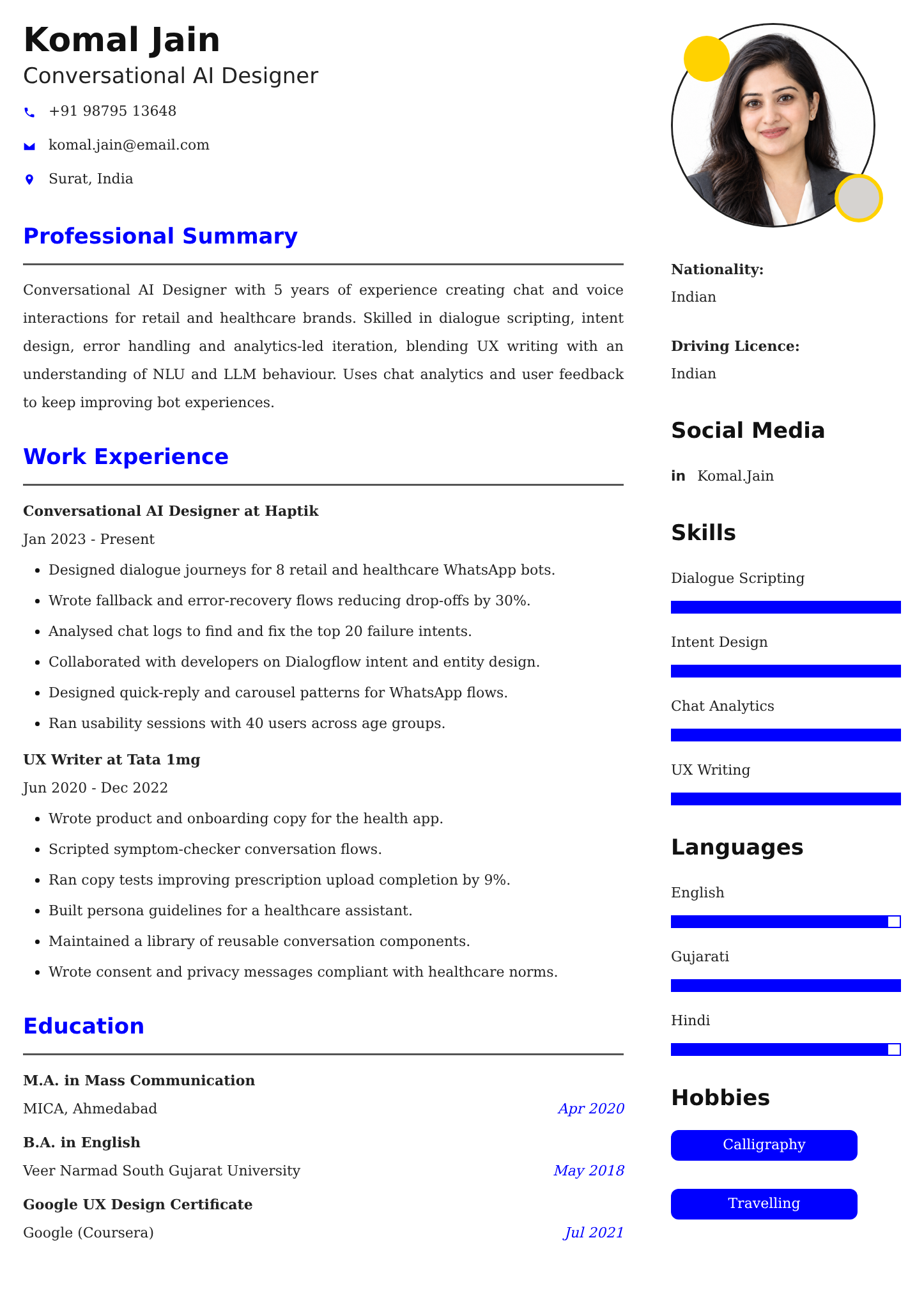
Conversational AI Designer
Welcome to our Conversational AI Designer resume sample page! This expertly crafted resume template is designed to showcase your expertise in designing the tone, structure, and narrative flow of AI-driven conversations across chat and voice platforms. Whether you specialize in branded virtual assistants, IVR systems, or in-product AI guides, this sample highlights key skills like Dialogue Flow Design, Persona Development, Voice & Tone Strategy, Storyboarding, and User Research tailored to meet the demands of conversational product teams. Use this guide to create a compelling resume that stands out and secures your next career opportunity.
Superbresume.com empowers Conversational AI Designers to craft resumes that highlight their narrative and strategic approach to AI dialogue experiences. Our platform offers customizable templates tailored for conversational design roles, emphasizing skills like dialogue flow architecture, persona/voice strategy, storyboarding, and user research integration. With ATS-optimized formats, expert-written content suggestions, and real-time resume analysis, we ensure your resume aligns with job descriptions. Showcase your experience in developing brand-defining AI personas, improving conversational engagement, or leading cross-platform dialogue consistency with confidence. Superbresume.com helps you create a polished, results-driven resume that grabs hiring managers' attention and lands interviews.
How to Write a Resume for a Conversational AI Designer
Craft a Targeted Summary: Write a 2-3 sentence summary highlighting your expertise in conversational design strategy, persona/voice development, and success in improving engagement or brand consistency.
Use Reverse-Chronological Format: List recent conversational design, content strategy, or UX design roles first, focusing on measurable design outcomes.
Highlight Certifications/Degrees: Include a degree in Design, Communications, Linguistics, or a related field, plus relevant conversational or UX design certifications.
Quantify Achievements: Use metrics, e.g., "Increased user engagement by 30% through redesigned persona and dialogue flows" or "Standardized voice and tone across 8 product lines," to show impact.
Incorporate Keywords: Use terms like "Dialogue Flow Design," "Persona Development," "Voice & Tone Strategy," "Storyboarding," "User Research," "Conversation Scripting," or "Brand Consistency" from job descriptions for ATS.
Detail Technical Skills: List proficiency with flowchart/storyboard tools, prototyping software, and basic conversational AI platform familiarity in a comprehensive skills section.
Showcase Key Projects: Highlight 3-4 design initiatives, detailing the brand/product challenge, your creative approach, and the measurable engagement result.
Emphasize Soft Skills: Include creativity, narrative thinking, empathy, and strong cross-functional communication.
Keep It Concise: Limit your resume to 1-2 pages, focusing on relevant conversational design achievements.
Proofread Thoroughly: Eliminate typos or inconsistent formatting for a professional document.
Narrative-Driven Dialogue Design: Focus on expertise crafting conversations with a clear narrative arc that keeps users engaged.
Distinct Brand Personas: Highlight experience developing unique, memorable AI personalities aligned with brand identity.
Cross-Platform Consistency: Showcase proficiency maintaining consistent voice and tone across chat, voice, and messaging channels.
User Research-Driven Iteration: Detail expertise using qualitative and quantitative research to refine dialogue design.
Storyboarding and Prototyping: Emphasize experience using visual tools to map and pressure-test conversation flows before development.
Metrics-Driven Achievements: Use results like "Improved conversation engagement time by 40%" or "Increased positive sentiment scores by 15 points through persona refinement."
Collaboration with Engineering: Include experience partnering with conversational AI engineers to ensure design intent is preserved in implementation.
Ethical and Inclusive Storytelling: Highlight proficiency designing conversations that are inclusive, culturally sensitive, and free of bias.
Choose Superbresume.com to craft a Conversational AI Designer resume that stands out in the competitive AI product design field. Our platform offers tailored templates optimized for ATS, ensuring your skills in dialogue design, persona strategy, and storyboarding shine. With expert guidance, pre-written content, and real-time feedback, we help you highlight achievements like improving engagement or standardizing brand voice. Whether you specialize in retail, finance, or entertainment AI assistants, our tools make it easy to create a polished, results-driven resume. Trust Superbresume.com to showcase your expertise in compelling conversational design. Start building your career today!
20 Key Skills for a Conversational AI Designer Resume
| Dialogue Flow Design & Architecture | Persona & Voice Development |
| Storyboarding & Prototyping | User Research & Testing |
| Conversation Scripting | Brand Voice Consistency |
| Cross-Platform Design (Chat/Voice) | Inclusive & Ethical Design |
| Cross-Functional Collaboration | Engagement & Sentiment Analysis |
| Voice User Interface (VUI) Design | IVR Flow Design |
| Design Tools (Voiceflow/Figma) | Microcopy & UX Writing |
| Error Recovery & Repair Strategies | Accessibility Standards |
| LLM Behavior & Prompt Guidelines | Design System Documentation |
| Conversation Analytics Interpretation | Human Handoff Experience Design |
10 Do's for a Conversational AI Designer Resume
Tailor Your Resume: Customize for the specific product focus (e.g., emphasize brand storytelling for retail bots, empathy for healthcare assistants).
Highlight Certifications/Degrees: List relevant design, communications, or UX certifications prominently.
Quantify Achievements: Include metrics on engagement, sentiment scores, or brand consistency adoption.
Use Action Verbs: Start bullet points with verbs like "designed," "developed," "storyboarded," "refined," or "standardized."
Showcase Key Projects: Detail the challenge, approach, and quantified result of 3-4 design initiatives.
Include Soft Skills: Highlight creativity, narrative thinking, and cross-functional collaboration.
Optimize for ATS: Use standard design section titles and incorporate key conversational design terms.
Keep It Professional: Use a clean, consistent font and modern layout.
Emphasize Brand and Engagement Impact: Clearly articulate how your designs strengthened brand voice or user engagement.
Proofread Thoroughly: Eliminate typos or jargon inconsistencies for a professional document.
10 Don'ts for a Conversational AI Designer Resume
Don't Overload with Jargon: Avoid confusing internal acronyms; use standardized conversational design terminology.
Don't Exceed Two Pages: Keep your resume concise, focusing on high-impact design achievements.
Don't Omit Dates: Include employment dates for career context.
Don't Use Generic Templates: Tailor your resume specifically to the narrative and brand-focused nature of the role.
Don't List Irrelevant Skills: Focus on dialogue design, persona development, and brand strategy.
Don't Skip Metrics: Quantify results wherever possible; engagement and sentiment are key metrics.
Don't Use Complex Formats: Avoid highly stylized elements or confusing graphics.
Don't Ignore Technical Fluency: Include familiarity with prototyping and conversational AI platforms.
Don't Include Outdated Experience: Omit non-relevant jobs over 15 years old.
Don't Forget to Update: Refresh for new design tools, personas, or research methods mastered.
5 FAQs for a Conversational AI Designer Resume
Recruiters want to see your experience designing the tone, structure, and narrative flow of AI conversations across chat and voice, backed by measurable results. Work keywords such as conversational design, dialogue flows, persona development, voice and tone, and user research naturally into your summary, skills, and experience so ATS filters rank you highly.
It should focus on dialogue, voice, and turn-taking rather than visual screens. Highlight persona documents, sample dialogues, and voice or chat flows instead of wireframes alone.
Note the channels you designed for, such as Alexa, Google Assistant, or contact-center IVR, and the outcome each achieved. Lower drop-off rates or shorter call times make strong evidence.
Consider Conversation Design Institute (CDI) certification, UX/UI design certificates, or voice design courses. Place them in a dedicated certifications section, including the issuing body and year.
Yes. Mention usability tests, Wizard-of-Oz studies, and transcript analysis, then link them to design changes. This shows your designs are grounded in real user behavior. A well-structured, ATS-friendly template from Superbresume.com can help you present this clearly.
Get 5x more interviews with our crafted Resumes. We make resumes that land jobs.

Get a Free Customized Cover Letter with Resume Expert Advice
with every resume order placed, you will get a free Customized Cover letter.