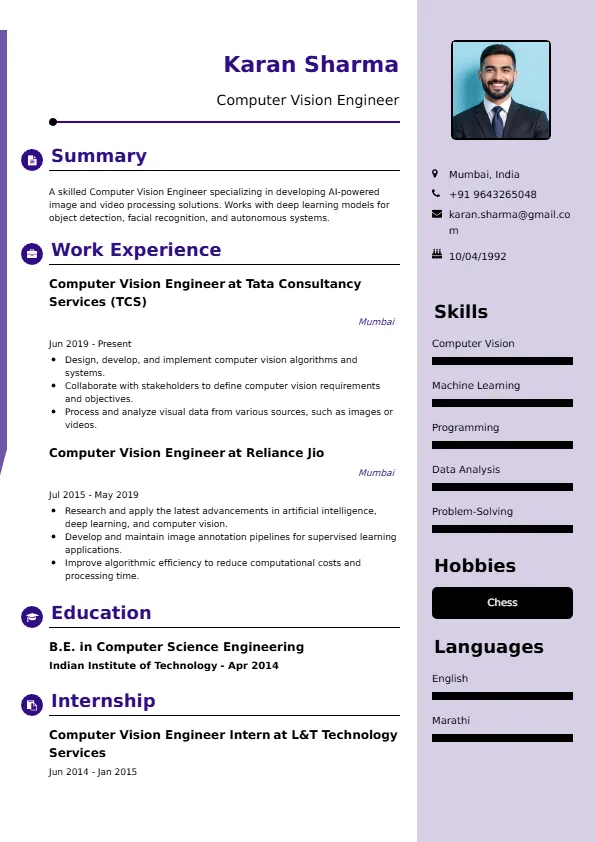
Computer Vision Engineer
Welcome to our Computer Vision Engineer resume sample page! This expertly crafted resume template is designed to showcase your expertise in deep learning, image processing, and AI deployment in tech and automation industries. Whether you're a junior engineer or senior specialist, this sample highlights key skills like CNNs, OpenCV, and real-time systems, tailored to meet top employers’ demands. Use this guide to create a compelling resume that stands out and secures your next career opportunity.
Superbresume.com empowers Computer Vision Engineers to craft resumes that highlight their AI and deep learning expertise. Our platform offers customizable templates tailored for tech roles, emphasizing skills like CNNs, OpenCV, and deployment. With ATS-optimized formats, expert-written content suggestions, and real-time resume analysis, we ensure your resume aligns with job descriptions. Showcase your experience in object detection, facial recognition, or autonomous systems with confidence. Whether you’re junior or senior, Superbresume.com helps you create a polished, results-driven resume that grabs hiring managers’ attention and lands interviews at FAANG and startups.
How to Write a Resume for a Computer Vision Engineer
Craft a Targeted Summary: Write a 2–3 sentence summary highlighting your CV expertise, frameworks, and project impact, tailored to the role.
Use Reverse-Chronological Format: List recent AI roles first, focusing on models or deployments.
Highlight Education & Certifications: Include MS/PhD in CS and certs like TensorFlow Developer.
Quantify Achievements: Use metrics, e.g., “Improved accuracy by 25% using YOLOv8,” to show impact.
Incorporate Keywords: Use terms like “CNN,” “OpenCV,” “PyTorch” from job descriptions for ATS.
Detail Technical Skills: Create a robust skills section with languages, libraries, and hardware.
Showcase Projects: Highlight GitHub repos, Kaggle rankings, or production models.
Emphasize Soft Skills: Include collaboration in agile teams or research publication.
Keep It Concise: Limit to 1–2 pages, focusing on relevant tech experience.
Proofread Thoroughly: Ensure code-like precision in language.
Focus on Edge AI: 75% of 2025 roles require on-device inference (e.g., TensorFlow Lite).
Multimodal Models: Highlight CLIP, ViT, or vision-language integration.
Real-Time Processing: Emphasize low-latency systems for robotics/drones.
3D Vision: Include point clouds, NeRF, and SLAM expertise.
Ethical AI: Showcase bias mitigation and fairness testing.
MLOps Integration: Use tools like MLflow, Kubeflow for deployment.
Open-Source Contributions: Highlight GitHub activity or papers.
Industry Applications: Tailor to autonomous vehicles, healthcare, or AR/VR.
20 Key Skills for a Computer Vision Engineer Resume
| Python | PyTorch |
| TensorFlow | OpenCV |
| CNNs | YOLO |
| Object Detection | Segmentation |
| Edge AI | Kubeflow |
| 3D Reconstruction | SLAM |
| Git | Docker |
| Linux | CUDA |
| Research | MLOps |
| Agile | Communication |
10 Do’s for a Computer Vision Engineer Resume
Tailor Your Resume: Match job tech stack (e.g., PyTorch vs TensorFlow).
Include GitHub Link: Showcase live projects or repos.
Quantify Impact: Use accuracy, FPS, or latency metrics.
Use Action Verbs: Start with “developed,” “optimized,” or “deployed.”
Highlight Publications: List arXiv or conference papers.
Include Soft Skills: Mention team collaboration or presentations.
Optimize for ATS: Use exact library names as keywords.
Keep It Technical: Focus on algorithms over soft jargon.
Add Kaggle/Competitions: Show rankings or medals.
Proofread Code-Style: Ensure flawless formatting.
10 Don’ts for a Computer Vision Engineer Resume
Don’t List Basic Skills: Skip “Microsoft Office” or “team player” alone.
Don’t Exceed Two Pages: Prioritize recent, high-impact work.
Don’t Omit Links: Always include GitHub or portfolio.
Don’t Use Vague Terms: Avoid “worked on AI” without specifics.
Don’t Ignore MLOps: Deployment is now mandatory.
Don’t Skip Metrics: Never say “improved model” without numbers.
Don’t Use Images: Keep text-only for ATS.
Don’t Include Old Tech: Omit outdated frameworks like Caffe.
Don’t Forget Education: MS/PhD is often required.
Don’t Be Generic: Tailor to computer vision, not general ML.
5 FAQs for a Computer Vision Engineer Resume
Yes—link to 2–3 strong CV projects with READMEs.
Use mAP, IoU, FPS, or latency reductions.
Preferred for research roles; strong projects can substitute.
Spell out acronyms (Convolutional Neural Networks) first.
Highlight Kaggle, open-source, or personal deployments.
Get 5x more interviews with our crafted Resumes. We make resumes that land jobs.

Get a Free Customized Cover Letter with Resume Expert Advice
with every resume order placed, you will get a free Customized Cover letter.