Executive Recruiter
Welcome to our Executive Recruiter resume sample page! This expertly crafted resume template is designed to showcase your expertise in sourcing, attracting, and placing senior-level talent (Director, VP, C-suite) in high-growth companies or specialized industries. Whether you work in-house or for an executive search firm, this sample highlights key skills like retained/contingent search, executive sourcing, candidate assessment, compensation negotiation, and confidential client management tailored to meet top organizational demands. Use this guide to create a compelling resume that stands out and secures your next career opportunity.
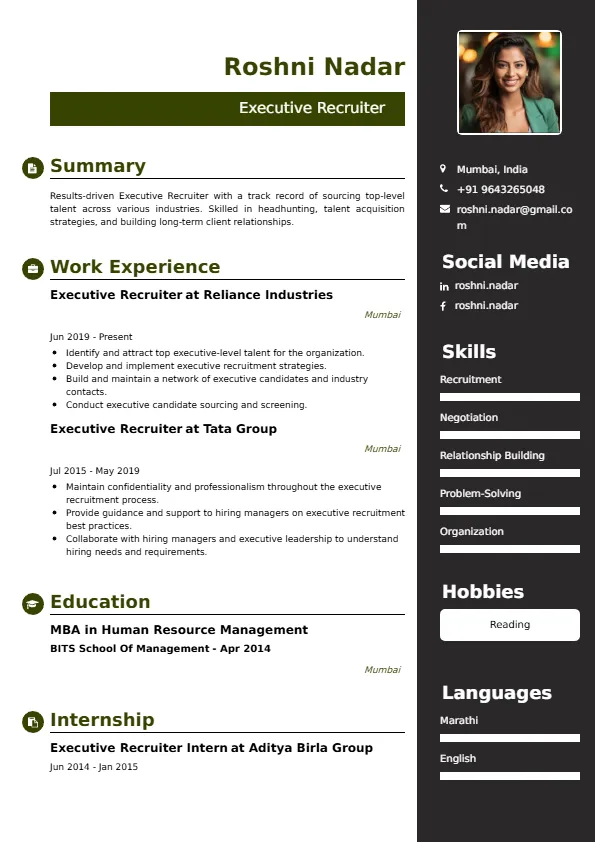
Superbresume.com empowers Executive Recruiters to craft resumes that highlight their high-impact placement success and discreet search expertise. Our platform offers customizable templates tailored for senior recruiting roles, emphasizing skills like talent mapping, executive compensation benchmarking, client relationship management, and passive candidate engagement strategies. With ATS-optimized formats, expert-written content suggestions, and real-time resume analysis, we ensure your resume aligns with job descriptions. Showcase your experience in consistently filling critical, hard-to-fill leadership roles, achieving high placement success rates, or advising C-suite clients on talent strategy with confidence. Superbresume.com helps you create a polished, results-driven resume that grabs hiring managers’ attention and lands interviews.
How to Write a Resume for an Executive Recruiter
Use Reverse-Chronological Format: List recent executive recruiting, search firm, or senior talent acquisition roles first, focusing on the level of positions filled and the industry/function specialization.
Highlight Certifications/Training: Include credentials like Certified Internet Recruiter (CIR), Human Resources certifications (SHRM-CP/SCP), or specialized assessment/interview training to boost credibility.
Quantify Achievements: Use metrics, e.g., “Successfully closed 15+ C-level/VP searches annually with an average placement fee of $150K,” or “Reduced average time-to-fill for critical executive roles by 30 days below the industry benchmark,” to show impact.
Incorporate Keywords: Use terms like “Executive Search,” “Retained/Contingent Recruiting,” “C-Suite/VP Placement,” “Talent Mapping,” “Confidential Sourcing,” “Compensation Negotiation,” “Candidate Assessment,” or “Client Relationship Management” from job descriptions for ATS.
Detail Search Strategy Skills: List expertise in passive candidate engagement, deep research (ZoomInfo/LinkedIn Recruiter), advanced Boolean sourcing, compensation benchmarking, and conducting highly structured interviews in a dedicated skills section.
Showcase Placement Success: Highlight 3-4 key placements (role, client industry, complexity), detailing the challenge of the search, the strategy used to find the talent, and the successful outcome.
Emphasize Soft Skills: Include discretion, professionalism, persuasive communication (for candidate/client), strategic advisory, and meticulous organization for complex searches.
Keep It Concise: Limit your resume to 1-2 pages, focusing on high-level search, placement, and client management experience.
Proofread Thoroughly: Eliminate typos or jargon for a professional document.
Talent Mapping and Intelligence: Highlight advanced skills in mapping entire executive landscapes of competitor organizations and generating deep market intelligence reports for clients.
Executive Compensation Benchmarking: Showcase expertise in advising on and structuring complex executive compensation packages, including stock options, bonuses, and long-term incentives (LTI).
Confidential Search Management: Detail experience managing highly discreet, confidential, and highly sensitive searches (e.g., replacement of an incumbent executive).
Technology Specialization: Emphasize expertise in searching for specialized, high-demand executive roles (e.g., CTO, Chief AI Officer, VP of Cloud Engineering).
Metrics-Driven Achievements: Use results like “Achieved a 95% stick rate (1-year retention) on all executive placements” or “Generated $2M in annual placement revenue.”
Advisory Role to C-Suite: Include experience acting as a strategic consultant, advising C-suite leaders on organizational design, succession planning, and market compensation trends.
Proprietary Database/CRM Management: Highlight expertise in building and maintaining highly specialized, confidential talent pools within internal CRM systems.
Choose Superbresume.com to craft an Executive Recruiter resume that stands out in the competitive search industry. Our platform offers tailored templates optimized for ATS, ensuring your skills in strategic sourcing, compensation negotiation, and confidential search shine. With expert guidance, pre-written content, and real-time feedback, we help you highlight achievements like closing critical C-level roles or generating significant placement revenue. Whether you specialize in retained or in-house executive search, our tools make it easy to create a polished, results-driven resume. Trust Superbresume.com to showcase your expertise in securing top leadership talent discreetly and efficiently. Start building your career today!
20 Key Skills for an Executive Recruiter Resume
| Executive Search (Retained/Contingent) | C-Suite/VP-Level Placement |
| Confidential Sourcing & Outreach | Executive Compensation Negotiation |
| Client Relationship Management (Advisory) | Advanced Sourcing (LinkedIn Recruiter/Boolean) |
| Talent Mapping & Competitive Intelligence | Candidate Assessment & Interviewing (Structured) |
| Sales & Business Development (Search Firm) | Diversity Sourcing Strategy |
| Reference Checks (Senior Level) | Search Strategy & Scoping |
| Discretion & Confidentiality | Market Compensation Benchmarking |
| ATS/CRM Management (Avature/Salesforce) | Complex Problem-Solving (Search Challenges) |
| Executive Presence & Communication | Process Efficiency (Time-to-Fill Reduction) |
10 Do’s for an Executive Recruiter Resume
Tailor Your Resume: Customize for the hiring model (e.g., emphasize client BD/sales for a search firm, emphasize internal stakeholder advisory for in-house).
Highlight Certifications/Training: List relevant recruiting certifications (CIR, SHRM) and specialized assessment training prominently.
Quantify Achievements: Include metrics on the number of executive placements, average placement fee/deal size, total revenue generated, or reduction in time-to-fill for critical roles.
Use Action Verbs: Start bullet points with verbs like “placed,” “sourced,” “negotiated,” “advised,” or “closed.”
Showcase Key Placements: Detail the scope and complexity of 3-4 major executive roles successfully filled, emphasizing the challenge overcome.
Include Soft Skills: Highlight discretion, professionalism, persuasive communication, and strategic advisory ability.
Optimize for ATS: Use standard recruiting section titles and incorporate key executive level titles and search methodology terms.
Keep It Professional: Use a clean, consistent font and professional layout.
Emphasize Confidentiality and Level: Clearly articulate experience handling highly sensitive, senior-level searches.
Proofread Carefully: Ensure no typos or errors in compensation details, metrics, or client/role titles.
10 Don’ts for an Executive Recruiter Resume
Don’t Overload with Jargon: Avoid confusing, internal company acronyms; use standardized executive search and HR terminology.
Don’t Exceed Two Pages: Keep your resume concise, focusing on high-level search strategy and placement success.
Don’t Omit Dates: Include employment dates for career context.
Don’t Use Generic Templates: Tailor your resume specifically to the strategic, high-stakes duties of an Executive Recruiter.
Don’t List Irrelevant Skills: Focus on sourcing, assessment, negotiation, talent mapping, and client advisory.
Don’t Skip Metrics: Quantify results wherever possible; search success is measured by placement volume, revenue, and speed.
Don’t Use Complex Formats: Avoid highly stylized elements or confusing graphics.
Don’t Ignore Client Advisory: Include examples of advising hiring managers/C-suite on market trends and talent strategy.
Don’t Include Outdated Experience: Omit non-recruiting or low-level HR jobs over 15 years old.
Don’t Forget to Update: Refresh for new industry specializations, successful high-profile closures, or advanced talent intelligence training.
5 FAQs for an Executive Recruiter Resume
Prioritize retained/contingent search expertise, C-level/VP placement track record, executive compensation negotiation, and advanced sourcing/talent mapping skills.
Use standard recruiting section titles, avoid graphics, and include keywords like “Talent Mapping,” “C-Suite Placement,” and “Confidential Search.”
Yes, always quantify placement revenue generated or the average deal size/placement fee to demonstrate sales and financial success.
Detail responsibilities that required managing highly sensitive information and conducting discreet searches without compromising client identity or search integrity.
Use a reverse-chronological format to emphasize your most recent, high-impact executive search and client management achievements.
Get 5x more interviews with our crafted Resumes. We make resumes that land jobs.

Get a Free Customized Cover Letter with Resume Expert Advice
with every resume order placed, you will get a free Customized Cover letter.