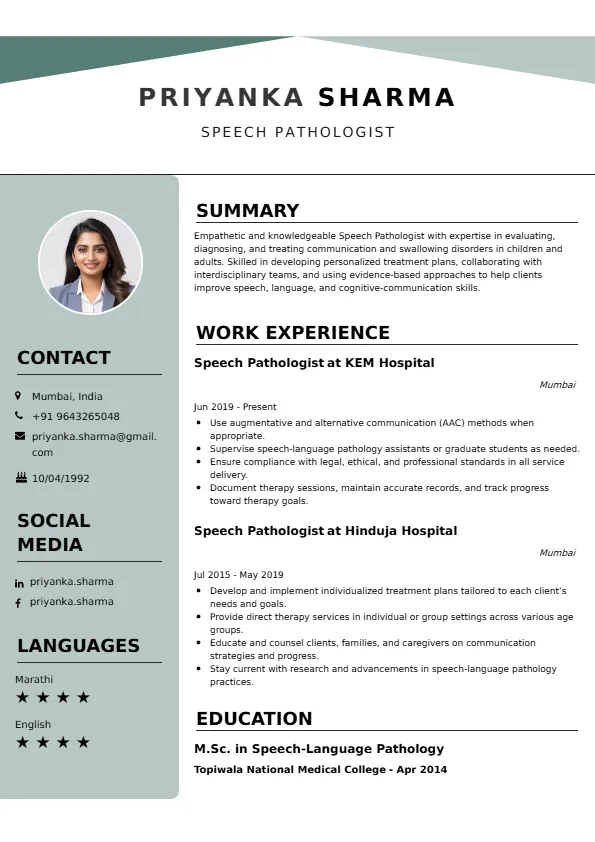
Speech Pathologist
Welcome to our Speech Pathologist (SLP) resume sample page! This expertly crafted resume template is designed to showcase your expertise in assessing, diagnosing, and treating speech, language, communication, cognitive, and swallowing disorders across various settings (schools, clinics, hospitals). Whether you work with pediatrics or geriatrics, this sample highlights key skills like ASHA CCC-SLP Certification, Diagnostic Assessment, Treatment Planning (EBP), Teletherapy, and Documentation Compliance (IEP/Insurance) tailored to meet top healthcare and educational demands. Use this guide to create a polished, results-driven resume that stands out and secures your next career opportunity.
How to Write a Resume for a Speech Pathologist
Craft a Targeted Summary: Write a 2-3 sentence summary highlighting your ASHA CCC-SLP certification, extensive clinical experience, proficiency in diagnostic assessment and evidence-based treatment, and success in achieving measurable client functional communication and swallowing goals.
Use Reverse-Chronological Format: List recent SLP roles, clinical fellowships (CFY), or relevant therapy positions first, focusing on clinical scope and measurable patient outcome achievements.
Highlight Certifications/Licensure: Include essential credentials like Active State SLP License, Certificate of Clinical Competence (CCC-SLP), specialized certifications (e.g., FEES, VitalStim), or relevant Master’s Degree (SLP) to boost credibility.
Quantify Achievements: Use metrics, e.g., “Managed a caseload of 40+ students (school setting), achieving an average 85% mastery rate on annual IEP/therapy goals,” or “Reduced patient aspiration rates by 20% in the acute care setting through implementation of modified swallow protocols,” to show impact.
Incorporate Keywords: Use terms like “ASHA CCC-SLP,” “Diagnostic Assessment (CELF/WAB),” “Dysphagia/Swallowing Intervention (FEES/VFSS),” “Speech/Language Therapy,” “IEP/Treatment Planning,” “Evidence-Based Practice (EBP),” or “Teletherapy Delivery” from job descriptions for ATS.
Detail Clinical/Technical Skills: List proficiency with specific assessment tools, therapeutic modalities (e.g., AAC, voice therapy), documentation systems (EMR/IEP software), and adherence to regulatory/payer documentation standards in a comprehensive skills section.
Showcase Program/QI Initiatives: Highlight 3-4 key contributions, such as developing a new therapy program, supervising clinical fellows/students, or leading a QI project focused on improving screening or documentation compliance.
Emphasize Soft Skills: Include empathy, strong communication (patient/family/team), analytical rigor (differential diagnosis), creative problem-solving, and adherence to ethical/legal standards.
Keep It Concise: Limit your resume to 1-2 pages, focusing on relevant clinical practice, intervention techniques, and measurable outcome experience.
Proofread Thoroughly: Eliminate typos or jargon for a professional document.
Teletherapy and Virtual Service Delivery: Focus on advanced expertise delivering high-quality speech and language therapy, assessment, and consultation services effectively and compliantly via secure telehealth platforms.
Advanced Swallowing/Dysphagia Management: Highlight specialization and procedural competence in dysphagia, often including training and experience performing instrumental swallowing assessments (FEES, VFSS) and complex therapeutic interventions (VitalStim).
Augmentative and Alternative Communication (AAC): Showcase expertise conducting AAC evaluations, programming communication devices (high/low tech), and training patients/families/staff on effective AAC system use.
EBP Integration and Outcomes Tracking: Emphasize utilizing standardized assessment tools and tracking functional outcomes measures to quantify treatment effectiveness and guide evidence-based practice decisions.
Multidisciplinary Team Collaboration: Detail experience working closely with neurologists, pediatricians, OTs, and PTs, leading the communication and swallowing components of the patient's holistic care plan.
Metrics-Driven Achievements: Use results like “Improved student articulation intelligibility scores by 20% on average within one academic year” or “Successfully managed a dysphagia caseload, reducing the incidence of aspiration pneumonia by 15%.”
IEP/504 and Documentation Compliance: Include experience navigating school-based documentation (IEP, 504) or clinical compliance (Medicare, insurance billing) with high accuracy and timeliness.
Cognitive-Communication Therapy: Highlight expertise assessing and treating cognitive-communication deficits (e.g., post-stroke, TBI, dementia) to improve functional communication in daily living.
Choose Superbresume.com to craft a Speech Pathologist resume that stands out in the competitive therapy sector. Our platform offers tailored templates optimized for ATS, ensuring your skills in CCC-SLP certification, diagnostic assessment, and evidence-based practice shine. With expert guidance, pre-written content, and real-time feedback, we help you highlight achievements like improving client communication scores or leading specialized therapy groups. Whether you specialize in dysphagia or pediatrics, our tools make it easy to create a polished, results-driven resume. Trust Superbresume.com to showcase your expertise in reliable, compassionate, and high-quality communication and swallowing intervention. Start building your career today!
20 Key Skills for a Speech Pathologist Resume
| ASHA CCC-SLP Certification & State Licensure | Diagnostic Assessment (Speech, Language, Cognitive, Swallowing) |
| Evidence-Based Practice (EBP) & Treatment Planning | Dysphagia/Swallowing Intervention (FEES/VFSS) |
| Augmentative and Alternative Communication (AAC) | Articulation, Fluency, & Voice Therapy |
10 Do’s for a Speech Pathologist Resume
Tailor Your Resume: Customize for the specific practice setting (e.g., school-based, acute care hospital, private pediatric clinic) and patient population.
Highlight Certifications/Licensure: List Active SLP license, CCC-SLP, and any specialty certifications (FEES, VitalStim) prominently.
Quantify Achievements: Include metrics on caseload size, mastery rate of therapy goals, reduction in aspiration/dysphagia scores, or successful discharge rates.
Use Action Verbs: Start bullet points with verbs like “assessed,” “treated,” “diagnosed,” “implemented,” or “developed.”
Showcase Functional Outcomes: Detail the methodology and the strategic, quantified functional communication or swallowing result of 3-4 key therapy interventions.
Include Soft Skills: Highlight empathy, strong therapeutic communication, analytical rigor, and adherence to EBP.
Optimize for ATS: Use standard therapy section titles and incorporate key ASHA, procedural, and assessment terms.
Keep It Professional: Use a clean, consistent font and medical/clinical layout.
Emphasize EBP and Specialization: Clearly articulate expertise in using evidence-based practice and specialized areas (AAC, Dysphagia).
Proofread Thoroughly: Eliminate typos or jargon for a professional document.
10 Don’ts for a Speech Pathologist Resume
Don’t Overload with Jargon: Avoid confusing, internal facility or unit acronyms; use standardized SLP and diagnostic terminology (ASHA, CPT codes).
Don’t Exceed Two Pages: Keep your resume concise, focusing on high-impact clinical practice and specialized procedural experience.
Don’t Omit Dates: Include full dates for education, licensure, and employment for credentialing purposes.
Don’t Use Generic Templates: Tailor your resume specifically to the specialized assessment and therapeutic duties of an SLP.
Don’t List Irrelevant Skills: Focus on speech, language, swallowing, cognitive-communication, and therapy modalities.
Don’t Skip Metrics: Quantify results wherever possible; link clinical work to communication scores, swallowing safety, or caseload volume.
Don’t Use Complex Formats: Avoid highly stylized elements or confusing graphics.
Don’t Ignore Documentation Compliance: Include explicit experience managing IEPs (school) or insurance documentation (clinical).
Don’t Include Outdated Experience: Omit non-therapy or non-clinical jobs over 15 years old.
Don’t Forget to Update: Refresh for new certification renewals, successful program development initiatives, or advanced procedural training.
5 FAQ's for a Speech Pathologist Resume
"Achieved significant progress in 90% of caseload, moving patients from liquid-only diets to mechanical soft through swallowing therapy."
Yes. Proficiency in Casamba, NetHealth, or specialized school documentation software is highly valued.
Specify if your experience is in SNFs, Acute Care, Home Health, or K-12 Schools.
Describe your expertise in evaluating and implementing Augmentative and Alternative Communication devices for non-verbal clients.
Absolutely. "Conducted monthly family training sessions to ensure carryover of communication strategies in the home environment."
Get 5x more interviews with our crafted Resumes. We make resumes that land jobs.

Get a Free Customized Cover Letter with Resume Expert Advice
with every resume order placed, you will get a free Customized Cover letter.