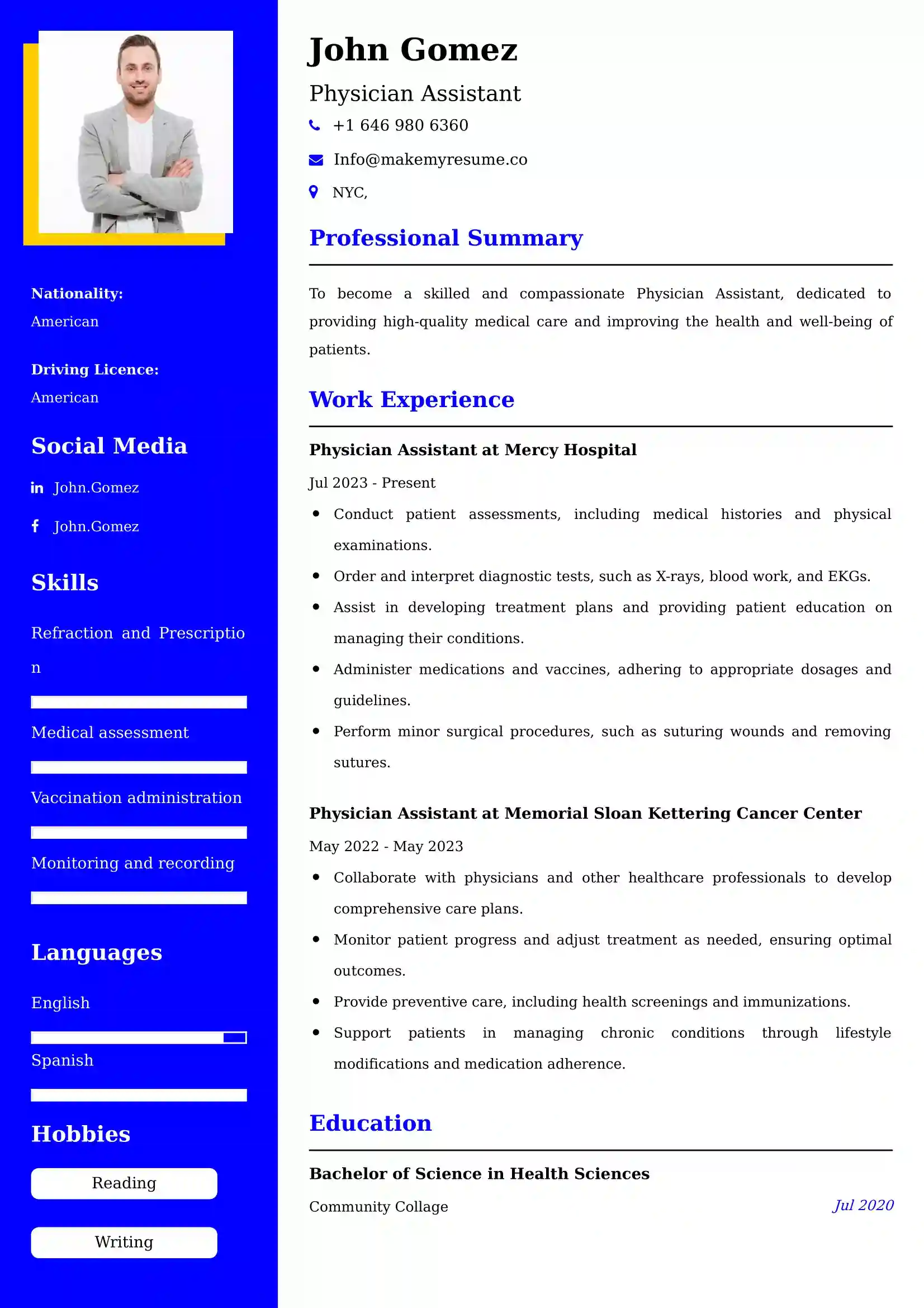
Physician Assistant
Welcome to our Physician Assistant (PA) resume sample page! This expertly crafted resume template is designed to showcase your expertise in providing medical care under physician supervision, including patient assessment, diagnosis, ordering/interpreting tests, prescribing medication, and managing treatment plans across various specialties (e.g., primary care, surgery, emergency medicine). Whether you work in a clinic, hospital, or specialty practice, this sample highlights key skills like Advanced Assessment, Diagnostic Reasoning, EMR Proficiency, Procedural Competence, and Collaborative Practice tailored to meet top hospital and clinic demands. Use this guide to create a polished, results-driven resume that stands out and secures your next career opportunity.
Superbresume.com empowers Physician Assistants to craft resumes that highlight their clinical versatility and patient outcome expertise. Our platform offers customizable templates tailored for advanced practice roles, emphasizing skills like evidence-based practice (EBP) integration, surgical first assist, quality improvement (QI) leadership, and efficient patient throughput management. With ATS-optimized formats, expert-written content suggestions, and real-time feedback, we ensure your resume aligns with job descriptions. Showcase your experience in successfully managing a large patient panel, significantly improving preventative screening compliance, or mastering specialized procedural techniques with confidence. Superbresume.com helps you create a polished, results-driven resume that grabs hiring managers’ attention and lands interviews.
How to Write a Resume for a Physician Assistant
Craft a Targeted Summary: Write a 2-3 sentence summary highlighting your active PA licensure (PA-C), extensive clinical experience in collaborative practice, proficiency in diagnosis, prescribing, and EMR documentation, and commitment to evidence-based, high-quality patient care.
Use Reverse-Chronological Format: List recent PA roles, clinical rotations/fellowships, and relevant critical care roles first, focusing on clinical scope and measurable patient outcome achievements.
Highlight Certifications/Licensure: Include essential credentials like Active PA License (State-Specific), NCCPA Certification (PA-C), DEA registration, specialized procedural certifications (e.g., ATLS, ACLS), or relevant Master’s Degree (MPAS) to boost credibility.
Quantify Achievements: Use metrics, e.g., “Managed an average of 25-30 patient encounters daily in a busy urgent care clinic, maintaining a 95% patient satisfaction rate,” or “Served as First Assist on 150+ surgical cases (e.g., orthopedic trauma), ensuring optimal surgical workflow,” to show impact.
Incorporate Keywords: Use terms like “NCCPA Certified (PA-C),” “Patient Assessment & Diagnosis,” “Prescribing & Medication Management,” “EMR/EHR Proficiency (Epic/Cerner),” “Procedural Competence (Suturing, Joint Injection),” “Surgical First Assist (if applicable),” or “Collaborative Practice” from job descriptions for ATS.
Detail Clinical/Procedural Skills: List proficiency with specific procedures (e.g., suturing, minor excisions, advanced trauma assessment), EMR systems (order entry, charting), clinical guidelines adherence, and strong diagnostic reasoning in a comprehensive skills section.
Showcase Quality/Program Initiatives: Highlight 3-4 key contributions, such as leading a disease management protocol implementation, serving on a hospital QI committee, or precepting new PA students/support staff.
Emphasize Soft Skills: Include clinical autonomy (under supervision), diagnostic acumen, patient education, empathy, strong communication (physician/team), and ethical decision-making.
Keep It Concise: Limit your resume to 1-2 pages, focusing on relevant advanced practice, clinical leadership, and measurable outcome experience.
Proofread Thoroughly: Eliminate typos or jargon for a professional document.
Specialty Procedural Competence: Focus on advanced skills and experience performing specialized procedures (e.g., joint injections, chest tube placement, skin biopsies) within the scope of practice of the supervising physician.
EHR Optimization and Efficiency: Emphasize advanced proficiency leveraging EHR systems (Epic, Cerner) for efficient order entry, documentation (using templates/smart phrases), and maximizing patient throughput.
Surgical First Assisting: If applicable, highlight extensive experience serving as the surgical first assistant, demonstrating knowledge of sterile technique, surgical anatomy, and closure techniques.
Telehealth and Virtual Care: Showcase proficiency utilizing virtual visits, remote patient monitoring, and secure communication platforms for high-quality, convenient patient care.
Quality Improvement (QI) Leadership: Include experience leading or participating in QI projects focused on improving patient safety, optimizing clinical protocols (e.g., sepsis), or enhancing efficiency metrics.
Metrics-Driven Achievements: Use results like “Successfully managed a follow-up clinic that reduced the physician’s appointment burden by 30%” or “Achieved 95% compliance on a complex pre-operative order set design.”
Diagnostic Reasoning and Test Interpretation: Detail expertise ordering and interpreting complex laboratory tests and diagnostic imaging to formulate differential diagnoses and treatment plans.
Collaborative Practice and Communication: Highlight strong communication and seamless collaboration with the supervising physician, ensuring adherence to the delegated scope of practice and state regulations.
Choose Superbresume.com to craft a Physician Assistant resume that stands out in the competitive advanced practice sector. Our platform offers tailored templates optimized for ATS, ensuring your skills in PA-C certification, procedural competence, and EMR proficiency shine. With expert guidance, pre-written content, and real-time feedback, we help you highlight achievements like managing high patient volumes or leading quality initiatives. Whether you specialize in primary care or surgery, our tools make it easy to create a polished, results-driven resume. Trust Superbresume.com to showcase your expertise in decisive, evidence-based, and high-quality patient care delivery. Start building your career today!
20 Key Skills for a Physician Assistant Resume
| NCCPA Certification (PA-C) & State Licensure | Patient Assessment & Diagnostic Reasoning |
| Prescribing & Medication Management (DEA Registration) | EHR/EMR Proficiency (Epic/Cerner) & Order Entry |
| Procedural Competence (Suturing, Biopsy, Joint Injection) | Surgical First Assist (if applicable) |
| Chronic Disease Management (Evidence-Based) | ATLS/ACLS/PALS Certified (if acute care) |
10 Do’s for a Physician Assistant Resume
Tailor Your Resume: Customize for the specific specialty (e.g., Orthopedics, Family Medicine, Emergency Department) and the practice setting.
Highlight Certifications/Licensure: List Active PA license, NCCPA Certification (PA-C), and DEA registration prominently.
Quantify Achievements: Include metrics on patient volume managed daily, number of procedures performed, QI project outcomes, or efficiency gains in patient flow.
Use Action Verbs: Start bullet points with verbs like “diagnosed,” “prescribed,” “managed,” “performed,” or “collaborated.”
Showcase Procedural Skills: Detail specific procedures and the volume of high-acuity/specialty cases managed.
Include Soft Skills: Highlight clinical autonomy (under supervision), diagnostic acumen, patient education mastery, and strong communication.
Optimize for ATS: Use standard medical section titles and incorporate key PA, specialty, and EMR terms.
Keep It Professional: Use a clean, consistent font and medical layout.
Emphasize EBP and Scope: Clearly articulate expertise in evidence-based practice and operating effectively within the collaborative scope.
Proofread Thoroughly: Eliminate typos or jargon for a professional document.
10 Don’ts for a Physician Assistant Resume
Don’t Overload with Jargon: Avoid confusing, internal facility or unit acronyms; use standardized medical and PA terminology (AAPA).
Don’t Exceed Two Pages: Keep your resume concise, focusing on high-level advanced practice, clinical leadership, and measurable outcomes.
Don’t Omit Dates: Include full dates for education, licensure, and employment for credentialing purposes.
Don’t Use Generic Templates: Tailor your resume specifically to the autonomous clinical and procedural duties of a Physician Assistant.
Don’t List Irrelevant Skills: Focus on advanced practice, prescribing, diagnosis, EMR, and procedural competence.
Don’t Skip Metrics: Quantify results wherever possible; link clinical work to patient volume, procedure count, or efficiency metrics.
Don’t Use Complex Formats: Avoid highly stylized elements or confusing graphics.
Don’t Ignore Procedural Skills: Include explicit experience performing and assisting with minor and major procedures.
Don’t Include Outdated Experience: Omit pre-PA or non-clinical jobs over 15 years old.
Don’t Forget to Update: Refresh for new certification renewals, successful quality improvement initiatives, or continued education/training.
5 FAQ's for a Physician Assistant Resume
"Managed an independent panel of 15-20 patients daily, including diagnosis, treatment planning, and prescribing."
If applicable, yes: "Served as First Assist in 200+ orthopedic surgeries, including total joint replacements and trauma cases."
NCCPA (PA-C), DEA registration, and ACLS/PALS.
"Reduced clinic wait times by 20% by implementing a streamlined patient triage and charting workflow."
Yes. State "Expert user of Epic (including SmartPhrases/Order Sets) to optimize documentation speed."
Get 5x more interviews with our crafted Resumes. We make resumes that land jobs.

Get a Free Customized Cover Letter with Resume Expert Advice
with every resume order placed, you will get a free Customized Cover letter.