Physical Therapist
Welcome to our Physical Therapist (PT) resume sample page! This expertly crafted resume template is designed to showcase your expertise in assessing, diagnosing, and treating movement dysfunction, designing rehabilitation programs, providing manual therapy, and educating patients to restore function and prevent disability. Whether you work in orthopedics, neurorehabilitation, or acute care, this sample highlights key skills like Patient Assessment (ROM/Strength), Manual Therapy, Therapeutic Exercise, Evidence-Based Practice (EBP), and Documentation (ICD-10/CPT) tailored to meet top hospital, clinic, and rehabilitation demands. Use this guide to create a polished, results-driven resume that stands out and secures your next career opportunity.
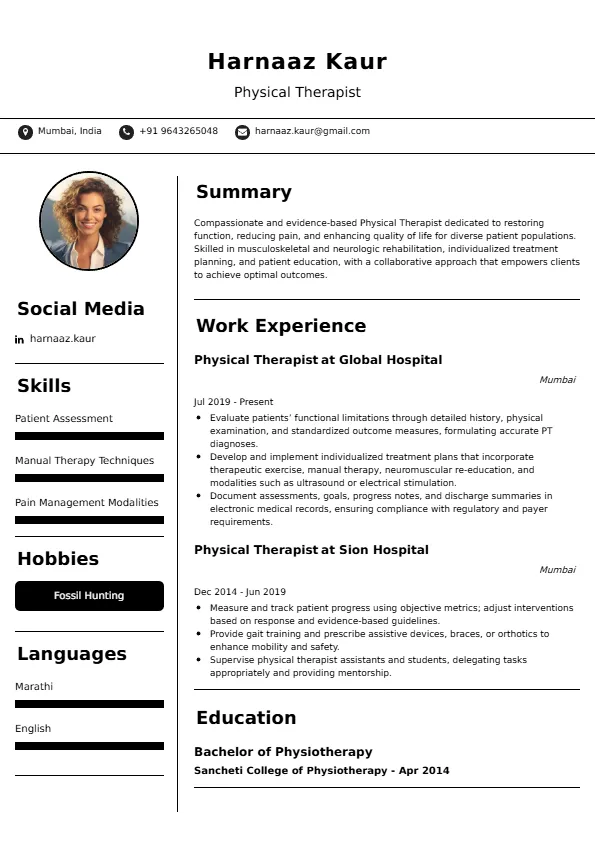
Superbresume.com empowers Physical Therapists to craft resumes that highlight their clinical expertise and measurable client functional outcomes. Our platform offers customizable templates tailored for therapy roles, emphasizing skills like advanced manual techniques (Maitland/McKenzie), neurorehabilitation protocols, outcomes tracking (FIM/G-Code), and adherence to regulatory/payer documentation requirements. With ATS-optimized formats, expert-written content suggestions, and real-time resume analysis, we ensure your resume aligns with job descriptions. Showcase your experience in successfully managing a high-volume caseload, significantly improving client functional independence scores, or leading successful program development initiatives with confidence. Superbresume.com helps you create a polished, results-driven resume that grabs hiring managers’ attention and lands interviews.
How to Write a Resume for a Physical Therapist
Craft a Targeted Summary: Write a 2-3 sentence summary highlighting your active PT licensure, extensive experience in evidence-based rehabilitation (specify setting: outpatient, acute care), proficiency in assessment and manual/therapeutic intervention, and success in achieving measurable client independence and recovery goals.
Use Reverse-Chronological Format: List recent PT roles, clinical fellowships/rotations, or relevant therapy positions first, focusing on clinical scope and measurable patient outcome achievements.
Highlight Certifications/Licensure: Include credentials like Active PT License (State-Specific), Board Certification (e.g., OCS, NCS), specialized certifications (e.g., Dry Needling), or relevant Master’s/Doctorate (DPT) degree to boost credibility.
Quantify Achievements: Use metrics, e.g., “Managed a daily caseload of 10-15 patients, achieving an average functional independence measure (FIM) score improvement of 15 points over a 4-week episode of care,” or “Designed a post-operative protocol that reduced patient time-to-functional-discharge by 10%,” to show impact.
Incorporate Keywords: Use terms like “Evidence-Based Practice (EBP),” “Therapeutic Exercise,” “Manual Therapy (Joint/Spinal Mobilization),” “Functional Assessment (FIM/G-Code),” “Neurorehabilitation/Orthopedics,” “EMR Documentation (CPT/ICD-10),” or “Interdisciplinary Team Collaboration” from job descriptions for ATS.
Detail Clinical/Technical Skills: List proficiency with specific manual techniques, modalities (e.g., dry needling, electrical stimulation), documentation systems (EHR), outcome measure tracking, and adherence to payer guidelines in a dedicated skills section.
Showcase Program/QI Initiatives: Highlight 3-4 key contributions, such as developing a new rehab program, precepting students, or leading a QI project focused on reducing patient falls or improving documentation compliance.
Emphasize Soft Skills: Include empathy, strong communication (patient/family/team), critical thinking (differential diagnosis), attention to detail (documentation), and adherence to ethical/legal standards.
Keep It Concise: Limit your resume to 1-2 pages, focusing on relevant clinical practice, rehabilitation techniques, and measurable outcome experience.
Proofread Thoroughly: Eliminate typos or jargon for a professional document.
Specialization and Advanced Certifications: Focus on advanced training and Board Certification (e.g., OCS for Orthopedics, NCS for Neurology), which are highly valued in acute care and outpatient settings, demonstrating deep expertise.
Outcomes Tracking and Value-Based Care: Highlight expertise utilizing standardized outcomes measures (FIM, COPM, patient-reported outcomes - PROMs) to quantify treatment effectiveness and justify therapy frequency under value-based payment models.
Telehealth and Home Exercise Programs (HEPs): Showcase proficiency delivering high-quality virtual therapy sessions and utilizing digital platforms for remote monitoring and customized HEP prescription/tracking.
Neurorehabilitation and Advanced Techniques: Detail expertise implementing specialized protocols for stroke, TBI, or spinal cord injury, often involving advanced technology (e.g., robotic gait training, virtual reality).
Documentation and Payer Compliance: Emphasize meticulous attention to detail in documentation (daily notes, evaluations, discharge summaries) to meet strict Medicare, Medicaid, and commercial payer requirements for necessity and frequency.
Metrics-Driven Achievements: Use results like “Successfully discharged 90% of post-operative joint replacement patients to home rather than skilled nursing” or “Increased outpatient clinic volume by 15% through high patient satisfaction and referral rates.”
Interdisciplinary Team Leadership: Highlight experience collaborating closely with physicians (PCP, Ortho), OTs, and SLPs, often serving as the primary driver of patient mobilization and functional goal setting.
Pain Neuroscience Education (PNE): Include expertise educating patients on chronic pain physiology and utilizing PNE to shift beliefs and facilitate active coping strategies.
Choose Superbresume.com to craft a Physical Therapist resume that stands out in the competitive rehabilitation sector. Our platform offers tailored templates optimized for ATS, ensuring your skills in DPT licensure, functional outcomes, and evidence-based practice shine. With expert guidance, pre-written content, and real-time feedback, we help you highlight achievements like improving patient independence scores or leading program development initiatives. Whether you specialize in orthopedics or neurorehab, our tools make it easy to create a polished, results-driven resume. Trust Superbresume.com to showcase your expertise in restoring movement, function, and quality of life. Start building your career today!
20 Key Skills for a Physical Therapist Resume
| Active PT License (DPT/MPT) & NBCOT Certification | Functional Assessment & Outcomes Tracking (FIM, PROMs) |
| Evidence-Based Practice (EBP) & Clinical Reasoning | Therapeutic Exercise & Modalities (Neuro/Ortho) |
| Manual Therapy (Joint Mobilization/Soft Tissue) | Interdisciplinary Team Collaboration |
| Rehabilitation Protocols (Post-Operative/Stroke) | Documentation & Payer Compliance (CPT/ICD-10) |
| Gait/Balance Training & Fall Prevention | Adaptive Equipment & Assistive Devices |
10 Do’s for a Physical Therapist Resume
Tailor Your Resume: Customize for the specific practice setting (e.g., outpatient orthopedics, inpatient rehabilitation, school-based) and patient population.
Highlight Certifications/Licensure: List Active PT license, DPT degree, and specialty certifications (OCS, NCS) prominently.
Quantify Achievements: Include metrics on caseload size, functional improvement scores (FIM/PROMs), successful discharge rates, or efficiency gains in documentation time.
Use Action Verbs: Start bullet points with verbs like “treated,” “assessed,” “designed,” “rehabilitated,” or “restored.”
Showcase Functional Outcomes: Detail the methodology and the strategic, quantified functional independence result of 3-4 key therapy interventions.
Include Soft Skills: Highlight empathy, strong communication (patient/family/team), critical thinking, and adherence to EBP.
Optimize for ATS: Use standard therapy section titles and incorporate key assessment and treatment terms.
Keep It Professional: Use a clean, consistent font and medical/clinical layout.
Emphasize Outcomes and EBP: Clearly articulate expertise in restoring function and utilizing evidence-based treatment protocols.
Proofread Thoroughly: Eliminate typos or jargon for a professional document.
10 Don’ts for a Physical Therapist Resume
Don’t Overload with Jargon: Avoid confusing, internal facility or unit acronyms; use standardized therapy and assessment terminology (APTA).
Don’t Exceed Two Pages: Keep your resume concise, focusing on high-impact clinical practice and rehabilitation achievements.
Don’t Omit Dates: Include full dates for education, licensure, and employment for credentialing purposes.
Don’t Use Generic Templates: Tailor your resume specifically to the specialized functional and holistic duties of a PT.
Don’t List Irrelevant Skills: Focus on functional assessment, rehabilitation techniques, therapeutic exercise, and interdisciplinary care.
Don’t Skip Metrics: Quantify results wherever possible; link clinical work to independence scores, discharge success, or caseload volume.
Don’t Use Complex Formats: Avoid highly stylized elements or confusing graphics.
Don’t Ignore Documentation: Include explicit experience with CPT/ICD-10 coding and payer compliance requirements.
Don’t Include Outdated Experience: Omit non-therapy or non-clinical jobs over 15 years old.
Don’t Forget to Update: Refresh for new certification renewals, successful program development initiatives, or advanced EBP training.
5 FAQ's for a Physical Therapist Resume
"Improved patient independence scores (FIM) by an average of 30% for post-operative orthopedic cases."
Yes. Proficiency in NetHealth, Casamba, or WebPT is highly valued.
Mention Dry Needling, Graston Technique, or McKenzie Method certifications.
Yes, in many settings: "Consistently achieved 90% productivity targets while maintaining high quality of care and defensible documentation."
"Coordinated care plans with Physicians, OTs, and Case Managers to facilitate successful home discharges."
Get 5x more interviews with our crafted Resumes. We make resumes that land jobs.

Get a Free Customized Cover Letter with Resume Expert Advice
with every resume order placed, you will get a free Customized Cover letter.