Patient Care Technician
Welcome to our Patient Care Technician (PCT) resume sample page! This expertly crafted resume template is designed to showcase your expertise in providing direct patient care, monitoring vital signs, assisting with activities of daily living (ADLs), performing basic clinical tasks (e.g., phlebotomy, EKG), and ensuring patient safety and comfort. Whether you work in a hospital, long-term care, or clinic setting, this sample highlights key skills like Vitals Monitoring, Phlebotomy/EKG, Basic Patient Care, Documentation (EMR), and Patient Safety tailored to meet top healthcare demands. Use this guide to create a polished, results-driven resume that stands out and secures your next career opportunity.
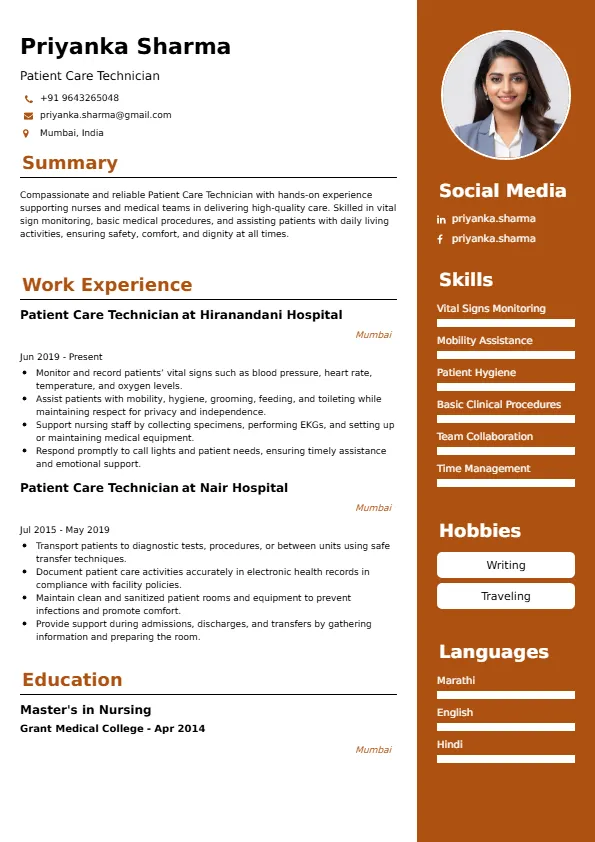
Superbresume.com empowers Patient Care Technicians to craft resumes that highlight their direct care competence and patient safety vigilance. Our platform offers customizable templates tailored for patient support roles, emphasizing skills like aseptic technique, specimen collection, EMR charting, and clear communication with nurses/physicians. With ATS-optimized formats, expert-written content suggestions, and real-time resume analysis, we ensure your resume aligns with job descriptions. Showcase your experience in successfully managing a high volume of patient tasks, maintaining flawless vital signs documentation, or assisting effectively with clinical procedures with confidence. Superbresume.com helps you create a polished, results-driven resume that grabs hiring managers’ attention and lands interviews.
How to Write a Resume for a Patient Care Technician
Craft a Targeted Summary: Write a 2-3 sentence summary highlighting your certification, extensive experience in direct patient care (ADLs, Vitals), proficiency in basic clinical tasks (Phlebotomy/EKG), and commitment to patient safety and accurate documentation.
Use Reverse-Chronological Format: List recent PCT, CNA, or relevant clinical support roles first, focusing on measurable patient care and procedural achievements.
Highlight Certifications/Training: Include credentials like Certified Patient Care Technician (CPCT), Certified Nursing Assistant (CNA), BLS/CPR Certification, Phlebotomy/EKG certification, or specialized acute care training to boost credibility.
Quantify Achievements: Use metrics, e.g., “Managed care for a caseload of 10-15 patients per shift, ensuring 100% completion of vital signs and ADL documentation,” or “Performed 50+ phlebotomy draws monthly with a 98% success rate, minimizing specimen errors,” to show impact.
Incorporate Keywords: Use terms like “Activities of Daily Living (ADL) Assistance,” “Vitals Monitoring & Reporting,” “Phlebotomy/Venipuncture,” “EKG Administration (12-Lead),” “Patient Safety & Fall Prevention,” “EMR Documentation,” or “Basic Patient Assessment” from job descriptions for ATS.
Detail Clinical/Procedural Skills: List proficiency with specific tasks (e.g., foley insertion/care, blood glucose monitoring, specimen collection, simple wound care), EMR systems, infection control protocols, and patient transport techniques in a dedicated skills section.
Showcase Unit Contributions: Highlight 3-4 key responsibilities or projects, such as serving as a preceptor for new staff, leading a safety rounding initiative, or assisting with a specialized clinical procedure.
Emphasize Soft Skills: Include empathy, patience, strong observational skills, meticulous attention to detail (vitals/specimens), and teamwork (with nurses).
Keep It Concise: Limit your resume to 1 page, focusing on relevant clinical support, procedural, and safety experience.
Proofread Thoroughly: Eliminate typos or jargon for a professional document.
Phlebotomy and EKG Expertise: Focus on high-volume experience and technical competence in performing venipuncture, specimen processing, and acquiring accurate 12-lead EKGs for diagnostic purposes.
Patient Safety and Fall Prevention: Highlight expertise implementing evidence-based protocols for fall risk assessment, toileting schedules, and bed alarm management to minimize adverse events.
Advanced Monitoring and Documentation: Showcase proficiency utilizing electronic vital signs monitors, tracking continuous input/output (I&O), and ensuring timely, accurate charting in the Electronic Medical Record (EMR).
Infection Control and Aseptic Technique: Emphasize strict adherence to hand hygiene, isolation protocols, and meticulous aseptic technique for procedures like foley catheter insertion and wound care.
Team Communication and Reporting: Detail strong communication skills, effectively reporting critical changes in patient status (e.g., vital signs, mental status) immediately to the supervising nurse (RN).
Metrics-Driven Achievements: Use results like “Maintained zero patient falls or pressure ulcers in caseload over 12 months” or “Reduced the time required for patient discharge setup by 10 minutes through streamlined process checks.”
Telemonitoring and Technology Support: If applicable, include experience setting up and monitoring stable patients using remote patient monitoring devices (e.g., cardiac monitors, pulse oximeters).
Cross-Training/Specialty Exposure: Highlight experience assisting in specialized units (e.g., Emergency Department, ICU Step-down) beyond general med-surg.
Choose Superbresume.com to craft a Patient Care Technician resume that stands out in the essential healthcare support sector. Our platform offers tailored templates optimized for ATS, ensuring your skills in CPCT/CNA certification, EKG/Phlebotomy, and patient safety shine. With expert guidance, pre-written content, and real-time feedback, we help you highlight achievements like managing high patient volumes or maintaining flawless safety records. Whether you support acute care or long-term settings, our tools make it easy to create a polished, results-driven resume. Trust Superbresume.com to showcase your expertise in reliable, compassionate, and efficient direct patient care. Start building your career today!
20 Key Skills for a Patient Care Technician Resume
| Vitals Monitoring & Reporting | Activities of Daily Living (ADL) Assistance |
| Phlebotomy & Specimen Processing | 12-Lead EKG Administration |
| Patient Safety & Fall Prevention Protocols | EMR Documentation (Charting Vitals/I&O) |
| Infection Control & Aseptic Technique | Blood Glucose Monitoring & Diabetic Support |
| Patient Transport & Mobility Assistance | Basic Wound Care & Simple Dressing Changes |
| BLS/CPR Certified | Communication (Reporting Changes to RN) |
10 Do’s for a Patient Care Technician Resume
Tailor Your Resume: Customize for the specific acuity level (e.g., acute care floor, skilled nursing unit) and patient demographic.
Highlight Certifications/Training: List CPCT/CNA, BLS, and Phlebotomy/EKG certifications prominently.
Quantify Achievements: Include metrics on caseload size managed, procedure success rates (phlebotomy), or zero incident safety records.
Use Action Verbs: Start bullet points with verbs like “assisted,” “monitored,” “performed,” “documented,” or “ensured.”
Showcase Procedural Skills: Detail specific advanced procedures routinely performed (Phlebotomy, EKG) beyond basic CNA duties.
Include Soft Skills: Highlight empathy, strong observational skills, attention to detail, and patient safety vigilance.
Optimize for ATS: Use standard healthcare section titles and incorporate key certification and procedural terms.
Keep It Concise: Limit your resume to one page, focusing on relevant clinical and procedural experience.
Emphasize Safety and Accuracy: Clearly articulate expertise in accurate documentation, vitals reporting, and adhering to fall prevention protocols.
Proofread Thoroughly: Eliminate typos or jargon for a professional document.
10 Don’ts for a Patient Care Technician Resume
Don’t Overload with Jargon: Avoid confusing, internal facility or unit acronyms; use standardized clinical terminology.
Don’t Exceed One Page: Keep your resume sharp and focused on the most relevant, measurable PCT duties.
Don’t Omit Dates: Include full dates for education, certification, and employment for credentialing purposes.
Don’t Use Generic Templates: Tailor your resume specifically to the combined clinical and basic procedural duties of a PCT.
Don’t List Irrelevant Skills: Focus on direct patient care, monitoring, basic procedures, and safety.
Don’t Skip Metrics: Quantify results wherever possible; link clinical work to patient volume, procedure success, or safety records.
Don’t Use Complex Formats: Avoid highly stylized elements or confusing graphics.
Don’t Ignore EMR Documentation: Include explicit experience charting vitals and patient observations accurately.
Don’t Include Outdated Experience: Omit non-clinical or irrelevant jobs over 10 years old.
Don’t Forget to Update: Refresh for new certification renewals, successful procedure training, or EMR system proficiency.
5 FAQ's for a Patient Care Technician Resume
List Phlebotomy, EKG/ECG lead placement, vitals monitoring, and specimen collection.
"Achieved a 0% patient fall rate in my assigned caseload through proactive rounding and risk assessment."
Yes. Mention proficiency in Epic or Cerner to show you can accurately chart care in real-time.
"Provided comprehensive support for Activities of Daily Living (ADLs), ensuring patient comfort and hygiene while adhering to strict aseptic techniques."
Always prominently list CPCT/A (Certified Patient Care Technician) and BLS/CPR.
Get 5x more interviews with our crafted Resumes. We make resumes that land jobs.

Get a Free Customized Cover Letter with Resume Expert Advice
with every resume order placed, you will get a free Customized Cover letter.