Lab Technician
Welcome to our Lab Technician resume sample page! This expertly crafted resume template is designed to showcase your expertise in performing, documenting, and analyzing laboratory tests, operating and maintaining analytical equipment, and adhering to strict quality control and safety protocols in clinical, research, or manufacturing settings. Whether you're an entry-level candidate or a seasoned professional, this sample highlights key skills like GLP/GMP/CLIA compliance, SOP adherence, instrument calibration, data analysis, and technical troubleshooting tailored to meet top scientific demands. Use this guide to create a compelling resume that stands out and secures your next career opportunity.
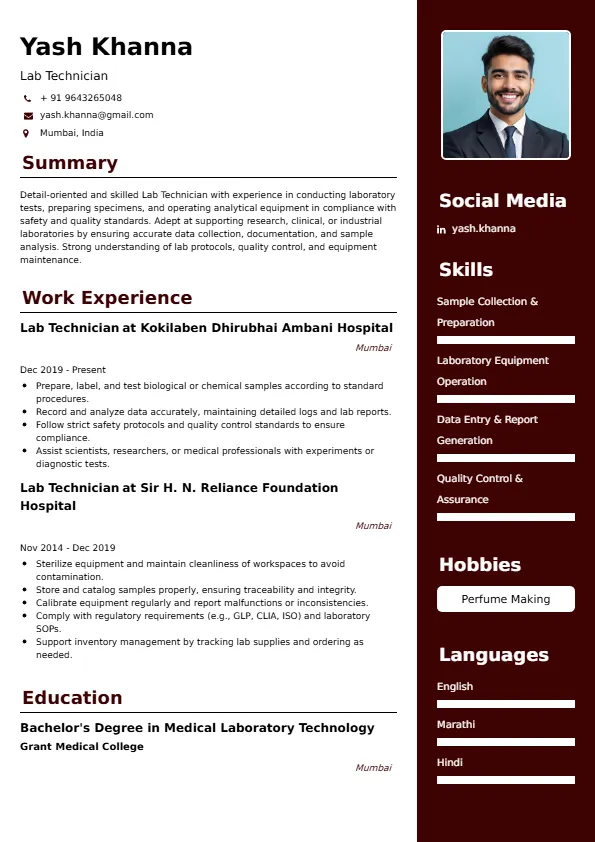
Superbresume.com empowers Lab Technicians to craft resumes that highlight their procedural precision and quality control expertise. Our platform offers customizable templates tailored for scientific roles, emphasizing skills like advanced analytical techniques (HPLC, PCR), LIMS (Laboratory Information Management System) proficiency, sample handling and preparation, and regulatory documentation. With ATS-optimized formats, expert-written content suggestions, and real-time resume analysis, we ensure your resume aligns with job descriptions. Showcase your experience in consistently achieving high sample throughput, reducing assay errors, or successfully troubleshooting complex analytical instrumentation with confidence. Superbresume.com helps you create a polished, results-driven resume that grabs hiring managers’ attention and lands interviews.
How to Write a Resume for a Lab Technician
Craft a Targeted Summary: Write a 2-3 sentence summary highlighting your expertise in laboratory testing and analysis, proficiency in operating and maintaining scientific instrumentation, and success in ensuring high data accuracy and strict regulatory compliance (e.g., GLP/CLIA).
Use Reverse-Chronological Format: List recent lab technician, research assistant, or quality control roles first, focusing on measurable technical and compliance achievements.
Highlight Certifications/Training: Include credentials like ASCP certification (MLT/MT), specialized instrument training (e.g., HPLC), GLP/GMP training, or relevant science/technical degrees to boost credibility.
Quantify Achievements: Use metrics, e.g., “Processed 100+ patient samples daily, maintaining a test accuracy rate of 99.8%,” or “Reduced instrument downtime by 15% through proactive calibration and preventive maintenance (PM) scheduling,” to show impact.
Incorporate Keywords: Use terms like “GLP/GMP/CLIA Compliance,” “Analytical Instrumentation (HPLC/GC/Spectroscopy),” “SOP Adherence,” “Quality Control (QC),” “LIMS Proficiency,” “Data Analysis & Reporting,” or “Sample Preparation & Handling” from job descriptions for ATS.
Detail Technical Skills: List proficiency with specific analytical techniques, laboratory equipment, statistical software (JMP, Minitab), LIMS, safety protocols (chemical handling), and instrument calibration procedures in a comprehensive skills section.
Showcase Lab Projects/Tests: Highlight 3-4 key tests or projects managed, detailing the methodology used, the equipment operated, the challenge solved (e.g., assay validation), and the quantified accuracy/efficiency result.
Emphasize Soft Skills: Include meticulous attention to detail, procedural precision, analytical rigor, adherence to safety/hygiene protocols, and strong technical communication (reporting results).
Keep It Concise: Limit your resume to 1-2 pages, focusing on relevant laboratory analysis, technical operation, and compliance experience.
Proofread Thoroughly: Eliminate typos or jargon for a professional document.
LIMS and Data Automation: Focus on expertise using Laboratory Information Management Systems (LIMS) for seamless sample tracking, results logging, and generating automated compliance reports.
Advanced Analytical Techniques: Highlight proficiency operating and troubleshooting complex, specialized instrumentation common in the industry (e.g., Mass Spectrometry, Real-Time PCR, NGS).
Quality Assurance and Method Validation: Showcase experience participating in method validation, developing written SOPs (Standard Operating Procedures), and adhering to formal Quality Assurance (QA) standards.
Root Cause Analysis (RCA) for Deviations: Detail experience investigating unexpected assay results or instrument malfunctions, identifying the root cause, and documenting corrective and preventive actions (CAPA).
Regulatory Compliance (CLIA, FDA, ISO): Emphasize deep commitment to and experience maintaining the laboratory environment and documentation required for external regulatory audits.
Metrics-Driven Achievements: Use results like “Successfully completed the annual calibration/qualification for 5 major analytical instruments on time” or “Processed 20% more samples per day after optimizing the pre-analytical workflow.”
Cross-Functional Collaboration: Include experience collaborating with R&D scientists, QA/Compliance officers, and clinical staff to ensure sample integrity and reliable result delivery.
Basic Statistical Analysis: Highlight proficiency performing basic statistical analysis (e.g.,Basic Statistical Analysis: Highlight proficiency performing basic statistical analysis (e.g., calculating control limits, precision, accuracy) on generated data to ensure result reliability.Choose Superbresume.com to craft a Lab Technician resume that stands out in the essential scientific and medical sectors. Our platform offers tailored templates optimized for ATS, ensuring your skills in procedural precision, instrument operation, and regulatory compliance shine. With expert guidance, pre-written content, and real-time feedback, we help you highlight achievements like reducing assay errors or maintaining flawless quality control records. Whether you work in a clinical lab or a manufacturing QC setting, our tools make it easy to create a polished, results-driven resume. Trust Superbresume.com to showcase your expertise in reliable, accurate, and safe laboratory analysis. Start building your career today!
20 Key Skills for a Lab Technician Resume
| Analytical Instrumentation (HPLC, PCR, Spectro) | GLP/GMP/CLIA Regulatory Compliance |
| SOP Adherence & Documentation | Quality Control (QC) & Quality Assurance (QA) |
| Sample Preparation & Handling (Aseptic Technique) | Instrument Calibration & Maintenance |
| LIMS (Laboratory Information Management System) | Data Analysis & Reporting (Excel/Statistical Software) |
| Technical Troubleshooting (Assay/Instrument) | Root Cause Analysis (RCA) for Deviations |
| Chemical Handling & Safety Protocols (OSHA/PPE) | Inventory & Supply Management |
| Test Method Validation Assistance | Meticulous Attention to Detail |
| Statistical Process Control (SPC) | Cross-Functional Collaboration (R&D/QA) |
10 Do’s for a Lab Technician Resume
Tailor Your Resume: Customize for the specific lab type (e.g., clinical hematology, pharmaceutical QC, environmental analysis) and the instrumentation used.
Highlight Certifications/Training: List ASCP (MLT/MT), specialized instrument training, and GLP/GMP certifications prominently.
Quantify Achievements: Include metrics on sample throughput, accuracy rates, instrument downtime reduction, or efficiency gains in testing procedures.
Use Action Verbs: Start bullet points with verbs like “performed,” “analyzed,” “maintained,” “calibrated,” or “documented.”
Showcase Procedural Success: Detail the methodology and the accuracy/efficiency result of 3-4 key tests or projects.
Include Soft Skills: Highlight precision, analytical rigor, adherence to safety/compliance, and technical troubleshooting.
Optimize for ATS: Use standard lab/scientific section titles and incorporate key regulatory and instrument terms.
Keep It Professional: Use a clean, consistent font and scientific layout.
Emphasize Quality and Compliance: Clearly articulate expertise in SOP adherence, QC checks, and maintaining GLP/CLIA standards.
Proofread Thoroughly: Ensure no typos or errors in scientific terminology or metrics.
10 Don’ts for a Lab Technician Resume
Don’t Overload with Jargon: Avoid confusing, internal lab or facility acronyms; use standardized scientific and regulatory terminology.
Don’t Exceed Two Pages: Keep your resume concise, focusing on high-impact technical analysis and compliance achievements.
Don’t Omit Dates: Include employment dates for career context.
Don’t Use Generic Templates: Tailor your resume specifically to the technical, procedural duties of a Lab Technician.
Don’t List Irrelevant Skills: Focus on testing, instrumentation, QC, compliance, and data analysis.
Don’t Skip Metrics: Quantify results wherever possible; accuracy, throughput, and downtime reduction are key metrics.
Don’t Use Complex Formats: Avoid highly stylized elements or confusing graphics.
Don’t Ignore System Proficiency: Include mastery of LIMS and specific analytical instruments.
Don’t Include Outdated Experience: Omit non-lab or irrelevant jobs over 15 years old.
Don’t Forget to Update: Refresh for new certification mastery, successful assay validation projects, or advanced instrument training.
5 FAQ's for a Lab Technician Resume
Mention GLP (Good Laboratory Practice), GMP (Good Manufacturing Practice), or CLIA depending on whether you are in a clinical or research setting.
Use specific metrics: "Maintained a <0.5% error rate in processing 200+ daily clinical samples" or "Achieved 100% accuracy in titration and calibration tasks."
Be specific: "HPLC, Gas Chromatography, PCR Thermal Cyclers, or Mass Spectrometers."
Yes, listing specific LIMS (Laboratory Information Management Systems) like StarLIMS or LabVantage shows you can manage data digitally.
Yes. "Promoted a 'Safety First' culture, resulting in zero OSHA-recordable lab accidents over 3 years."
Get 5x more interviews with our crafted Resumes. We make resumes that land jobs.

Get a Free Customized Cover Letter with Resume Expert Advice
with every resume order placed, you will get a free Customized Cover letter.