Fraud Investigator
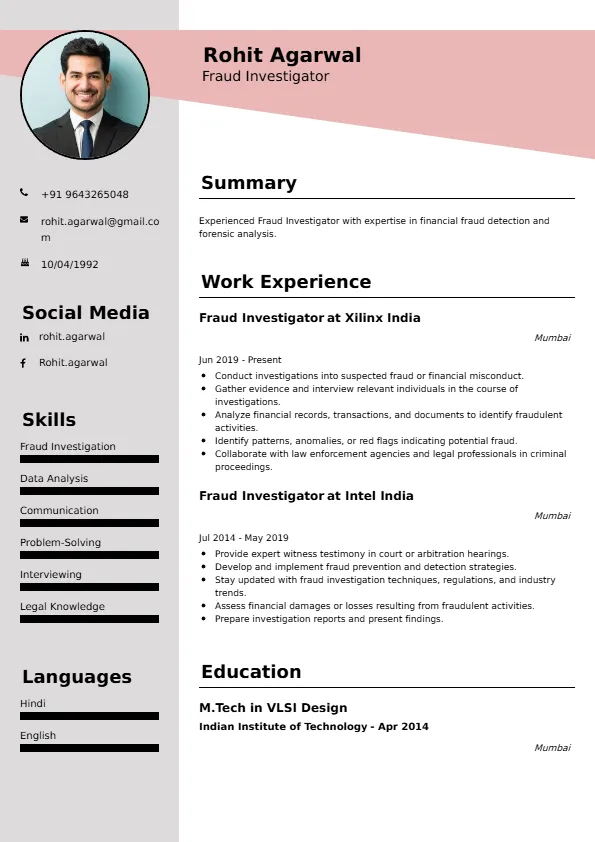
Welcome to our Fraud Investigator resume sample page! This expertly crafted resume template is designed to showcase your expertise in detecting, investigating, and resolving fraudulent activities across financial, corporate, or insurance sectors, and preparing cases for legal action. Whether you're a former law enforcement officer or a seasoned analyst, this sample highlights key skills like evidence collection, interviewing, financial forensics, regulatory compliance (AML), and link analysis tailored to meet top banking, insurance, and corporate demands. Use this guide to create a compelling resume that stands out and secures your next career opportunity.
How to Write a Resume for a Fraud Investigator
Use Reverse-Chronological Format: List recent investigative, compliance, or forensic accounting roles first, focusing on measurable case resolution and loss recovery achievements.
Highlight Certifications/Training: Include credentials like CFE (Certified Fraud Examiner), CAMS (Certified Anti-Money Laundering Specialist), Certified Public Accountant (CPA), or law enforcement/interview training to boost credibility.
Quantify Achievements: Use metrics, e.g., “Investigated 50+ cases of suspected internal and external fraud, resulting in the recovery/prevention of $5M in losses,” or “Reduced fraud loss rates in a key product line by 25% by implementing new detection rules,” to show impact.
Incorporate Keywords: Use terms like “Fraud Investigation (Internal/External),” “Case Management,” “Evidence Collection & Chain of Custody,” “AML/KYC Compliance,” “Suspicious Activity Reports (SAR),” “Interviewing & Interrogation,” or “Link Analysis/Data Forensics” from job descriptions for ATS.
Detail Investigative/Technical Skills: List expertise in specific software (e.g., Palantir, i2 Analyst's Notebook, Excel/SQL for data analysis), regulatory compliance (AML, FCPA), interviewing techniques, and preparing detailed investigative reports in a dedicated skills section.
Showcase Case/Project Success: Highlight 3-4 key investigation types (e.g., insurance claim fraud, payment fraud, identity theft), detailing the methodology used, the evidence uncovered, and the final resolution (e.g., termination, prosecution, loss recovery).
Emphasize Soft Skills: Include analytical rigor, critical thinking, persistence, ethical conduct, strong communication (for reports and testimony), and meticulous attention to detail (evidence integrity).
Keep It Concise: Limit your resume to 1-2 pages, focusing on relevant investigative, analytical, and risk mitigation experience.
Proofread Thoroughly: Eliminate typos or jargon for a professional document.
Digital and Cyber Fraud: Highlight expertise investigating financial crimes involving technology, including online payment fraud, account takeover (ATO), and basic digital forensics/cryptocurrency tracing.
SAR Filing and Regulatory Reporting: Showcase deep knowledge of compliance requirements and experience accurately drafting and submitting Suspicious Activity Reports (SAR) to FinCEN/regulatory bodies.
Machine Learning in Fraud Scoring: Detail experience collaborating with data science teams to test, validate, and utilize ML models for real-time fraud risk scoring and alert generation.
Interviewing and Deception Detection: Emphasize specialized training and practical experience in conducting non-confrontational and confrontational interviews with witnesses, suspects, and employees.
Metrics-Driven Achievements: Use results like “Implemented a new fraud rule that blocked $2M in fraudulent transactions before loss” or “Reduced the average investigation lifecycle time by 10%.”
Cross-Border and International Compliance: Include experience managing cases that involve international jurisdictions and adherence to global anti-corruption (FCPA) or AML regulations.
Internal Controls and Prevention: Highlight involvement in reviewing and recommending improvements to internal controls to close vulnerabilities exploited by fraudulent activity.
Choose Superbresume.com to craft a Fraud Investigator resume that stands out in the high-stakes risk and compliance sector. Our platform offers tailored templates optimized for ATS, ensuring your skills in CFE/CAMS certification, digital evidence analysis, and case resolution shine. With expert guidance, pre-written content, and real-time feedback, we help you highlight achievements like recovering financial losses or implementing advanced detection systems. Whether you focus on internal corporate fraud or external payment crime, our tools make it easy to create a polished, results-driven resume. Trust Superbresume.com to showcase your expertise in protecting organizational assets and integrity. Start building your career today!
20 Key Skills for a Fraud Investigator Resume
| Certified Fraud Examiner (CFE) | Financial Fraud Investigation |
| Evidence Collection & Chain of Custody | AML/KYC Compliance & SAR Filing |
| Interviewing Techniques (Witness/Suspect) | Data Analysis & Link Analysis (SQL/i2) |
| Case Management Software (e.g., Verafin) | Digital Forensics (Basic Evidence) |
| Regulatory Compliance (FCPA/Anti-Corruption) | Loss Recovery & Asset Tracing |
| Internal Controls Testing & Assessment | Investigative Report Writing (Legal/Internal) |
| Risk Mitigation Strategy | Financial Statement Analysis (Anomalies) |
| Critical Thinking & Skepticism | Coordination with Law Enforcement |
| Attention to Detail & Confidentiality | Insurance/Payment Fraud Schemes Knowledge |
10 Do’s for a Fraud Investigator Resume
Tailor Your Resume: Customize for the specific industry risk (e.g., emphasize AML/KYC for banking, emphasize claim investigation for insurance).
Highlight Certifications/Training: List CFE, CAMS, CPA, and relevant interview/forensic training prominently.
Quantify Achievements: Include metrics on financial loss recovered/prevented, case volume managed, investigation cycle time reduction, or success rate of internal controls implemented.
Use Action Verbs: Start bullet points with verbs like “investigated,” “uncovered,” “resolved,” “analyzed,” or “mitigated.”
Showcase Case Resolution: Detail 3-4 key investigation types, emphasizing the methodology and the resulting financial or legal resolution.
Include Soft Skills: Highlight analytical rigor, persistence, ethical conduct, and strong communication (especially for reports).
Optimize for ATS: Use standard investigative/compliance section titles and incorporate key fraud, regulatory, and system terms.
Keep It Professional: Use a clean, consistent font and professional layout.
Emphasize Proactive/Reactive Roles: Clearly articulate experience in both reacting to incidents and proactively developing prevention strategies.
Proofread Carefully: Ensure no typos or errors in case names, financial data, or regulatory terminology.10 Don’ts for a Fraud Investigator Resume
Don’t Overload with Jargon: Avoid confusing, internal company acronyms; use standardized fraud investigation and regulatory terminology.
Don’t Exceed Two Pages: Keep your resume concise, focusing on high-impact investigative and risk mitigation achievements.
Don’t Omit Dates: Include employment dates for career context.
Don’t Use Generic Templates: Tailor your resume specifically to the detailed, investigative duties of a Fraud Investigator.
Don’t List Irrelevant Skills: Focus on investigation, analysis, compliance, evidence, and case management.
Don’t Skip Metrics: Quantify results wherever possible; link achievements to loss prevention, recovery, or investigation speed.
Don’t Use Complex Formats: Avoid highly stylized elements or confusing graphics.
Don’t Ignore Regulatory Requirements: Include explicit experience drafting SARs and adhering to AML/KYC standards.
Don’t Include Outdated Experience: Omit low-level or non-investigative jobs over 15 years old.
Don’t Forget to Update: Refresh for new CFE/CAMS status, successful loss recovery cases, or advanced data analytics/ML model utilization.
5 FAQs for a Fraud Investigator Resume
Prioritize CFE/CAMS certification, financial investigation/evidence collection, AML/SAR reporting, and data analysis tools (SQL, link analysis).
Use standard investigative section titles, avoid graphics, and include keywords like “AML Compliance,” “SAR Filing,” and “Link Analysis.”
Yes, quantifying the loss prevented, recovered, or the volume of SARs filed demonstrates the scale of impact.
Detail a project where you developed a new fraud rule set or alert system that resulted in a quantified reduction in loss rates.
Use a reverse-chronological format to emphasize your most recent, high-impact investigative and risk mitigation achievements.
Get 5x more interviews with our crafted Resumes. We make resumes that land jobs.

Get a Free Customized Cover Letter with Resume Expert Advice
with every resume order placed, you will get a free Customized Cover letter.