Financial Planner
Welcome to our Financial Planner (FP) resume sample page! This expertly crafted resume template is designed to showcase your expertise in creating comprehensive financial plans, investment strategies, retirement roadmaps, and insurance analyses for individual clients. Whether you're an entry-level candidate or a seasoned professional, this sample highlights key skills like CFP® certification, goal-based planning, client acquisition/retention, investment product knowledge, and regulatory compliance (FINRA/SEC) tailored to meet top banking, wealth management, and independent advisory demands. Use this guide to create a compelling resume that stands out and secures your next career opportunity.
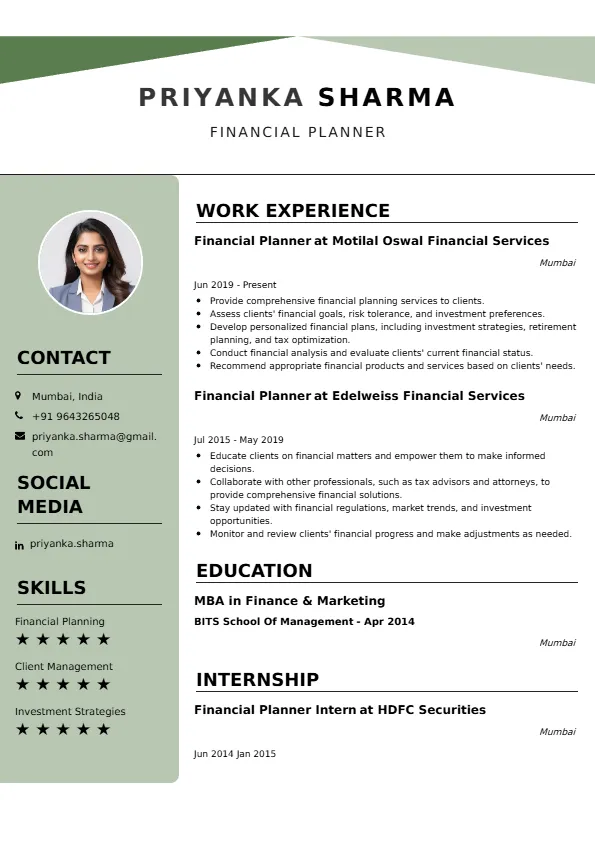
Superbresume.com empowers Financial Planners to craft resumes that highlight their holistic planning expertise and measurable client progress. Our platform offers customizable templates tailored for financial services roles, emphasizing skills like retirement cash flow modeling, risk tolerance assessment, estate planning coordination, and superior client education. With ATS-optimized formats, expert-written content suggestions, and real-time resume analysis, we ensure your resume aligns with job descriptions. Showcase your experience in guiding clients to achieve complex financial goals (e.g., early retirement, college funding), growing client Assets Under Management (AUM), or maintaining flawless regulatory compliance with confidence. Superbresume.com helps you create a polished, results-driven resume that grabs hiring managers’ attention and lands interviews.
How to Write a Resume for a Financial Planner
Use Reverse-Chronological Format: List recent planning, advisory, or high-level financial services roles first, focusing on planning scope and client relationship responsibilities.
Highlight Certifications/Licenses: Include essential credentials like CFP®, active FINRA licenses (Series 7/66, if applicable), or specialized insurance/tax certifications to boost credibility.
Quantify Achievements: Use metrics, e.g., “Authored 100+ comprehensive financial plans annually, resulting in a 98% client retention rate,” or “Guided 50+ clients to fully fund their children’s college education goals through customized savings plans,” to show impact.
Incorporate Keywords: Use terms like “CFP® Certification,” “Comprehensive Financial Planning,” “Retirement Cash Flow Modeling,” “Investment Strategy,” “Risk Management (Insurance/Taxes),” “Goal-Based Planning,” or “Regulatory Compliance (FINRA/SEC)” from job descriptions for ATS.
Detail Planning/Technical Skills: List expertise in financial planning software (eMoney, MoneyGuidePro), retirement plan design (401k/IRA), tax-efficient investing, and client presentation/education in a dedicated skills section.
Showcase Planning Success: Highlight 3-4 key planning achievements (e.g., successful retirement transition, implementation of a complex estate strategy, significant debt reduction), detailing the strategy and the financial outcome for the client.
Emphasize Soft Skills: Include empathy, trustworthiness, patient client education, analytical rigor, and adherence to strict ethical/fiduciary standards.
Keep It Concise: Limit your resume to 1-2 pages, focusing on relevant planning, investment, and client advisory experience.
Proofread Thoroughly: Eliminate typos or jargon for a professional document.
Digital Planning Tools Mastery: Highlight advanced proficiency utilizing modern planning software (eMoney, MoneyGuidePro) for dynamic scenario testing, risk assessment, and interactive client presentations.
Behavioral Finance Coaching: Showcase experience counseling clients through market volatility, debt management, and behavioral biases to keep them aligned with long-term goals.
Tax-Efficient Retirement Strategies: Detail expertise advising on tax implications, Roth conversions, RMDs (Required Minimum Distributions), and tax-loss harvesting within client portfolios.
Client Relationship Automation (CRM): Emphasize using CRM and automation tools (e.g., Redtail) to manage client touchpoints, track goals, and ensure proactive communication.
Metrics-Driven Achievements: Use results like “Managed $X million in client assets with a focus on long-term capital preservation” or “Assisted 90% of clients in meeting their annual cash flow targets.”
Fiduciary Responsibility: If applicable, clearly state operating under the fiduciary standard (CFP® commitment) and prioritizing client best interest.
Specialization (e.g., Executive Compensation, Small Business Owners): Clearly articulate and demonstrate planning expertise in a high-value niche market.
Choose Superbresume.com to craft a Financial Planner resume that stands out in the competitive wealth management and advisory field. Our platform offers tailored templates optimized for ATS, ensuring your skills in CFP® certification, holistic planning, and client goal achievement shine. With expert guidance, pre-written content, and real-time feedback, we help you highlight achievements like guiding clients to early retirement or maximizing tax efficiency. Whether you work with mass affluent or high-net-worth individuals, our tools make it easy to create a polished, results-driven resume. Trust Superbresume.com to showcase your expertise in achieving financial security and success for clients. Start building your career today!
20 Key Skills for a Financial Planner Resume
| Certified Financial Planner (CFP®) Certification | Comprehensive Financial Planning (Holistic) |
| Retirement Cash Flow Modeling & Analysis | Investment Strategy & Asset Allocation |
| Risk Management (Insurance/Debt) | Tax-Efficient Investing & Strategy |
| Digital Planning Software (eMoney/MoneyGuidePro) | Client Acquisition & Relationship Management |
| Regulatory Compliance (FINRA/SEC) | Estate Planning Coordination |
| Behavioral Finance Principles | Client Education & Presentation Skills |
| Debt Management & Cash Flow Optimization | Investment Product Knowledge (Stocks, Bonds, Funds) |
| Fiduciary Standard Adherence | CRM Utilization (Redtail/Salesforce) |
| Goal Setting & Tracking | Analytical Rigor |
10 Do’s for a Financial Planner Resume
Tailor Your Resume: Customize for the specific firm (e.g., RIA, brokerage, bank planning division) and its core service offering.
Highlight Certifications/Licenses: List CFP® (or progress toward), active FINRA licenses, and any advanced designations prominently.
Quantify Achievements: Include metrics on the number of plans created, client goal achievement rates, AUM managed/influenced, or client retention rates.
Use Action Verbs: Start bullet points with verbs like “planned,” “advised,” “modeled,” “guided,” or “structured.”
Showcase Planning Success: Detail the methodology and the strategic, quantifiable goal achievement of 3-4 key clients.
Include Soft Skills: Highlight empathy, patient education, ethical conduct, and analytical problem-solving.
Optimize for ATS: Use standard finance section titles and incorporate key planning, certification, and regulatory terms.
Keep It Professional: Use a clean, consistent font and professional finance layout.
Emphasize Holistic Planning: Clearly articulate the ability to integrate tax, estate, risk, and investment planning.
Proofread Carefully: Ensure no typos or errors in financial data, license names, or planning metrics.
10 Don’ts for a Financial Planner Resume
Don’t Overload with Jargon: Avoid confusing, internal firm acronyms; use standardized financial planning and regulatory terminology.
Don’t Exceed Two Pages: Keep your resume concise, focusing on high-impact planning, client advisory, and wealth management experience.
Don’t Omit Dates: Include employment dates for career context.
Don’t Use Generic Templates: Tailor your resume specifically to the consultative, fiduciary duties of a Financial Planner.
Don’t List Irrelevant Skills: Focus on planning, retirement, investment, risk management, and client education.
Don’t Skip Metrics: Quantify results wherever possible; link planning work to client goal achievement and financial outcomes.
Don’t Use Complex Formats: Avoid highly stylized elements or confusing graphics.
Don’t Ignore Planning Tools: Include mastery of modern planning software (eMoney, MoneyGuidePro).
Don’t Include Outdated Experience: Omit non-finance or irrelevant jobs over 15 years old.
Don’t Forget to Update: Refresh for CFP® status achievement, successful goal attainment metrics, or advanced planning software training.
5 FAQs for a Financial Planner Resume
Prioritize CFP® certification, retirement cash flow modeling, investment strategy, tax-efficient planning, and client acquisition/retention.
Use standard finance section titles, avoid graphics, and include keywords like “CFP®,” “Goal-Based Planning,” and “Retirement Cash Flow.”
Yes, quantifying the number of plans created, goals achieved, or AUM influenced is appropriate.
Detail the specific strategy recommended (e.g., Roth conversion, tax-loss harvesting) and the resulting quantified tax savings or benefit for the client.
Use a reverse-chronological format to emphasize your most recent, high-impact planning and advisory achievements.
Get 5x more interviews with our crafted Resumes. We make resumes that land jobs.

Get a Free Customized Cover Letter with Resume Expert Advice
with every resume order placed, you will get a free Customized Cover letter.